lotto/ancient egypt MRCDgJr 633209647 / In vendita
lotto/ancient egypt MRCDgJr 633209647
In venditaRisultati d’asta
lotto/ancient egypt MRCDgJr 633209647
In venditaRisultati d’asta
Porta la tua asta ai collezionisti di tutto il mondo!
Pubblica oraPorta la tua asta ai collezionisti di tutto il mondo!
Pubblica oraIscrivendoti, accetti la politica sulla privacy. Annulla l'iscrizione in qualsiasi momento.
Barnebys HQ
Brahegatan 10
BOX 5038
114 37 Stockholm
Tutte le aste / Arte Antica / Ancient Egypt

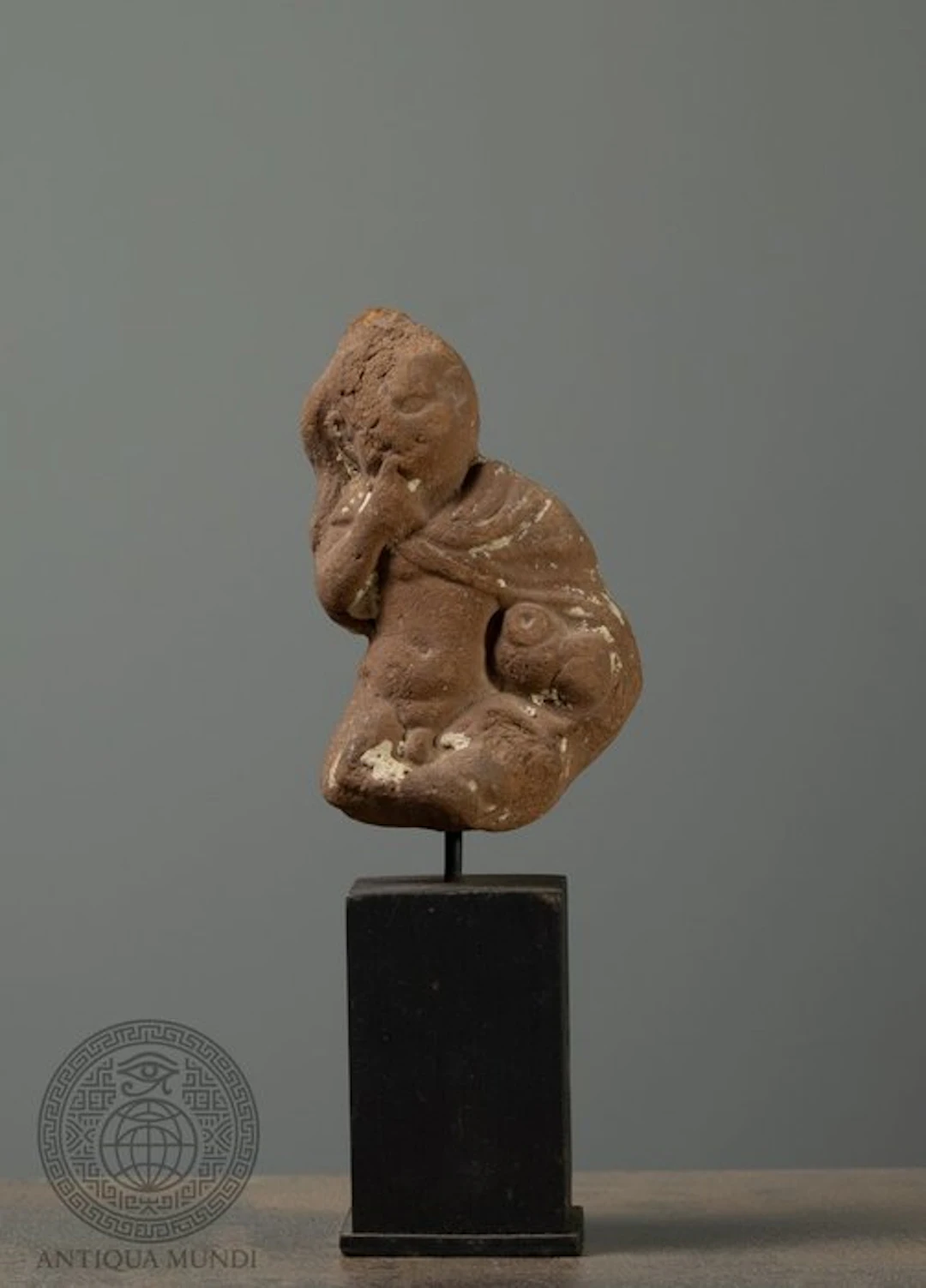
Graeco-Egyptian terracotta figure depicting Harpocrates, the Hellenistic-Roman manifestation of the ancient Egyptian god Horus the Child (Horus-pa-khered). The compact figure depicts the youthful deity in a seated or crouching position. The body is modelled in the soft, rounded forms characteristic of Graeco-Egyptian terracotta sculpture. The head is slightly inclined to one side. The face has large, prominently modelled eyes, a small nose and a closed mouth. The hair or headdress is only partially preserved. Particularly characteristic is the hand raised towards the mouth. This gesture, originating from the ancient Egyptian representation of a child with a finger at the mouth, is one of the principal iconographic features associated with Harpocrates and supports the identification of the figure. The other arm rests in front of or alongside the body. Garment and Posture A plastically modelled garment or mantle extends over the shoulder and back and is rendered in several pronounced, curving folds, while parts of the upper body remain exposed. The legs are strongly bent and drawn closely towards the body. Beside the body is an additional rounded, modelled element. Due to the state of preservation, its original meaning or iconographic function cannot be determined with certainty and it is therefore not identified here as a specific attribute. The side views demonstrate the strongly three-dimensional modelling of the body and garment. The reverse is considerably simpler and less detailed than the front, as is characteristic of many mould-made Egyptian terracottas of this period. Harpocrates – Horus the Child Harpocrates is the Greek name for the Egyptian Horus-pa-khered, “Horus the Child.” With the spread of Greek culture in Egypt, particularly during the Ptolemaic and Roman periods, an extensive visual tradition developed in which Egyptian deities were represented using elements of Hellenistic artistic language. Harpocrates was frequently depicted as a naked or partially clothed child. His most characteristic feature is the finger held to the mouth. In ancient Egyptian iconography, this gesture originally signified the youthful age of the deity. In the Graeco-Roman world, Harpocrates became a widely venerated deity associated with childhood, protection, fertility, regeneration and divine life force. Terracotta figures depicting Harpocrates were widespread throughout Graeco-Roman Egypt and could be used both in domestic religious practice and as votive offerings. Manufacture and Surface The figure is made of reddish to brown fired terracotta. The front is considerably more detailed and three-dimensionally modelled than the reverse. Across the surface are pale whitish to cream-coloured deposits and/or remnants of an earlier surface coating. Without scientific material analysis, it is not possible to determine with certainty to what extent these represent surviving traces of an original ground or pigmentation, or later mineral deposits. The terracotta has an evenly aged, slightly granular surface with small pores and inclusions. A later black collection or inventory inscription is present on the reverse. Condition Age-related, fragmentary state of preservation. The figure displays surface wear, minor chips, encrustations and mineral deposits. Some sculptural details have become softened through age and wear. Nevertheless, the face, the characteristic hand raised towards the mouth, the posture of the body and the pronounced folds of the garment remain clearly recognizable and allow a good iconographic identification. For presentation in the photographs, the figure is mounted on a modern black display stand. Provenance Formerly in the Madeleine & Erich Dammann Collection, Germany. Acquired during the collectors’ extensive travels between 1950 and 1970. The collection is documented in Germany by 1970 through historical photographs of the family residence and subsequently remained in continuous family ownership. The objects were acquired privately during the collectors’ travels. As was customary for private purchases made at local markets during the 1950s and 1960s, purchase receipts or invoices were generally neither issued nor requested. Historical photographs and biographical documentation relating to the Dammann Collection are available and support the long-standing provenance of the collection.
Stima:€375
Vai all’astaVedi tutti gli oggetti diCatawikioArte Antica
Stima:
€375
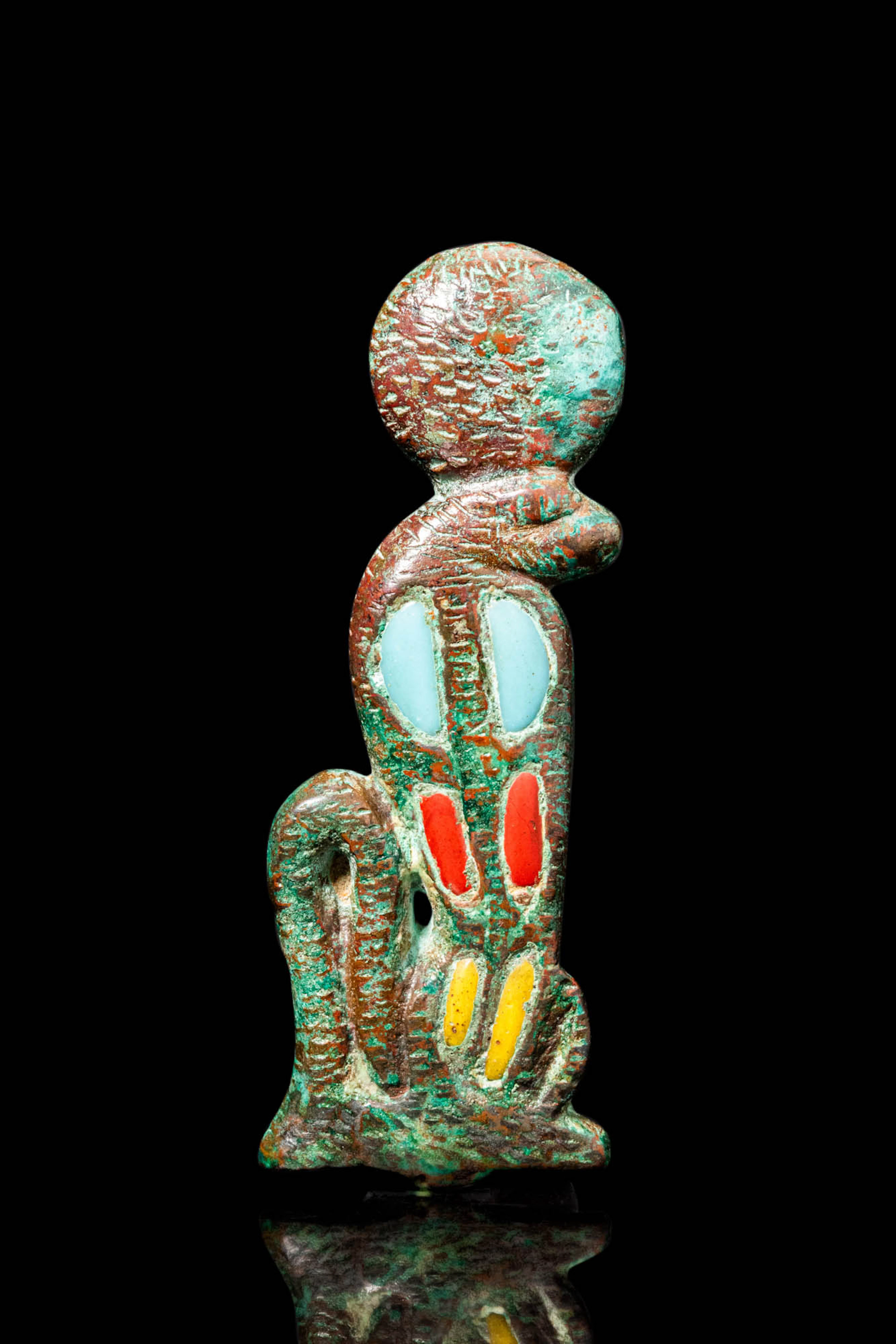
EGYPTIAN BRONZE INLAID APPLIQUE OF URAEUS - MUSEUM EXHIBITED
06/21/2026

€1,623.13
Stima: €1,154.78
Porta la tua asta ai collezionisti di tutto il mondo!
Pubblica ora