Wine glass - c. 1750 Greek Roman Muse Erato - Glass - Nymph Erato
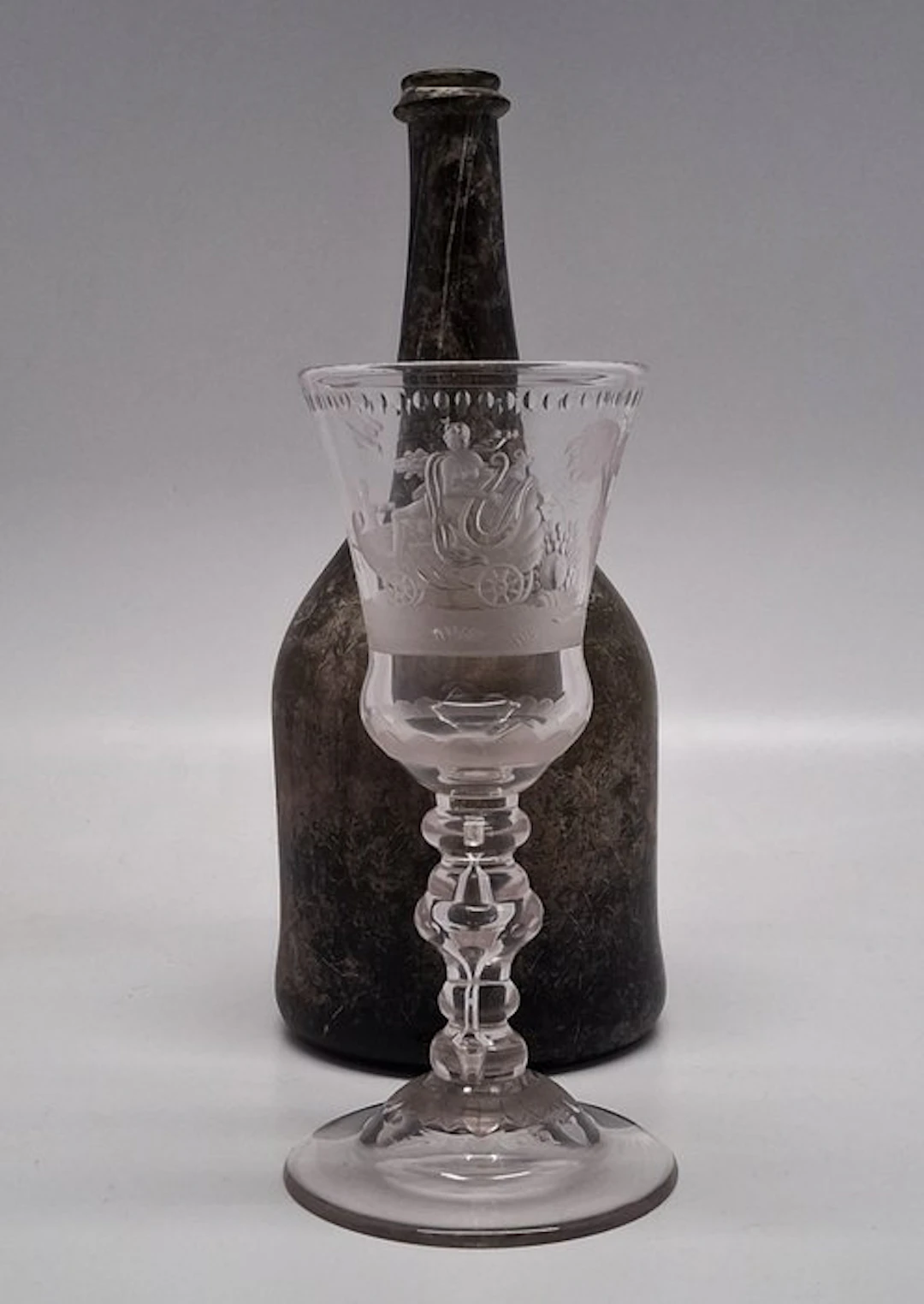
A truly beautifully engraved Wine Glass / Baluster from the second quarter of the 18th century, in excellent condition. The glass is engraved all around with a mythological scene. A cart with the Muse/Nymph Erato on it, holding the musical instrument lyre. The cart is drawn by a Putto through a landscape with trees and flowers; you can also see a bird in flight. Title: Engraved Wine Glass with the Muse/Nymph Erato Dating: 1725-1750 Provenance: Netherlands or Germany Period: Stadtholder Willem IV, Prince of Orange Color: Clear Cup: Thorn-shaped; engraved with the mythological Muse Erato, who is often depicted with a lyre. She is the muse of lyric poetry, love poems, and hymns (erotic poetry) Stem: Complex stem with many knots and a continuous air chamber through the entire shaft Foot: Dome-shaped. A sticker from a recent collection. The upper side of the dome around the stem is nicely engraved Pontil: Broken, sharp (not ground smooth) Glass type: Lead-free Dimensions: Height 18.8 cm; cup diameter 7.8 cm; foot diameter 9.2 cm Condition: Excellent, no chip or break; for a good impression I would like to refer you to the photos, which are also part of the description Weight: 255 grams Background information from Historiek Website: The nine Muses (Μοῦσαι – also known as the Piërides) are known from Greek-Roman mythology. The immortal nymphs symbolized the different classical arts. In that capacity they inspired artists and scientists. The word ‘museum’ refers to the Muses. Originally, the word comes from Mouseion (seat of the Muses). Muse, possibly Clio, on a oil jar from circa 430 BC. The Muses were the daughters of Zeus and sisters of Apollo, who was regarded as their leader. According to the Greek philologist Apollodorus of Athens, Mnemosyne, the Titaness and personification of memory, was their mother. During the feasts of the Olympian gods the Muses were often present to sing, dance or recite poetry. Initially there were only three Muses: Melete (meditation), Mneme (memory) and Aoede (songs). Later there were usually nine Muses, namely: Erato – The muse of hymn, song, lyric poetry and love poetry. Often depicted with a large stringed instrument in hand. Euterpe – The muse of flute playing and lyrical poetry. Often depicted with a double flute at the lips. Calliope – The muse of heroic epic, the poem, philosophy and rhetoric. Considered the most capable of all Muses and often depicted at a writing desk with writing implements in hand. Clio / Kleio – The muse of history. Often depicted with a roll of papyrus or a chest of books. Melpomene – The muse of tragedy and melodrama. Often shown with a club, sword or mask in hand and a crown of grape leaves on the head. Polyhymnia – The muse of rhetoric and serious sacred songs. Often depicted with a serious and pensive face. Terpsichore – The muse of cheerful dance and lyrical poetry, without religious connotations. Popular among youths. Often depicted with a lyre in hand. Thalia / Thaleia – The muse of comedy and festive joy. Often shown with a comical mask and a crook in hand and a ivy crown on the head. Urania – The muse of astronomy. Her name literally means ‘the heavenly’. Sings of the deeds of the gods. Often depicted with a celestial globe in her hand. Hesiod and the Muse – Gustave Moreau, 1891 The Muses were sometimes jealous and one day quarreled with the so-called Sirens, half-goddesses with the body of a bird and the head of a woman who tried to entice their listeners with their song. The Muses considered these Sirens as rivals and one day challenged them in a singing contest. After the Muses won, the Sirens were punished by having their feathers torn out, causing them to fall into the sea and drown. All this happened near the city of Aptera, which means ‘without wings’. Helicon According to some stories the Muses lived on Mount Helicon in Boeotia, together with the horse Pegasus. A spring was said to be there (Hippokrene) that was managed by the Muses and was considered the source of inspiration for art and science. In other stories the Muses lived on the neighboring Mount Parnassus and the spring they managed was called Kastalia (see also: The Kastalian Spring). Little is known about the worship of the Muses. Every four years in the ancient Greek city of Thespiae, not far from Helicon, a festival in their honor was held. Probably the Muses were initially only the patron goddesses of poets and were later associated with more arts and sciences. They were sometimes called the Piërides, after the landscape Piërion in present-day Macedonia where the nymphs were said to be born. In most stories the Muses are unmarried. There are however also poets who say that the nymphs gave birth to some famous figures from Greek mythology. For example, Orpheus would be a son of Calliope. In Roman mythology the Muses were later identified with the Camenae. The nine Muses are already mentioned in Hesiod’s famous genealogy of the Greek gods, the Theogony (ca. 700 BC). In his opening hymn he locates the Muses on Mount Helicon. In a second hymn their names are listed, but there is not yet any differentiation of functions. The glass is carefully packaged, insured and registered-delivered.
Stima:€550
Vai all’astaVedi tutti gli oggetti diCatawikioAltro