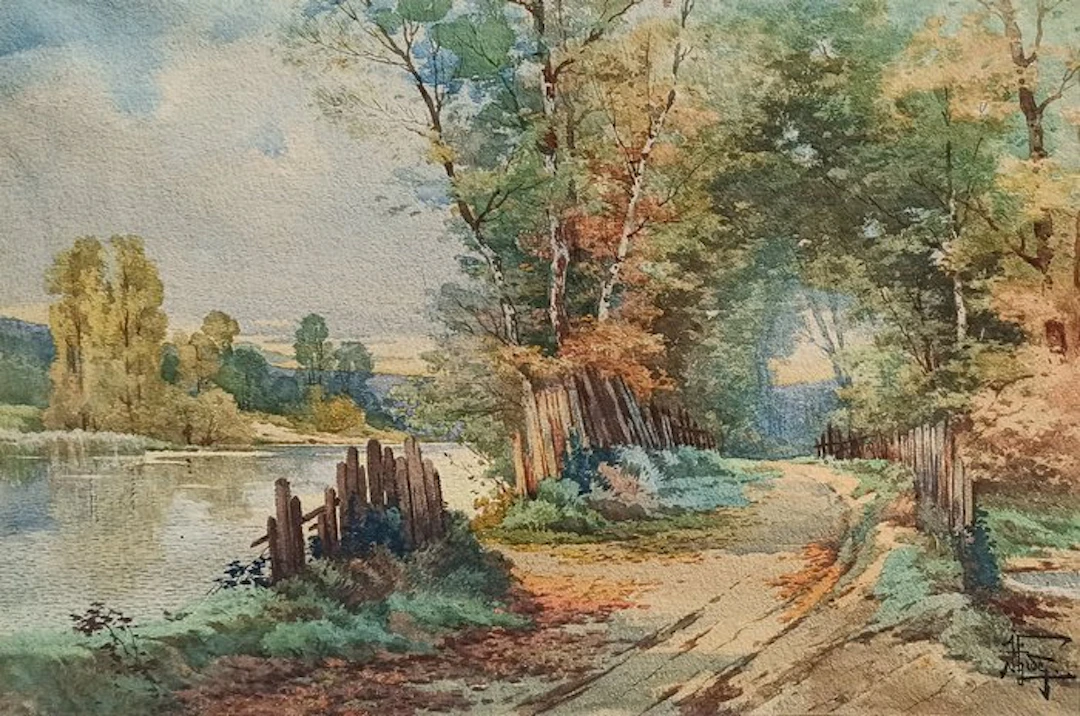
Théophile Gide (1822-1890) - French landscape - Country path and river
Original 19th-century watercolour on paper Artist : François Théophile Étienne Gide ( Paris 1822–1890 ) French Realism - Naturalism Title : " Country path and river " - France Medium : Watercolour on paper Date : 1870–1890 Image size : 37 × 55 cm Framed size : 45 × 63 cm Signature : signed lower right Certification : Modì Arte stamped and signed in accordance with Italian law Frame : antique carved wooden frame, probably early 20th century Glazing : museum-grade anti-reflective conservation glass, supplied with its original guarantee/certificate Provenance : private collection - France Shipping : by Fedex,UPS,TNT,SDA express from Italy Photos : the first two images and images A,B,C,D,E were taken without the glass in front, with natural light, the rest of the images are with museum glass DESCRIPTION A beautiful original 19th-century watercolour by François Théophile Étienne Gide (1822–1890), depicting a peaceful rural landscape with a river or pond, a country path, mature trees and rustic wooden fencing. The composition is particularly atmospheric, the path in the foreground leads the eye naturally into the landscape, while the calm water on the left creates a strong sense of depth, the extensive vegetation is rendered with delicate layers of green, ochre, brown and blue, creating the characteristic luminous and softly atmospheric effect of watercolour painting. CONDITION The watercolour is in good overall condition considering its age. The paper retains its natural aged patina and shows some light age-toning and minor scattered traces consistent with an artwork of the 19th century, there are no major tears, significant losses or structural damages apparent from visual inspection. As is normal for a work of this age, some minor surface imperfections and signs of ageing may be present. The colours remain well preserved and the original watercolour technique is clearly visible. The work has recently been placed behind museum-grade anti-reflective conservation glass, specifically chosen to improve the viewing experience while providing enhanced protection for the artwork, the glass is accompanied by its manufacturer's guarantee/certificate, which will be included with the artwork. FRAME The watercolour is presented in an attractive carved and moulded wooden frame, finished in a dark brown tone with a rich aged patina. The frame appears to be later than the artwork itself, and its construction and decorative details suggest a date around the early 20th century, approximately 1900–1920, this dating is indicative rather than documented. The frame has the expected minor scratches, abrasions, small imperfections and signs of ageing associated with an antique frame, these do not detract from its overall appearance and contribute to its authentic historical character. The combination of the original 19th-century watercolour, the antique frame and the newly installed museum conservation glass makes this a particularly attractive presentation for both a collector and a decorative interior. For safety, a new gold hanger frame has been inserted BIOGRAPHY François Théophile Étienne Gide (known simply as Théophile Gide) was a prominent 19th-century French painter, born in Paris on 15 March 1822 and died in the same city on 29 November 1890. He is mainly remembered as a refined master of genre painting, historical scenes and religious and monastic subjects Raised in an upper-middle-class Parisian family (he was the uncle of the famous Nobel Prize-winning writer André Gide), Théophile demonstrated from a very young age an exceptional talent for drawing and painting His studies: On 1° October 1840 he was admitted to the prestigious School of Fine Arts in Paris. There he studied under two pillars of French classicism: Paul Delaroche (master of historical drama) and Léon Cogniet (master of formal rigor) His debut at the Salon: In 1845 he exhibited for the first time at the famous Paris Salon, the most important artistic showcase of the time, presenting the painting "The Fall of the Leaves" (La chute des feuilles), at which time he became a regular exhibitor and much loved by official critics. Gide perfectly embodied the style of the French Academic School (Art Pompier), characterized by impeccable drawing, balanced geometric compositions and a pleasant and soft use of color. The Monastic Scenes: His greatest critical success came from paintings set inside monasteries, churches, and choirs. Works such as "The Monks Studying" (Les Moines à l'étude) or "The Repetition of a Mass", also presented with enormous success at the Universal Exhibition of 1867, made him famous throughout France Genre scenes in Italy: He made numerous study trips, particularly to the south of France (Pyrenees) and Italy. He was fascinated by Italian folklore, portraying scenes of everyday life of the people and the countryside with a picturesque, intimate and very characteristic realism. The public commissions: As a testament to his great institutional prestige, he was entrusted with the interior decoration of the famous church of Saint-Roch in Paris, for which he created the mural painting "The Miracle of the Flowers" Alongside his large historical studio canvases, Gide cultivated a lifelong passion for rural landscapes and life studies (en plein air). During his summer travels, he loved using the quick, flowing technique of watercolor to capture the effects of light on trees, country paths, and waterways.
Stima:€200
Vai all’astaVedi tutti gli oggetti diCatawikioAltro