The Pale Blue Dot
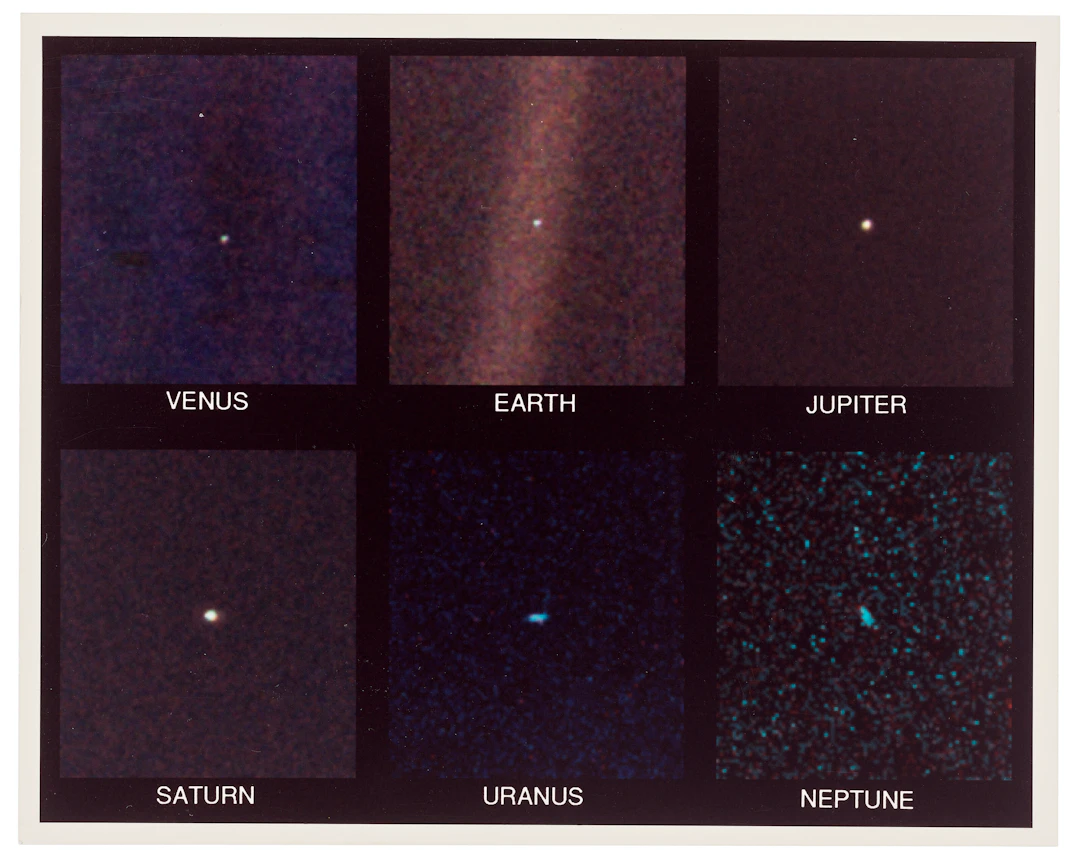
Three vintage chromogenic prints on resin coated Kodak paper, all with 'This paper manufactured by Kodak' watermarks and ink annotations on the verso and two with NASA JPL captions affixed. The longest distance image of Earth ever taken, from 3.7 billion miles away – the inspiration behind Carl Sagan’s The Pale Blue Dot (1994). First appearance of this set at auction. One of the most famous photographs taken in space: from over 3.7 billion miles from Earth, the Family Portrait series shows the entire solar system. The images in this lot were cropped from a continuous stream of photographs taken by Voyager 1 at 04:48 UTC on February 14, 1990 which NASA explains was “just 34 minutes before Voyager 1 powered off its cameras forever.” The signal took nearly four months to be transmitted back to Earth. Carl Sagan, who helped advocate for the creation of this now-iconic image, reflected on the seeming insignificance of Earth from so far away – Earth takes up just 0.12 of a single pixel, out of 640,000 pixels in each shot from Voyager: “From this distant vantage point, the Earth might not seem of any particular interest. But for us, it's different. Consider again that dot. That's here. That's home. That's us. On it everyone you love, everyone you know, everyone you ever heard of, every human being who ever was, lived out their lives. The aggregate of our joy and suffering, thousands of confident religions, ideologies, and economic doctrines, every hunter and forager, every hero and coward, every creator and destroyer of civilization, every king and peasant, every young couple in love, every mother and father, hopeful child, inventor and explorer, every teacher of morals, every corrupt politician, every "superstar", every "supreme leader", every saint and sinner in the history of our species lived there – on a mote of dust suspended in a sunbeam.” [NASA caption on reverse] These six narrow-angle color images were made from the first ever “portrait” of the solar system taken by Voyager 1, which was more than 4 billion miles from Earth and about 32 degrees above the ecliptic. The spacecraft acquired a total of 60 frames for a mosaic of the solar system which shows six of the planets. Mercury is too close to the sun to be seen. Mars was not detectable by the Voyager cameras due to scattered sunlight in the optics, and Pluto was not included in the mosaic because of its small size and distance from the sun. these blown-up images, left to right and top to bottom are Venus, Earth, Jupiter, and Saturn, Uranus, Neptune. The background feature sin the images are artifacts resulting from the magnification. The images were taken through three color filters -- violet, blue and green – and recombined to produce the color images, Jupiter and Saturn were resolved by the camera but Uranus and Neptune appear larger than they really are because of image smear due to the spacecraft motion during the long (15 second) exposure times. Earth appears to be in a band of light because it, coincidentally, lies right in the center of the scattered light rays resulting from taking the image so close to the sun. Earth was a crescent only 0.12 pixel in size. Venus was 0.11 pixel in diameter. The planetary images were taken with the narrow-angle camera (1500 mm focal length).
Stima:€6,154.75
Vai all’astaVedi tutti gli oggetti diChristie'soLibri, Mappe & Manoscritti