The Duke of Grafton Elected Chancellor of Cambridge University, Gold
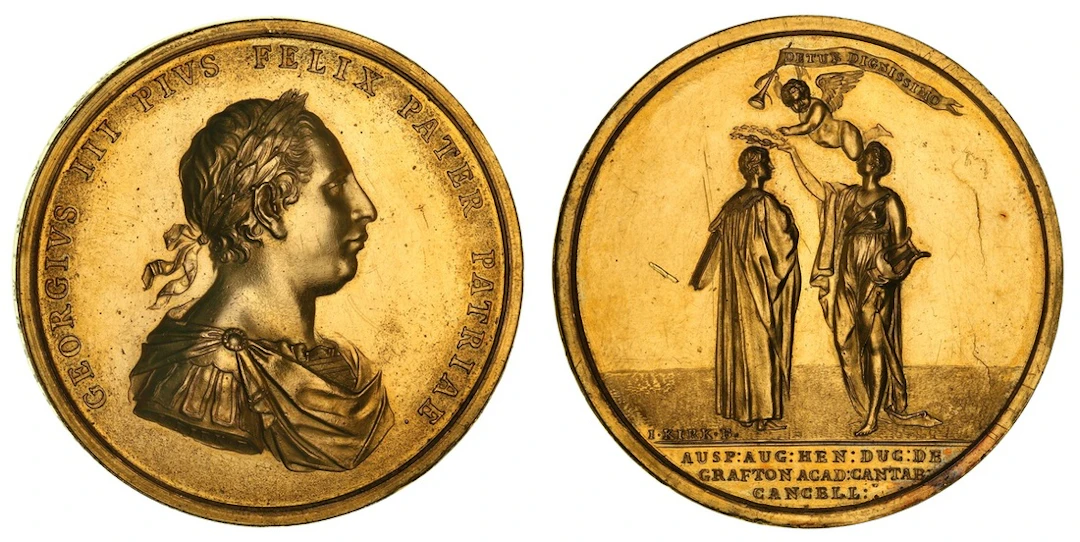
The Duke of Grafton Elected Chancellor of Cambridge University, Gold Medal, awarded to Matthew Feild in 1772, by J. Kirk, GEORGIVS III PIVS FELIX PATER PATRIAE., laureate, draped and cuirassed bust right of George III, rev. Apollo holding a lyre, crowns a student with a laurel wreath, cherub above holds trumpet and banner reading DETUR DIGNISSIMO [LET IT BE GIVEN TO THE MOST WORTHY], AUSP : AUG : HEN : DUC : DE : GRAFTON ACAD : CANTAB : CANCELL :, in exergue in three lines, MATTHAEUS FEILD AUL : PEMB : A : B : MDCCLXXII . on edge, upwards lettered edge, 107.69g, 54mm (BHM 112; Eimer 728; Erlanger 61), small test scratch to obverse and reverse field, suggestion of previous mounting due to peripheral and edge contact marking, otherwise with brilliance, nearly extremely fine, rarely encountered and an early awarded example, thus scarce, with original case of issue This medal was first awarded in 1768, the same year Augustus Henry FitzRoy, third Duke of Grafton (1735-1811), was appointed Chancellor of the University of Cambridge. That October he also became Prime Minister, a post he held until January 1770. Educated at Westminster and Peterhouse, Cambridge, Grafton was descended from the illegitimate line of Charles II and Barbara Villiers. Though widely described as amiable and handsome, his ministry was dogged by controversy, and political pressure forced his resignation in 1770. The medal itself was awarded for excellence in classical studies, continuing a tradition that began in 1752 under Grafton's predecessor as Chancellor, Thomas Pelham-Holles, Duke of Newcastle (1693-1768). Academic prize medals originated in Germany in the sixteenth century before becoming widespread across England and the rest of Europe by the 1700s. This example, typical of the period, depicts a classical figure representing alma mater presenting a medal or laurel to a student in academic dress. Rendered in low relief, it shows the clear influence of classical sculpture on the engraver, the noted medallist and gem-engraver John Kirk (1724-1776). Kirk was a student of James Dassier and his work was acclaimed by the Society of Arts. This medal was awarded to Matthew Feild (or Field) (1748-1796) in 1772. Born in London in 1748 to stationer John Feild, records show he was baptised in the capital on the 22nd March 1748. For his education he was sent to Christ's Hospital. The school has a long tradition of its pupils wearing and being awarded medals as a mark of academic achievement. Silver badges were first worn by pupils in 1673, and the practice was still very much alive during Feild's time almost a century later. Therefore, from an early age Matthew would have been familiar with the concept of academic awards and the social status which accompanied the recognition of academic success. Feild went up to Cambridge in 1767 and matriculated Pembroke College in November of that year. In 1772, the same year he received the Chancellor's Medal, he was awarded his BA. Three years later in 1775 he was conferred his MA from Pembroke. After his time at Cambridge he returned to Christ's Hospital, serving as the lower grammar master between 1776-1796. He also had a long and established career within the church, holding a number of positions throughout his lifetime. He was first ordained as a deacon on 15th March 1772 by John Green, Bishop of Lincoln and again by Green as a priest in June 1775. John Green had also served as Vice-Chancellor of Cambridge University from 1756-1757. Feild went on to hold a succession of livings: curate of Tetford (1772); vicar of Ugley (1785); curate of Berden (1785); rector of St Ann and St Agnes with St John Zachary (1788); curate of St Nicholas Cole Abbey with St Nicholas Olave (1790); Prebendary of Gretton, Lincoln Cathedral (1791); sinecure rector of Corwen (1793); and Prebendary of Ealdstreet, St Paul's Cathedral (1794). These were all positions he retained until his death. In March 1781 he was appointed as domestic chaplain of Charles Fitzroy, 1st Baron Southampton (1737-1797), British army office, politician and courtier. At this point in his life Fitzroy had been newly elevated to the peerage as Baron Southampton and appointed as Groom of the Stole to the Prince of Wales, later George IV. In this position, Fitzroy acted as a special advisor and head of the household to Wales. Feild's academic duties at Christ's Church are fascinatingly recorded by two of his most well-known students: Leigh Hunt and Charles Lamb. Hunt, the renowned English critic, essayist and poet, writes about Feild in his 1828 work 'Lord Byron and Some of His Contemporaries; with Recollections of the Author's Life, and of his Visit to Italy'. He recounts: "The under grammar-master was the Reverend Mr. Field. He was a good-looking man, very gentlemanly, and always dressed at the neatest. I believe he once wrote a play. He had the reputation of being admired by the ladies. A man of a more handsome incompetence for his situation perhaps did not exist. He came late of a morning; went away soon in the afternoon; and used to walk up and down, languidly bearing his cane, as if it was a lily, and hearing our eternal Dominuses and As in præsenti's with an air of ineffable endurance. Often, he did not hear at all. It was a joke with us, when any of our friends came to the door and we asked his permission to go to them, to address him with some preposterous question, wide of the mark; to which he used to assent. We would say, for instance, "Are you not a great fool, sir?" or "Isn't your daughter a pretty girl?" to which he would reply, "Yes, child." When he condescended to hit us with the cane, he made a face as if he was taking physic. Miss Field, an agreeable-looking girl, was one of the goddesses of the school; as far above us, as if she had lived on Olympus." Charles Lamb, English essayist, poet and antiquarian, best known for his Essays of Elia wrote about Feild in his 1820 essay "Christ's Hospital Five And Thirty Years Ago": "The Upper and the Lower Grammar Schools were held in the same room; and an imaginary line only divided their bounds. Their character was as different as that of the inhabitants on the two sides of the Pyrennees. The Rev. James Boyer was the Upper Master; but the Rev. Matthew Field presided over that portion of the apartment, of which I had the good fortune to be a member. We lived a life as careless as birds...Field never used the rod; and in truth he wielded the cane with no great good will-holding it "like a dancer." It looked in his hands rather like an emblem than an instrument of authority; and an emblem, too, he was ashamed of. He was a good easy man, that did not care to ruffle his own peace, nor perhaps set any great consideration upon the value of juvenile time. He came among us, now and then, but often staid away whole days from us; and when he came, it made no difference to us-he had his private room to retire to, the short time he staid, to be out of the sound of our noise…Matthew Field belonged to that class of modest divines who affect to mix in equal proportion the gentleman, the scholar, and the Christian; but, I know not how, the first ingredient is generally found to be the predominating dose in the composition. He was engaged in gay parties, or with his courtly bow at some episcopal levee, when he should have been attending upon us. He had for many years the classical charge of a hundred children, during the four or five first years of their education; and his very highest form seldom proceeded further than two or three of the introductory fables of Phaedrus. …Boyer…would sometimes, with ironic deference, send to borrow a rod of the Under Master, and then, with Sardonic grin, observe to one of his upper boys, "how neat and fresh the twigs looked." …the remembrance of Field comes back with all the soothing images of indolence, and summer slumbers, and work like play, and innocent idleness, and Elysian exemptions, and life itself a "playing holiday."" Alongside his religious and educational duties, it appears his true passion was to be a playwright. This came true for him in 1782 when his work Vertumnus and Pomona, a Dramatic Pastoral, was performed at the Theatre Royal, Covent Garden on 21st February 1782. Records show that he married a woman called Mary, and together they had seven children. One of which, a son Edward, also went on to be educated at Christ's Hospital. Feild died at the age of only 48 on 26th August 1796. Subject to 20% VAT on Buyer’s Premium. For more information please view Terms and Conditions for Buyers.
Stima:€13,956.62
Vai all’astaVedi tutti gli oggetti diSpink AuctionsoMonete & Banconote