Statuette de lettré en grès émaillé de Shiwan - Ceramic...
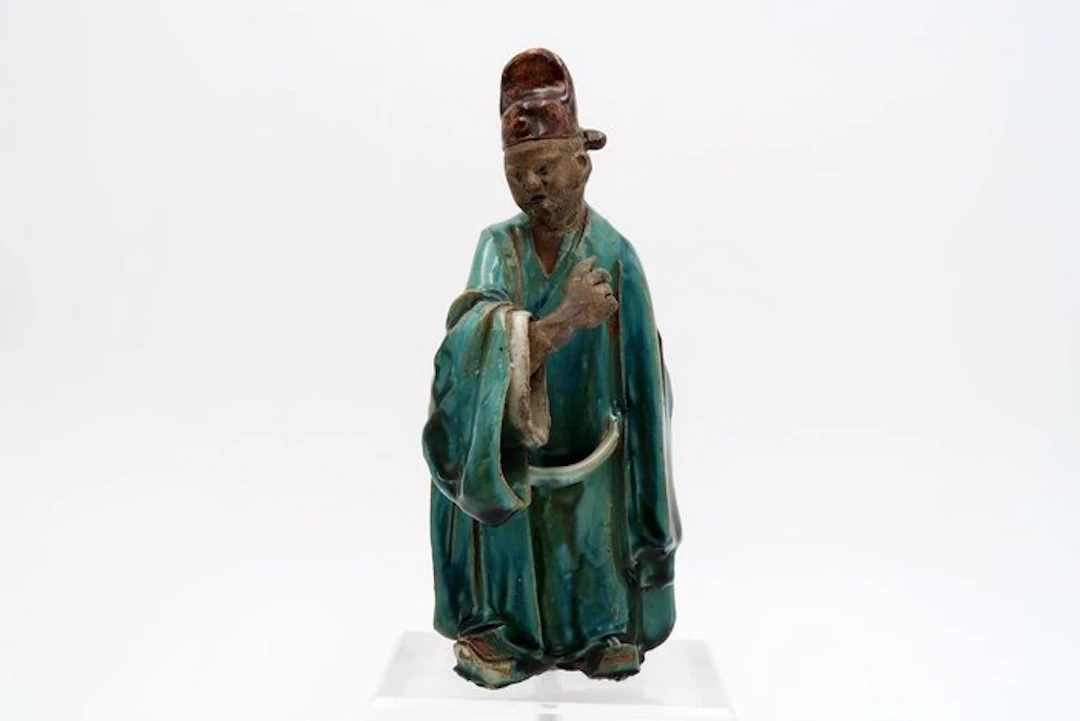
Lacquered stoneware statuette of a literati from Shiwan, China Sold with a custom-made transparent plexiglass base with beveled edges. This 27 cm tall, 14 cm wide, 10 cm deep statuette depicts a dignitary or a literati wearing a long fluid robe cinched at the waist with a belt and topped with a characteristic pointed official hat. Molded in stoneware, it displays the iconic two-tone treatment of Shiwan workshops: the face, hands, and feet are left in an unglazed brown-gray biscuit to emphasize, by contrast, the expressiveness of the hand-sculpted features, while the garment is coated with a thick glaze of turquoise-green lead tempered with blue, the hat accentuated by a deep aubergine brown. The back of the piece, largely hollow, confirms its design for frontal or three-quarter presentation, against a wall or in a niche, rather than in full-rotation display. This production comes from the renowned Shiwan kilns, located in the Shiwanzhen district near Foshan, in Guangdong province, southern China. This ceramic industry, which developed from the late Ming dynasty through the Qing dynasty, became famous for its dense-paste stoneware covered with thick, running glazes, blending greens, turquoises, blues, aubergine browns, and creams, some of which intentionally imitated the famous Jun ware glazes from northern China. Beyond utilitarian pieces produced in abundance—jars, pots, domestic utensils—Shiwan is particularly noted for figurative sculpture aimed at a popular and decorative market: figures of Taoist immortals, bodhisattvas, literati, sages, or legendary heroes, often compared by ceramic historians to Staffordshire figurines produced in England during the same period for a similar clientele. These statuettes decorated domestic altars, shelves, and bourgeois interiors, where they combined decorative function with symbolic meaning—wisdom, longevity, or protection—depending on the character depicted. Historically, Shiwan holds a special place in Chinese ceramics: unlike major imperial centers like Jingdezhen, oriented toward fine porcelain and court commissions, Shiwan developed a more vernacular, technical, and robust production, driven by family workshops passing their know-how from generation to generation, a tradition stylistically stable from the 18th century to the mid-20th century. This continuity often makes precise dating of an unsigned piece delicate, but it bears witness to the enduring vitality of a regional craft that, over time, became one of the most recognizable symbols of Chinese popular ceramics. There may be an old restoration on the forearm. Signs of wear on the base.
Stima:€1
Vai all’astaVedi tutti gli oggetti diCatawikioArte Asiatica