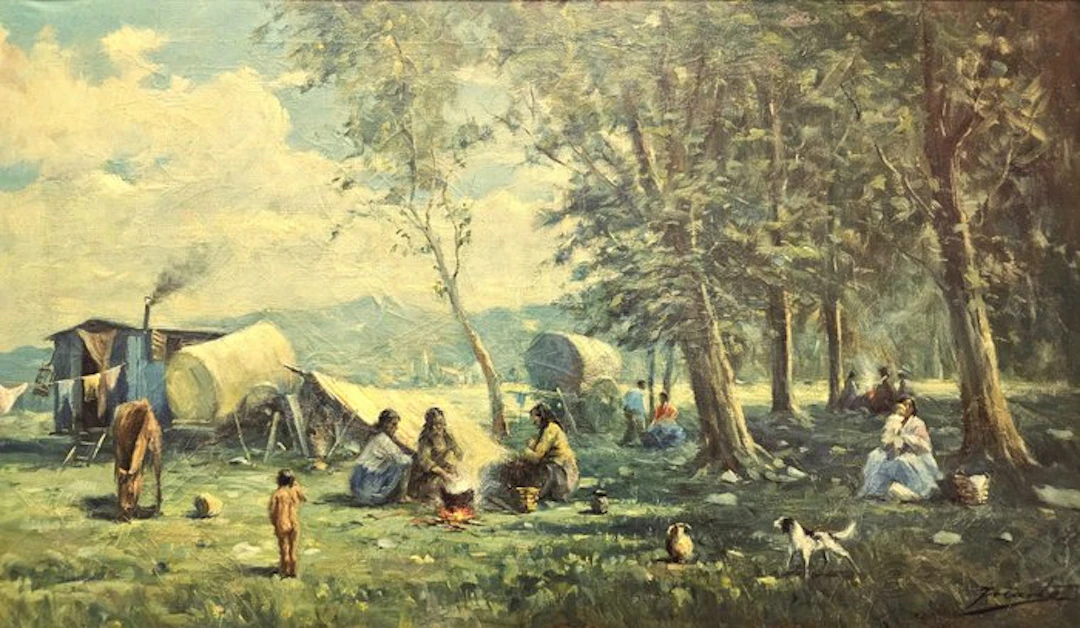
Spanish School (c.1930) - XL Format - Nomadic camp by the forest
1. TECHNICAL DATA Author: Signed, reading not fully resolved: “Iriarte” / “Uriarte” School: Spanish Era: First half of the 20th century, c. 1920–1950 Style: Landscape genre painting with post-impressionist and luminist influence Proposed title: Nomadic Camp near the Forest Technique: Oil on canvas Dimensions of the work: 119 × 71 cm Dimensions with frame: 134 × 85 cm Support: Canvas on wooden stretcher with central crossbar Signature: Signed in the lower right corner Condition: Condition in keeping with its age. It presents general craquelure, especially visible in certain light areas, small losses and signs of use. On the reverse there are old targeted repairs with patches of canvas. 2. DESCRIPTION Interesting large-format oil on canvas, produced during the first half of the 20th century and signed in the lower right corner. The work depicts a costumbrista outdoor scene, developed in a nomadic or itinerant camp. In the center of the composition several female figures appear gathered around a small fire, over which a cooking pot is placed. Around them are distributed different elements of daily life: wagons or mobile structures, hanging clothes, animals, containers and various chores. In the foreground a child stands beside a horse, while to the right a dog and several figures complete a scene rich in narrative. The whole set unfolds under a wide canopy of trees, whose shade contrasts with the intense brightness of the sky and the landscape in the background. 3. STYLISTIC AND COMPOSITIONAL ANALYSIS The painting is part of the Spanish costumbrismo developed in the early decades of the 20th century, incorporating resources from post-impressionism and Mediterranean luminism. The brushwork is quick, visible, and spontaneous. The painter does not seek a meticulous description of every element, but rather to convey the overall impression of the atmosphere, light, and movement. The composition is organized by a clear division between two realms. To the left the open and luminous area of the camp unfolds, while to the right the mass of trees dominates in darkness. Between these spaces the human figures are distributed, generating a visual journey that leads progressively into depth. The trees also function as large vertical axes that balance the markedly horizontal format of the work. The execution of figures, animals, and secondary elements with brief, condensed touches is one of the most attractive features of the painting. 4. ATMOSPHERIC AND CHROMATIC DIMENSION Light plays an essential role. The artist contrasts the bluish-warm clarity of the sky with the deep, bluish greens of the grove. The central scene is animated by small touches of red, yellow, blue, and white corresponding to clothing, everyday objects, and reflections from the bonfire. Especially interesting is the small fire located at the center of the composition, built with short orange and reddish brushstrokes that create one of the main visual focal points. The overall atmosphere is bright and serene, conveying the sense of a summer day spent outdoors. 5. SIGNATURE AND AUTHORSHIP HYPOTHESIS The work bears a signature in the lower right corner. The handwriting could be read as “Iriarte” or “Uriarte,” although the exact reading cannot be established with absolute certainty based solely on the available photographs. For prudence, the work is presented as a Spanish school painting from the first half of the 20th century, without making a concrete attribution of authorship. From a stylistic point of view, both the brushwork and the handling of light and the choice of an outdoor everyday life scene fit perfectly within the costumbrista, post-impressionist, and luminist trends active in Spain during the early decades of the 20th century. 6. OTHER INTERESTING DATA The theme of itinerant camps was recurrent within European and Spanish costumbrismo from the late 19th century to the early 20th century. These subjects allowed artists to combine landscape, genre painting, animal representation, and the study of popular types. In this work the naturalness with which the figures integrate into the landscape stands out. They are not arranged as isolated characters but as part of a daily environment in which people, animals, trees, wagons, and objects relate to each other. The surface preserves a coherent craquelure for paintings of this chronology. On the reverse there are also several old interventions with small fabric patches intended to consolidate specific damage to the support. Despite these interventions, the work retains a strong decorative presence, favored by its large format and by the atmospheric quality of the scene. 7. SHIPMENT AND CONDITIONS The work will be shipped by a professional specialized company. A custom-made box and foam protections will be used to ensure maximum safety during transport. We ship internationally to all destinations. Due to the canvas’s large size, certain destinations, especially outside the European Union, may incur additional packaging, transportation, customs, or import costs, which will be borne by the buyer. The frame is included as a gift with the work and will not be a subject of complaint.
Stima:€900
Vai all’astaVedi tutti gli oggetti diCatawikioAltro