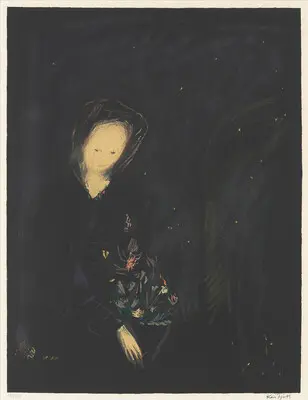




Tutte le aste / Altro / Spanish Cubist School (c.1950) - Seated Figure


1. TECHNICAL DATA Authorship: Unidentified author, signed “Jandro” School / style: European Cubist school Chronology: Mid-20th century Genre: Figurative composition / human figure Technique: Oil on canvas Support: Canvas on wooden stretcher Dimensions of the work: 65 × 46 cm Dimensions with frame: 76 × 56 cm Orientation: Vertical Signature: Signed “Jandro” in the lower right corner Framing: Wooden frame with a silvery finish and textured appearance (frame with flaws and restorations) ((included as a gift)) Conservation status: Good overall condition, with signs of aging. See the detailed photographs, which form an integral part of the description. 2. DESCRIPTION Interesting oil on canvas in cubist language, created during the first half of the 20th century and signed “Jandro” in the lower right corner. The composition represents a seated human figure, deeply synthesized through geometric shapes and fragmented volumes. The body is built from large curved, triangular, and ellipsoidal surfaces, deliberately eliminating conventional anatomical representation to transform the figure into an architecture of planes. The character appears gathered within itself, occupying practically the entire pictorial surface and generating a monumental composition despite the contained dimensions of the work. The palette is mainly organized around whites, creams, ochers, browns, and reddish tones, which contrast with the light blue background. This contrast emphasizes the silhouette and reinforces the volumetric construction of the figure. 3. STYLISTIC AND COMPOSitional ANALYSIS The work clearly participates in the formal investigations developed by Cubism and its European derivatives during the early decades of the 20th century. The artist decomposes the human anatomy into different geometric planes superimposed, replacing naturalistic modeling with a structure of curves, diagonals, and closed surfaces. The head, arms, and legs are integrated within a large oval shape that visually concentrates the entire composition. The figure seems to enclose itself, creating a sense of inner tension and concentration. The alternation of light and dark planes is especially interesting, by which the painter generates depth without resorting to traditional perspective. The use of bold outlines and clearly differentiated color surfaces recalls the different reinterpretations of Cubism developed in Europe during the interwar period, when many artists incorporated its geometric principles into a personal figuration. 4. PSYCHOLOGICAL DIMENSION Beyond its formal construction, the work possesses a strong introspective character. The gathered posture of the figure, with the body folded onto itself and the head inclined, transmits a sense of reflection, withdrawal, or isolation. The figure seems to occupy a closed and autonomous space, practically independent of the background. This physical concentration of the body reinforces the psychological dimension of the scene and makes the representation more of an emotional interpretation than a traditional portrait. The Cubist treatment thus permits transforming the human anatomy into a visual structure charged with tension and expressiveness. 5. SIGNATURE AND AUTHORSHIP HYPOTHESIS The work presents in the lower right corner a clearly visible signature that can be read as “Jandro”. There is currently no additional documentation available that would allow securely identifying the artist corresponding to that signature. Therefore, and following a prudent cataloguing criterion, the work is presented as belonging to the EUROPEAN CUBIST SCHOOL OF THE FIRST HALF OF THE TWENTIETH CENTURY, explicitly indicating the existing signature. The definitive attribution to the author would require further comparative study of the signature and other documented works. 6. OTHER INTERESTING DATA The historical importance of Cubism lies in its break with traditional representation based on Renaissance perspective, replacing it with a new conception of space constructed through planes, geometries, and multiple viewpoints. The movement's influence quickly spread across Europe and generated numerous personal variants during the 1910s, 1920s, 1930s, and 1940s. This work belongs precisely to that tradition of figurative reinterpretation of the Cubist language, maintaining recognizable human presence but subjecting it to intense geometric simplification. Its compact composition, its careful organization of volumes, and the contrast between the earthy tones of the figure and the blue background give it a strong decorative presence. 7. SHIPPING AND CONDITIONS The work will be professionally packed to ensure proper conservation during transport. All our shipments are carried out by a professional transport company, using custom-made boxes, foam protections and materials specifically adapted to each work. We ship worldwide. The photographs are part of the description and allow detailed appreciation of the conservation status, the technique, the signature, the reverse, and the general characteristics of the work.
Stima:€600
Vai all’astaStima:
€600





1 x 0,5 l Myken Arctic Single Malt Whisky Ichthyopathol 4 Years
10/22/2026

€125.92
Stima: €76.41

1 x James Martin's Blended Scotch Whisky Fine & Rare Aged 30 Years
10/22/2026
€305.27
Stima: €382.06
Porta la tua asta ai collezionisti di tutto il mondo!
Pubblica oraIscrivendoti, accetti la politica sulla privacy. Annulla l'iscrizione in qualsiasi momento.
Barnebys HQ
Brahegatan 10
BOX 5038
114 37 Stockholm
