




Tutte le aste / Veicoli / Shmidt.Art - Ferrari - Ferrari Testarossa 1986 - 1980s

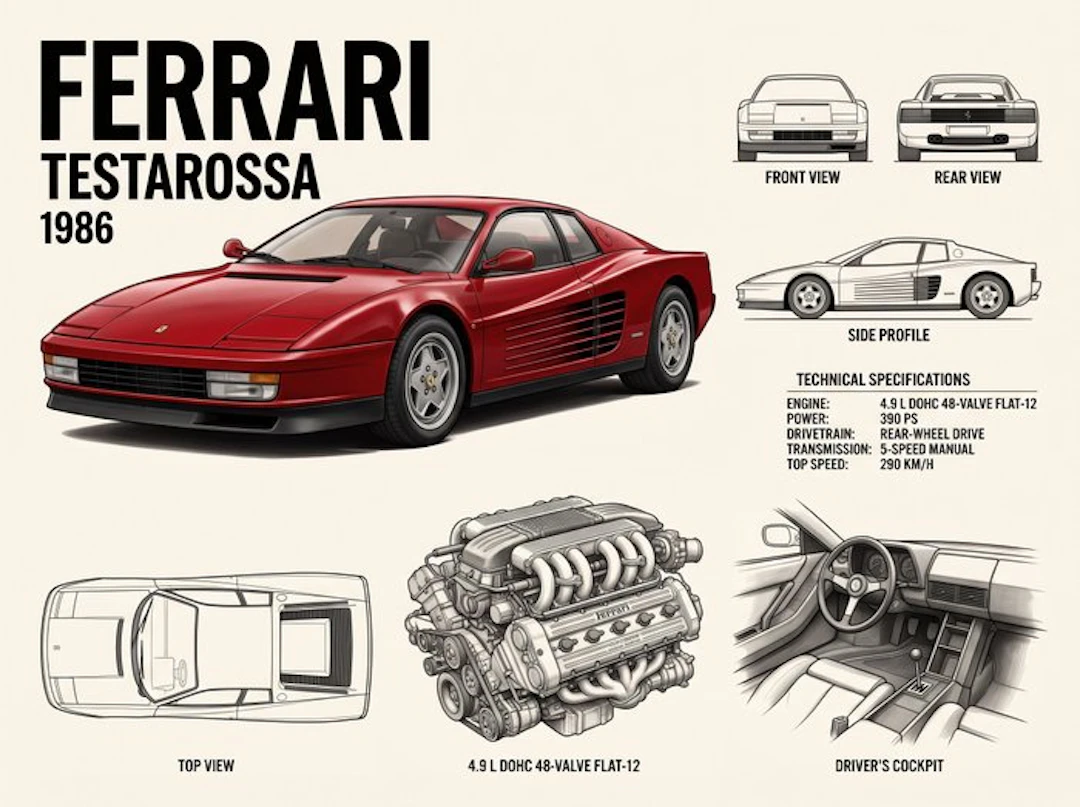
A premium automotive poster dedicated to the 1986 Ferrari Testarossa — one of the most iconic Italian supercars of the 1980s and a defining symbol of Ferrari's twelve-cylinder grand touring heritage. This artwork presents the Ferrari Testarossa in its legendary Rosso Corsa red finish, combining a large three-quarter exterior illustration with precise front, side and rear views, a top-down body study, a detailed flat-twelve engine illustration and a technical drawing of the driver's cockpit. The Icon of the 1980s Introduced at the 1984 Paris Motor Show, the Ferrari Testarossa represented a dramatic evolution of Ferrari's mid-engine twelve-cylinder sports car philosophy. Developed as the successor to the Ferrari 512 BBi, the Testarossa introduced a completely redesigned body, improved cooling architecture, a wider rear track and a more spacious interior. Designed by Pininfarina, the car became instantly recognizable for its dramatic side air intake strakes, exceptionally wide rear bodywork, low wedge-shaped profile and distinctive pop-up headlights. Its name, Testarossa, meaning "red head" in Italian, paid tribute to the red-painted cylinder head covers of Ferrari's twelve-cylinder engines and revived a designation associated with the company's historic racing heritage. The Testarossa quickly became one of the most recognizable supercars of its generation, combining extraordinary performance with unmistakable Italian design. Flat-Twelve Ferrari Engineering At the heart of the Ferrari Testarossa is a naturally aspirated 4.9-litre twelve-cylinder boxer-style engine, mounted longitudinally behind the passenger compartment. With a displacement of 4943 cc, the European-specification engine produces approximately 390 PS and 490 Nm of torque, delivering exceptional performance and the distinctive sound of Ferrari's twelve-cylinder powerplants. Although commonly described as a flat-twelve or boxer engine, the Testarossa uses a 180-degree V12 configuration with opposing cylinder banks. The engine features dual overhead camshafts for each cylinder bank, four valves per cylinder and Bosch KE-Jetronic fuel injection. Its advanced cylinder head design and improved breathing characteristics represented an important development over the earlier Ferrari Berlinetta Boxer models. Power is transmitted exclusively to the rear wheels through a five-speed manual transmission. With a top speed of approximately 290 km/h and acceleration from 0 to 100 km/h in approximately 5.8 seconds, the Testarossa ranked among the fastest production grand touring cars of its era. Design & Aesthetic The poster uses a warm ivory background with restrained black and grey technical illustrations, inspired by vintage Ferrari engineering publications, factory technical drawings and historic automotive design documents. The central illustration presents the Ferrari Testarossa in its iconic Rosso Corsa finish, emphasizing its low front profile, distinctive pop-up headlights, sculpted front bumper, dramatic side strakes and exceptionally wide rear bodywork. The classic five-spoke Ferrari alloy wheels and sharply defined Pininfarina styling further highlight the car's unmistakable 1980s appearance. Supporting technical illustrations provide detailed front and rear elevations, a true side profile and a top-down view of the vehicle's body. A large mechanical illustration highlights the naturally aspirated flat-twelve engine, including its distinctive intake manifolds, cylinder head covers and associated mechanical assemblies. The driver's cockpit illustration reveals the traditional Ferrari three-spoke steering wheel, analog instrumentation, gated manual gear selector and distinctive dashboard architecture. Together, these elements create a detailed visual study of one of Ferrari's most celebrated twelve-cylinder sports cars. Poster Details Size: A1 (841 × 594 mm) Orientation: Landscape Subject: Ferrari Testarossa Year: 1986 Manufacturer: Ferrari Design: Pininfarina Body Style: Two-door Berlinetta Engine: 4.9-litre naturally aspirated flat-twelve Displacement: 4943 cc Configuration: 180-degree V12 Valvetrain: DOHC, 48 valves Cooling: Water-cooled Engine Position: Mid-mounted, longitudinal Fuel System: Bosch KE-Jetronic injection Power: approximately 390 PS (European specification) Torque: approximately 490 Nm Transmission: 5-speed manual Drive: Rear-wheel drive Top Speed: approximately 290 km/h 0–100 km/h: approximately 5.8 seconds Advanced Twelve-Cylinder Engineering The Ferrari Testarossa introduced several important engineering improvements over its predecessor, the 512 BBi. One of the most distinctive innovations was the relocation of the cooling radiators to the sides of the vehicle, allowing improved thermal management and eliminating the need for a large front-mounted radiator. The famous horizontal side strakes directed airflow toward these radiators while becoming one of the most recognizable styling features in automotive history. The car's exceptionally wide rear track contributed to improved stability and handling, while its mid-mounted twelve-cylinder engine provided balanced weight distribution and strong traction. Its tubular steel chassis, independent suspension and powerful ventilated disc brakes reflected Ferrari's commitment to high-performance engineering. The five-speed manual gearbox and naturally aspirated engine delivered a direct and mechanical driving experience characteristic of Ferrari's traditional grand touring philosophy. The combination of sophisticated engineering, powerful twelve-cylinder performance and distinctive aerodynamic styling made the Testarossa one of the most technically ambitious Ferrari road cars of its era. A Cultural and Automotive Icon Beyond its engineering achievements, the Ferrari Testarossa became a defining symbol of 1980s automotive culture. Its dramatic proportions, unmistakable side strakes and powerful twelve-cylinder engine established it as one of the most recognizable exotic cars in the world. The model gained international recognition through appearances in popular television, films, video games and automotive publications. Its association with the television series Miami Vice further strengthened its status as a cultural icon of the decade. Unlike many contemporary sports cars, the Testarossa combined extreme visual presence with genuine grand touring comfort, making it suitable for both high-speed driving and long-distance journeys. The original Testarossa remained in production until 1991, when it was succeeded by the updated Ferrari 512 TR. Collector's Appeal Today, the Ferrari Testarossa is regarded as one of the most iconic and collectible Italian supercars of the 1980s. Its combination of Pininfarina styling, naturally aspirated twelve-cylinder performance, gated manual transmission and unmistakable wide-body design makes it especially appealing to Ferrari enthusiasts. The model represents an important chapter in Ferrari's mid-engine twelve-cylinder history, connecting the earlier Berlinetta Boxer generation with the more advanced 512 TR and F512 M that followed. Its distinctive appearance, mechanical character and cultural significance have secured its position among the most celebrated Ferrari road cars ever produced. The Testarossa remains a lasting symbol of an era when exotic sports cars combined bold styling, sophisticated engineering and uncompromising mechanical performance. This poster is ideal for Ferrari enthusiasts, collectors of classic Italian supercars, admirers of 1980s automotive design and fans of historic twelve-cylinder performance engineering. It works particularly well in a home, office, garage, workshop, showroom or automotive collection. AI disclosure: This poster design was created using generative AI and subsequently reviewed and manually edited by Shmidt.Art.
Stima:€1
Vai all’astaStima:
€1

Porta la tua asta ai collezionisti di tutto il mondo!
Pubblica oraIscrivendoti, accetti la politica sulla privacy. Annulla l'iscrizione in qualsiasi momento.
Barnebys HQ
Brahegatan 10
BOX 5038
114 37 Stockholm
