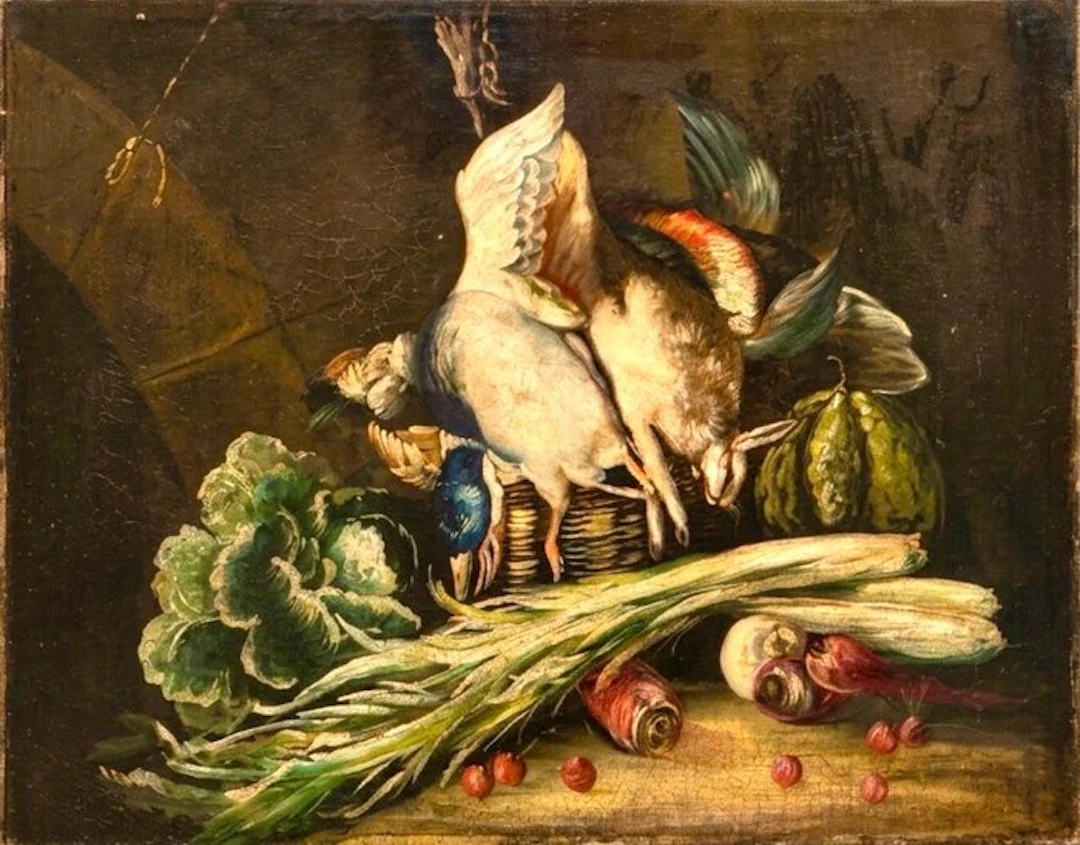
Seguace di Jan Fyt (XIX) - Natura morta - NO RESERVE
SHIPPING: I can ship within 24-48 hours, which is why the shipping is a bit higher; the item will be wrapped with bubble wrap and cardboard with maximum care since it is a fragile and precious object. Additionally, to avoid any issues, it will also be insured. -Are you on vacation? I offer a premium service, maximum delivery flexibility, I can ship to a pickup point near you, so you can collect it at your leisure when you prefer. I am one of the few sellers who can ship worldwide thanks to possession and registration of the EORI CODE, which guarantees peace of mind and faster shipping even outside the European Union. The work tells a fascinating story, suspended between the Northern Flemish Seicento and the influence of Italian painting schools of the 1800s. The examined work features stylistic and compositional characteristics attributable to the XVII century Flemish school, in particular to the circle of Jan Fyt. The attribution to a follower or an artist within Fyt’s milieu is based on the analysis of the following technical elements: Stylistic Analysis Material and Tactile Rendering: The distinctive hallmark of Jan Fyt, inherited by his followers, lies in the ability to differentiate organic textures. In the painting one observes a clear distinction between the soft opaque plumage of the birds, the roughness of the savoy cabbage leaves, and the glossy surface of the onions. This rendering is achieved through a dense and vibrant brushstroke, defined as “material.” Pyramidal and Disordered Composition: Unlike the Dutch still life, more static and orderly, here there is the typically Flemish accumulation of game and vegetables. The elements are arranged seemingly casually within and around a wicker basket, creating a sense of Baroque abundance and realistic immediacy. Light Contrast (Chiaroscuro): The work adopts a dark, deep background from which the subjects emerge thanks to a directional and intense light. This approach, blending Flemish analytical tradition with Caravaggesque tenebrism, is typical of Fyt’s mature phase and his school after contacts with the Italian artistic environment. Synergy between Game and Vegetables: The juxtaposition of small game (hare and birds) with “humble” vegetables (cardoons, onions, cabbage and roots) is a recurring theme in Fyt’s catalog. These vegetal elements serve to balance the color composition, introducing variations of green and ochre that contrast with the warm tones of meat and feathers. -The Story of the Painting Born in the first half of the 19th century by the hand of a Flemish school master active between Antwerp and Rome, the painting was commissioned to celebrate the abundance and prestige of the collector. The work depicts a still life with game and vegetables, a genre much loved by the aristocracies of the time for its extraordinary symbolic charge: the contrast between earthly life, prosperity and the transience of time (vanitas). In the course of the 19th century, the canvas was purchased by a refined bibliophile and patron and underwent a significant restoration and reupholstery to preserve the original structure, before passing by inheritance to important private collections. -The Home of Prestige Before arriving in the gallery, the painting illuminated for over a century the HALL OF THE BANQUETS OF PALAZZO VAN RENSSELAER, a splendid noble palace overlooking the Bruges canals. The canvas was placed above a monumental black marble fireplace from Belgium, designed to dialogue with walnut carved furnishings and leather-tooled Cordovan tapestries. The candlelight and the large arched windows highlighted the strong chiaroscuro of the work, amazing the house guests during gala dinners. -The Details that Make It Unique Tactile Rendering of Feathers: The contrast between the luminous whiteness of the hung bird and the iridescent shades of the duck’s neck show an extraordinary mastery of technique, typical of Flemish painting. Naturalness of the Still Life: The braided baskets, leeks, cabbages and onions painted in the foreground present a almost sculptural texture, where each fold and vein is rendered with meticulous precision. Dramatic Chiaroscuro: The deliberate use of a dark background and diagonal light enhances the shapes and volumes, giving a sense of deep intimacy and scenographic realism. The painting is currently kept in a private home and has been reupholstered by the Galleria Giosi in Rome as seen on the back of the painting. In the 17th century hunting was a privilege reserved for the aristocracy and the wealthy bourgeoisie. Displaying a painting with game and fine food in the dining rooms was a direct way to show guests one’s wealth, social prestige and the generosity of one’s table. Moral and Religious Meaning (Vanitas) Besides ostentation, these paintings hid a strong symbolic component: - Memento Mori: lifeless animals reminded of the transience of existence and the inevitability of death. - Virtue of Nature: the presence of fruit and vegetables represented divine providence and the cycle of seasons. - Demonstration of Technical Virtuosity For artists, the still life was the ultimate proving ground. It served to demonstrate one’s ability to reproduce extremely complex textures: - The soft and light plumage of the birds. - The glossy or porous surface of the vegetables. - The effect of light on the wicker baskets and on the fabrics. Colour disclaimer and item condition: As this is a vintage artwork/art object, it should be noted that the color tones, gilding reflections and details visible in the images may show slight tonal variations compared to the actual object due to photographic rendering and lighting. The images are considered an integral part of the description, but the live object will be the authoritative reference.
Stima:€400
Vai all’astaVedi tutti gli oggetti diCatawikioAltro