




Tutte le aste / Arte Antica / Replica of an Ancient Roman Glass millefiori bowl

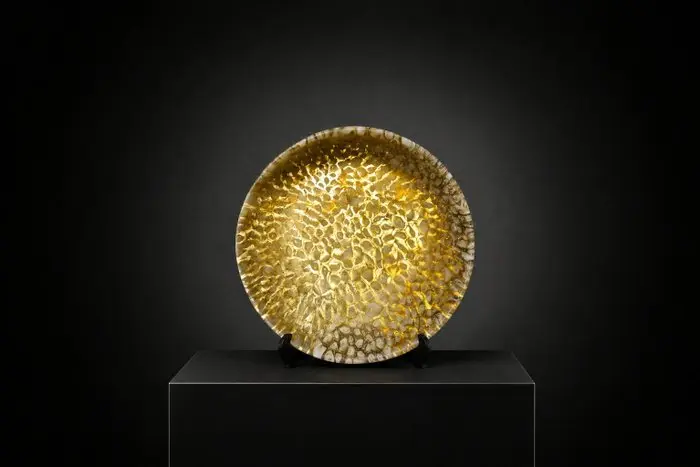
Probable reproduction of a Roman millefiori bowl, a decorative glass type whose technique harkens directly back to Hellenistic and early Roman workshops, especially between the 1st century BCE and the 1st century CE. A vessel with a shallow, hemispherical profile, whose shape suggests a bowl or patera for both utilitarian and ornamental use. The most striking feature is its surface completely covered by a complex glass pattern, in which the tones predominate: * Golden yellows * Opaque whites * Warm hues evoking honey, amber, and filtered sunlight These colors are not painted on, but integrated into the glass mass, a result of the millefiori technique (literally, “thousand flowers”). The decoration is achieved through multicolored glass rods (canes) prepared beforehand. These rods are cut into transverse sections and laid out in mosaic and fused into a single surface. In this piece, the motifs do not form defined flowers, but an organic and almost cellular lattice, with irregular, branched shapes that recall natural structures such as corals, lichens, or biological tissues. This suggests a more abstract variant within millefiori, possibly inspired by Roman models where the visual effect prevailed over figuration. The edge of the bowl is well defined, slightly lighter, framing the composition as if it were a luminous disk. Historical-artistic context: Millefiori was a highly valued technique in the Roman world, inherited from Alexandrian workshops. These pieces were luxury objects, associated with urban elites and often imitations of hard stonework or mosaic. Spanish private collection in the 1980s
Stima:€270
Vai all’astaVedi tutti gli oggetti diCatawikioArte Antica
Stima:
€270

Porta la tua asta ai collezionisti di tutto il mondo!
Pubblica oraIscrivendoti, accetti la politica sulla privacy. Annulla l'iscrizione in qualsiasi momento.
Barnebys HQ
Brahegatan 10
BOX 5038
114 37 Stockholm
