






Tutte le aste / Gioielli & Gemme / Pendant with Rubies, Demantoids, and Moonstones in Gold, c. 1910

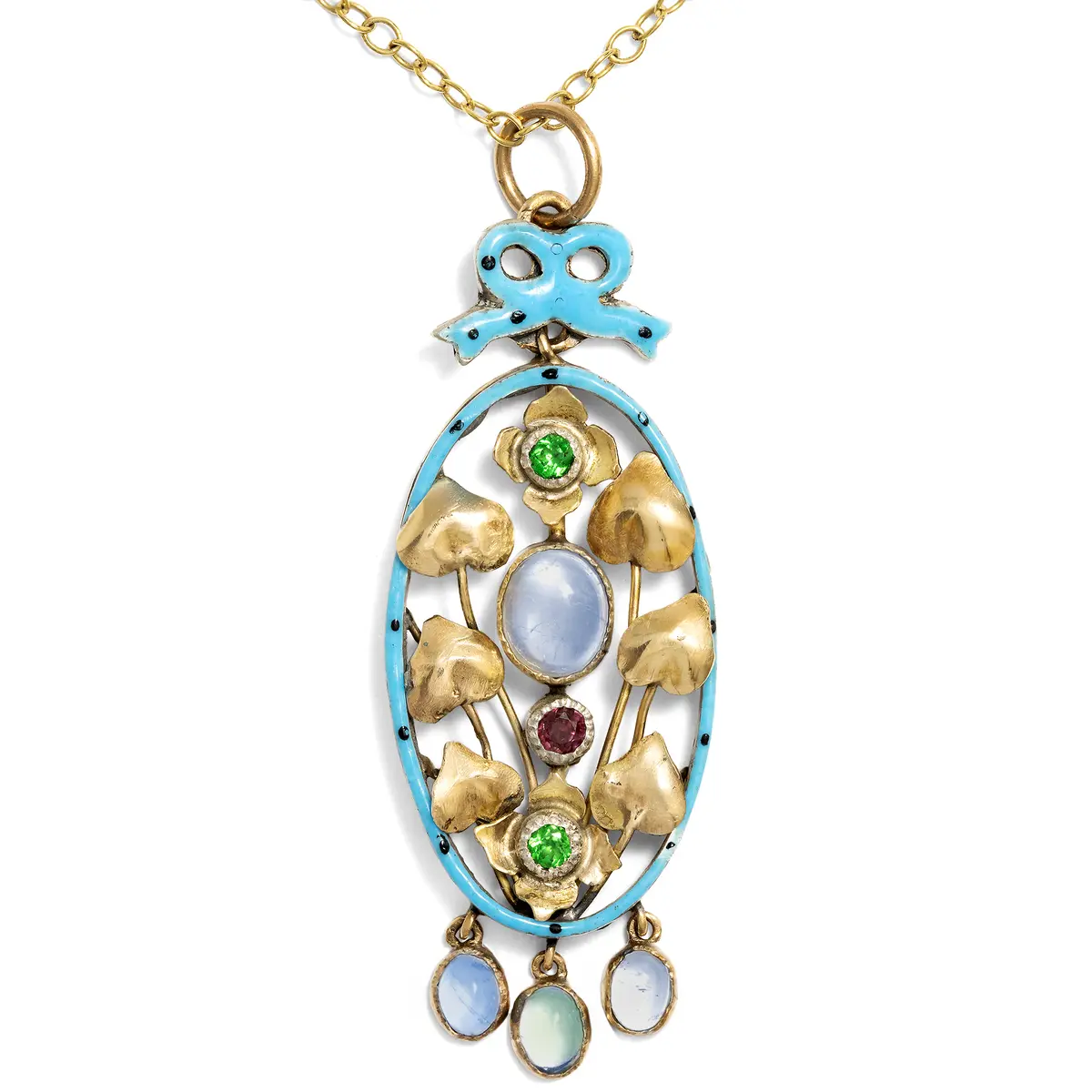
This delicate pendant made of gold, blue enamel, and gemstones is a beautiful example of the refined taste of the early 20th century. A bouquet of flowers is presented within an oval frame, mounted so that it can move freely beneath a bow. Upright gold leaves frame four flowers arranged in a row one below the other: the two outer ones are made of demantoid, a larger one of a shimmering blue moonstone, and a smaller one of a natural ruby. Below them, three additional, smaller moonstones are attached so they can move. They shimmer blue, or—in the center—slightly golden-greenish. It’s worth taking a close look at the pendant again and again. Only then does the sophistication and richness of allusion with which it was designed become apparent. First, there are the colours: alongside slightly reddish gold, blue appears in the form of the enamel and the iridescent moonstones. Along the central axis, green is introduced as a blend of gold and blue—more intense in the demantoids and subtler in the moonstone at the bottom center. The ruby alone creates a deliberate contrast here; it is the focal point of the composition, yet blends harmoniously into the design due to its placement almost exactly in the center. The bow and frame are covered with blue enamel, which, thanks to black dots, evokes the impression of a fabric ribbon. It has a Nordic, Northern European feel—and is, in any case, summery and light. The heart-shaped gold leaves are also typical of Art Nouveau jewellery in Northern and Central Europe. Archibald Knox frequently used them as a motif c. 1900. At the Wiener Werkstätte, Carl Otto Czeschka and Josef Hoffmann adopted this motif starting around 1905. It can also be found in Danish jewelry art of the so-called Skonvirke style c. 1910 and in the designs of, for example, Theodor Fahrner. The combination of the bow and heart-shaped leaf leads us to believe that the pendant was created c. 1910. Perhaps in Great Britain, where we discovered it in London, or perhaps in Germany or Austria. Unfortunately, it bears no hallmarks that could provide more precise information. The modern chain was already attached to it in Great Britain.
Stima:1.490€
Vai all’astaVedi tutti gli oggetti diHofer AntikschmuckoGioielli & Gemme
Stima:
1.490€


GARNITYR/SET, 3 delar, silver, Guldfynd AB, 2000-tal.
11/16/2026
83,53€
Stima: 135,06€


SALOVAARA, armring, sterlingsilver med bergkristall, Turku, Finland.
11/16/2026
166,88€
Stima: 108,05€
Porta la tua asta ai collezionisti di tutto il mondo!
Pubblica oraIscrivendoti, accetti la politica sulla privacy. Annulla l'iscrizione in qualsiasi momento.
Barnebys HQ
Brahegatan 10
BOX 5038
114 37 Stockholm
