



OCT 8 | 3:00 PM

Porta la tua asta ai collezionisti di tutto il mondo!
Pubblica oraIscrivendoti, accetti la politica sulla privacy. Annulla l'iscrizione in qualsiasi momento.
Barnebys HQ
Brahegatan 10
BOX 5038
114 37 Stockholm
Tutte le aste / Arte Contemporanea / Miquel Torner de Semir (1938) - La máquina del tiempo

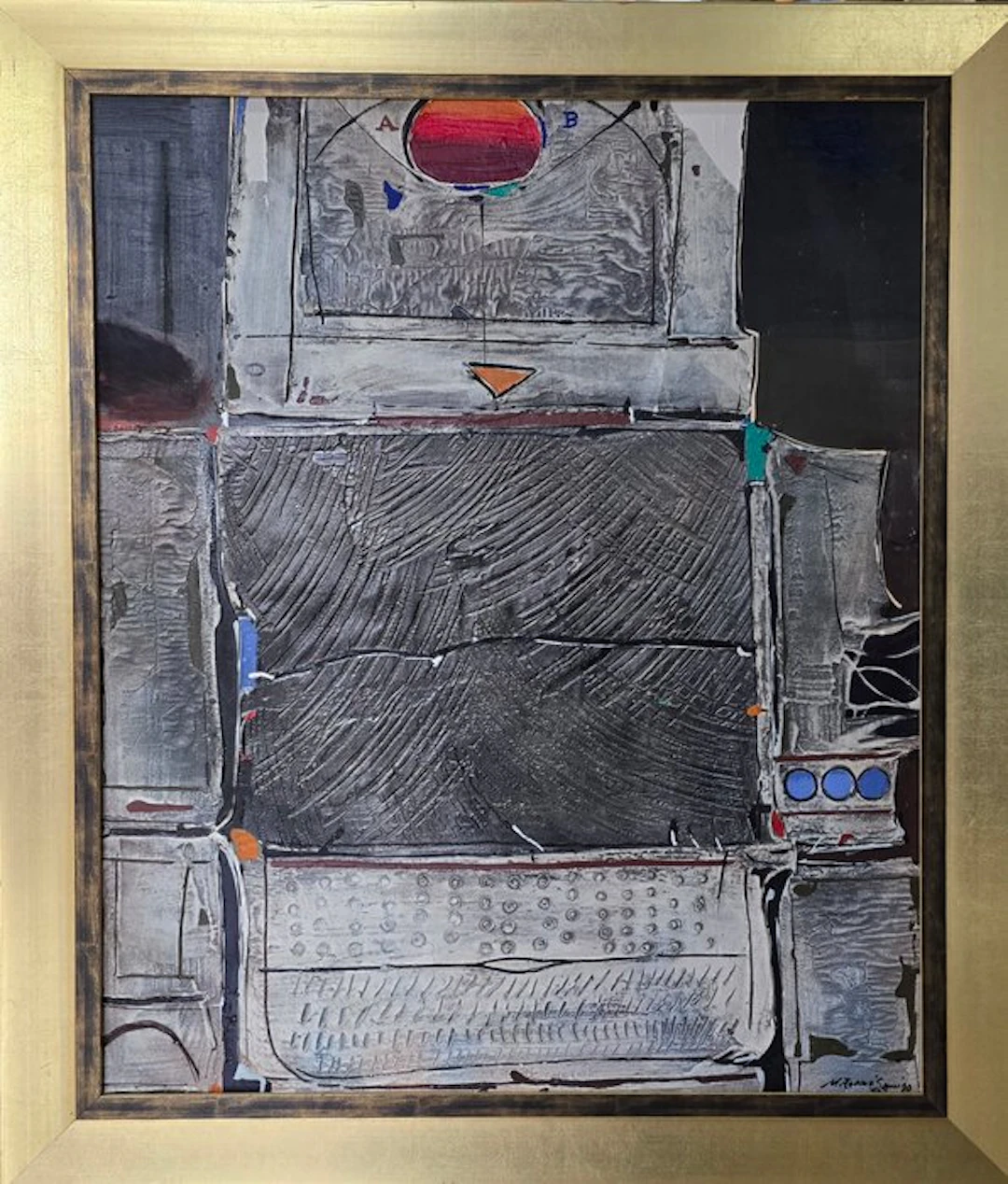
Pictura Galeria presents this magnificent artwork belonging to Miquel Torner de Semir, depicting a mysterious machine or control panel composed of screens, buttons and codes that seem to conceal information from an unknown technological world. The painting stands out for its excellent technique and the high pictorial quality it transmits. • Frame dimensions: 108x89x3 cm. • Artwork dimensions: 92x73 cm. • Oil on panel hand-signed by the artist in the lower right corner, Miquel Torner de Semir. • The piece is in good conservation condition. • The work is sold with a beautiful frame (included in the auction as a gift). The work comes from an exclusive private collection in Girona. Important note: the photographs included are an integral part of the lot description. The work will be professionally packaged by an IVEX expert (https://www.instagram.com/ivex.online/), using high-quality materials to guarantee its protection. The shipping price covers both the cost of professional packaging and the transportation itself. Shipping will be carried out by Correos or GLS with tracking. International shipping available. This painting presents an industrial and technological-looking composition, built from large rectangular structures, compartments, lines and small color details. The image recalls a machine, a control panel, an old computer or some device belonging to an imaginary world. Its vertical format reinforces the sense of looking at a very large object placed directly in front of the viewer. The center of the composition is occupied by a wide rectangular surface in black and dark gray. This large space can be interpreted as a powered-off screen, a hatch, a metal plate, or the main core of the machine. Its presence visually dominates the work and creates a strong contrast with the gray and whitish zones that surround it. The central surface is not completely uniform. Numerous diagonal lines, curves and interlaced patterns extend across it, forming a complex visual network. Some appear as scratches, signs of wear, or traces left by prolonged use, while others may recall waves, circuits, maps or information records. These marks add depth and make the large dark rectangle feel full of activity. Within this central area different directions can be distinguished. In the upper left, lines advance with parallel diagonals; to the right, denser and more curved groupings appear; and in the lower part, the shapes seem to converge toward a central point. This organization conveys a sense of accumulated energy or information flowing through the interior of the device. A horizontal line runs across roughly the lower half of the black rectangle. This separation can be interpreted as a division between two screens, as an opening, or as the junction between different components. Its irregular path breaks the surface continuity and reinforces the appearance of an object composed of several assembled modules. At the top there is another rectangular compartment in gray tones. Within it lies a large circular or oval shape that combines red, burgundy, pink and orange. This element immediately stands out due to its color and may resemble an emergency light, an indicator, a reservoir, a window, or a power symbol. The color bands of the upper circle are arranged horizontally and seem to represent different levels. The orange occupies the highest part, followed by intense reds and deep burgundies. This gradation may suggest heat, charge, pressure, or a warning system. The circle acts as the main warm focal point within a composition dominated by grays, blacks and whites. On either side of the circular shape appear letters and small signs. These characters reinforce the interpretation of the whole as a complex machinery that needs codes, instructions or signals to operate. Their meaning is not fully revealed, adding mystery and making one imagine that the device belongs to a scientific, industrial or futuristic reality. Below the upper compartment there is a horizontal band in which a small inverted orange triangle stands out. Its warm color makes it another point of attention and it seems to function as a button, an arrow or a signal that indicates a downward direction. The triangle’s orientation guides the gaze toward the large dark panel located just below. This arrow establishes a clear link between the top and the center of the composition. It could indicate where an order should be entered, the flow of energy, or access to a compartment. Although its shape is simple, it plays an important role in organizing the visual path and breaking the monotony of the gray structures. On the right side a small vertical module appears containing three blue circles aligned horizontally. These elements look like buttons, lights or controls. The intense blue contrasts with the dark, metallic tones of the surroundings, adding a cold, luminous note that balances the presence of red and orange. The three circles have similar sizes and are framed within a small rectangular box. Their repetition creates rhythm and order within a composition characterized by irregular surfaces. They could represent three different functions, three levels of operation, or a sequence of activation. Their meaning remains open, allowing the viewer to imagine the use of this mysterious machine. Around the blue module are concentrated white, black and gray lines that recall cables, connections or small boards. Some shapes seem to extend toward the right edge, as if the device continued beyond the image’s boundaries. This detail visually expands the composition and suggests that we are only looking at a part of a much larger structure. On the left side there are also narrow panels, vertical frames and small color signals. The light and dark grays alternate, creating the impression of different materials or assembled pieces. Some reddish, blue and orange fragments appear isolated, like tiny indicators distributed across the surface. The lower area is formed by several overlapping rectangular strips. The first contains a large amount of small circles and dots arranged in rows. These signs may recall perforations, keys, rivets, numerical codes or ventilation elements. Their repetition contrasts with the free, dynamic lines of the central screen. Further down there is another compartment covered with vertical and diagonal strokes. These marks evoke a keyboard, a series of inscriptions, a written record, or a command surface. The difficulty of reading them makes them a kind of visual language, as if the machine stored information that cannot be understood immediately. The frames surrounding the different zones perform an essential function. Black and gray lines delineate each compartment and create a highly defined internal architecture. The work seems built in layers: an exterior structure, several secondary panels, a central screen, side controls, and lower zones intended for control or storage. Despite its orderly appearance, the device shows irregularities, wear and small breaks. The edges are not perfectly straight, the lines stray, and the surfaces bear multiple marks. This imperfection gives it personality and makes one think of an old machine, used for a long time or recovered from a forgotten place. The predominance of grays, blacks and whites creates a cold, industrial atmosphere. However, red, orange, blue and turquoise details prevent the composition from becoming monotonous. These small color focal points seem to be active lights within a powered-down structure, signs that energy or information still circulate inside. The large central black area can also be interpreted as an unknown space. More than a simple screen, it could represent a closed door, a dark depth, or a boundary between the visible world and what remains hidden. The lines running through it look like signals of internal activity that the viewer cannot decipher. The work invites us to imagine the function of this strange mechanism. It could be a navigation console, an ancient computer, a communication device, a scientific panel, or a machine conceived to store memories. The lack of a definite explanation turns observation into an exercise of imagination and allows constructing different stories around the object. It can also be understood as a reflection on the relationship between humans and technology. The machine occupies the entire composition and leaves no space for any human figure. The viewer stands in front of it as a possible operator, but receives no clear instructions. This position generates curiosity and, at the same time, a certain sense of uncertainty before a complex and unknown system. Overall, the work represents a mysterious technological structure formed by screens, panels, buttons, symbols and compartments, akin to an ancient control machine or a device belonging to a imagined future. The grays and blacks convey solidity and an industrial character, while red, orange and blue details suggest activity and energy. The painting turns a mechanical object into a visual riddle that invites deciphering its function and imagining what information it may hide inside.
Stima:€1,000
Vai all’astaVedi tutti gli oggetti diCatawikioArte Contemporanea
Stima:
€1,000

1996 Australia 1/10 oz Gold Lunar Rat (Series I)
12/06/2017
€399
Stima: €495.6
OCT 8 | 3:00 PM
Porta la tua asta ai collezionisti di tutto il mondo!
Pubblica ora