Matthijs maris (1839-1917)
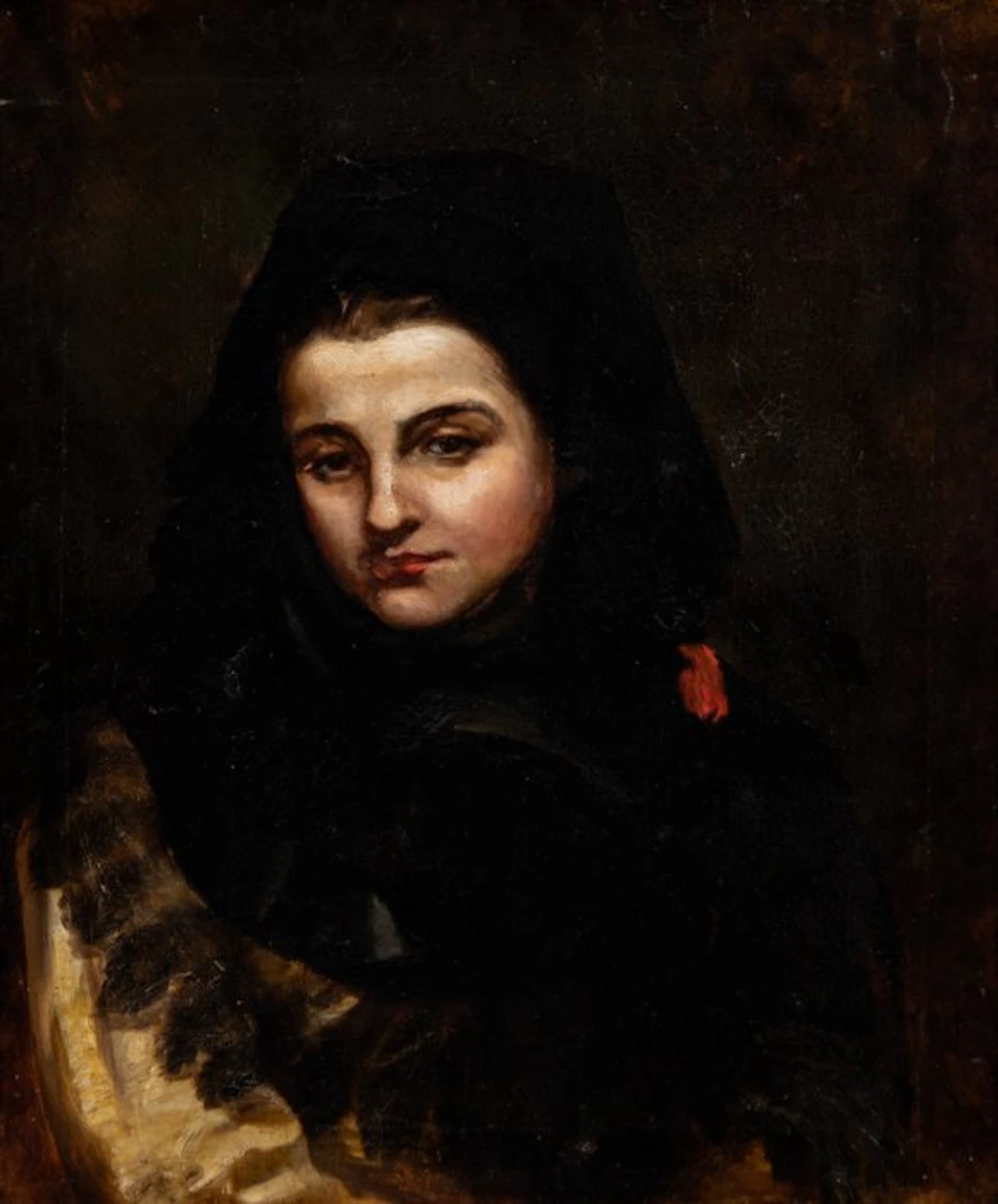
Attributed to Matthijs Maris (1839 to 1917) Portrait of a young woman with a dark headscarf Second half of the nineteenth century Oil on canvas, 61.5 × 51.5 cm No signature found on the front On the lower spieraamlat a partially faded pencil note, read as ‘Maris’ Gilded, hand-painted wooden Baroque frame Provenance: Dutch art collection Delivered with Historical and Technical Research Report An intensely rendered portrait of a young woman, whose illuminated face emerges from a broad dark headscarf. The upper body is tilted, while her gaze is directed toward the viewer. This subtle opposition lends the depiction a lively presence. The dark clothing and restrained background keep the focus on the face. A golden sleeve on the left and a small red accent at the opposite shoulder bring warmth and balance to the composition. The painting’s handling is especially attentive in the face. Short, curved, diagonally placed brushstrokes follow the contour of the forehead, cheeks, and chin. Warm skin tones blend into brown shadows around the eyes and under the nose. The dark upper arms and the narrow separation between the lips give the features sharpness, while softer transitions connect the facial form to the hair and headscarf. The red mouth forms a focused color accent. In the golden sleeve, the painting style broadens: light paint bands follow the folds and alternate with deep shadow areas and dark fringe. The attributions to Matthijs Maris rest on the affinity with his early portrait and figure work. An important comparison is his Portrait of Jacob Maris from 1857 in the Rijksmuseum. Both works combine a strongly modeled face with a dark surroundings and carefully placed accents around the eyes, nose, and mouth. The Portrait Study of 1856, also in the Rijksmuseum, offers a striking comparison for the visible, form-following brushstrokes on the forehead and the intensification of eye shadows. The Study of a Young Woman in Profile from 1855 in the Kunstmuseum Den Haag aligns through the coherence of warm skin, dark head covering, and broadly painted drapery. Together, these similarities form the basis for the attribution. Matthijs Maris, the middle of the three painting brothers in the Maris family, was born in The Hague and studied at the academies of The Hague and Antwerp. His early work testifies to a painstaking interest in the human face, fabric texture, and light. After returning from Antwerp, he shared a studio with Jacob. In 1869 he settled in Paris; from 1877 he lived in London. There he developed his characteristic, hushed scenes with veiled figures and fading contours. The present portrait mainly aligns with the tangible skin modeling and direct painting manner of his early figure studies. Technical examination and condition Infrared examination reveals signatures and alterations in the painting’s execution. Under ultraviolet light, old and recent retouchings are revealed. The paint surface shows craquelé and localized paint loss. The painting has been recently cleaned and given a satin varnish. Object description The painting portrays a young woman half-length against a dark brown background. Her upper body is slanted; the face is turned toward the viewer. A dark headscarf envelops the head and covers a large portion of the shoulders and chest. The forehead, the bridge of the nose, the cheeks, and the chin are lit. Brown shadows define the eye sockets and the lower side of the nose. The lips are painted red. On the lower left there is a golden sleeve with dark fringe; on the right edge of the image a red clothing accent appears. Technique and material analysis The work is executed in oil on canvas. In the light areas of the skin there are short, curved, diagonal brushstrokes that follow the curvature of the face. Around the eyes, nose, and mouth the forms are bounded with smaller, darker accents. The sleeve is built up with broader strokes, where light bands and brown shadows articulate the folds. The dark cloth forms more continuous swathes of color. The painterly approach includes signatures and adjustments in the execution. Composition and form analysis The head and upper body occupy most of the image plane. The diagonal placement of the shoulders contrasts with the forward gaze. The dark headscarf frames the face and connects the upper and lower parts of the figure. The spatial effect rests primarily on the modeling of skin and clothing; the background contains no elaborated spatial setting. The face constitutes the main light accent. The golden sleeve and the smaller red accent distribute the color contrasts across the lower half. Stylistic and art-historical context The compact figure composition, dark background, and plastically modeled face place the work within nineteenth-century portraiture. The alternation between a detailed face and broadly treated clothing aligns with the early portraiture with which Matthijs Maris is associated in this context. The form-following brushwork and warm skin tones are the key features of this stylistic placement. Contemporary artists Jacob Maris, Jozef Israels, David Adolphe Constant Artz, Camille Corot, Gustave Courbet Condition The paint surface shows craquelé and localized paint loss. Old and recent retouchings are present. The painting has recently been cleaned and given a satin varnish. The pencil note on the spieraam is partially worn and faded. Conclusion The work is catalogued as a women’s portrait from the second half of the nineteenth century, attributed to Matthijs Maris. No signature was found on the front. The material condition is characterized by craquelé, localized paint loss and retouchings, alongside recent cleaning and a renewed varnish layer. The work “Portrait of a Young Woman with a Dark Headscarf” is housed in a museum antique gilded hand-stitched wooden frame with plaster ornaments Total dimensions: 92 × 81 cm Medium dimensions: 61.5 × 51.5 cm All shipments in professional packaging via FedEx, DPD, or PostNL. For all shipments there is a surcharge for packing materials, which is already included in the stated shipping price. The customer is responsible for any import duties and additional costs that may apply upon delivery abroad. Shipping artworks always carries certain risks. Although shipping is possible, we recommend collecting the artwork in person when this option is available. If shipping is chosen, it is entirely at the buyer’s risk. In-person collection ensures that the work arrives undamaged and in optimal condition. After purchase, you can easily schedule a pickup appointment at our workshop and studio, where it will be safely and carefully prepared for you. Transport Quote request via our website (Service-transport) or via Catawiki support Upon purchase of this artwork you may choose to have it delivered with or without a frame. The frame, richly ornamented and suited to the work, is offered free of charge so you can hang the painting immediately. While we take utmost care to ensure professional packaging and shipping, there is a small risk of damage to the frame or glass during transport. Any damage to the frame or glass that does not affect the artwork itself is not accepted as a valid reason for a claim or cancellation. We advise collecting the work or arranging your own transport, as damage to the frame, especially the plaster ornaments, is not covered. We strive to deliver your artwork safely and in optimal condition, paying careful attention to packaging and shipping procedures. If you have questions or special requests, you can always contact Catawiki customer service. From the moment your purchase is confirmed, we treat every shipment as an individual project. Each painting is carefully packed with high-quality, professional shipping materials, and we select the most suitable carrier based on destination, transit time, and handling requirements. We monitor each package closely until delivery is completed. Because no two artworks are the same, we often create custom-made, handmade shipping crates or boxes tailored to the size, frame, and fragility of the painting, as well as the distance and transport conditions to your address. This guarantees the best possible protection throughout the journey. To support a smooth international shipping process, we prepare the correct paperwork and shipping documentation, including customs codes and export-related information if needed. In some cases we proactively contact you to confirm that your package has arrived safely, that the painting is in good condition, and to answer any questions you may have. We usually call the phone number provided to Catawiki, and the call will be in English. If desired, you can also reach us by email or via the Catawiki chat.
Stima:€6,000
Vai all’astaVedi tutti gli oggetti diCatawikioAltro