


OCT 8 | 3:00 PM

Porta la tua asta ai collezionisti di tutto il mondo!
Pubblica oraIscrivendoti, accetti la politica sulla privacy. Annulla l'iscrizione in qualsiasi momento.
Barnebys HQ
Brahegatan 10
BOX 5038
114 37 Stockholm
Tutte le aste / Arte, Pittura e Arti Grafiche / MARIANO ROSSI (ITALIAN 1731-1807), TRIUMPHANT FLORA
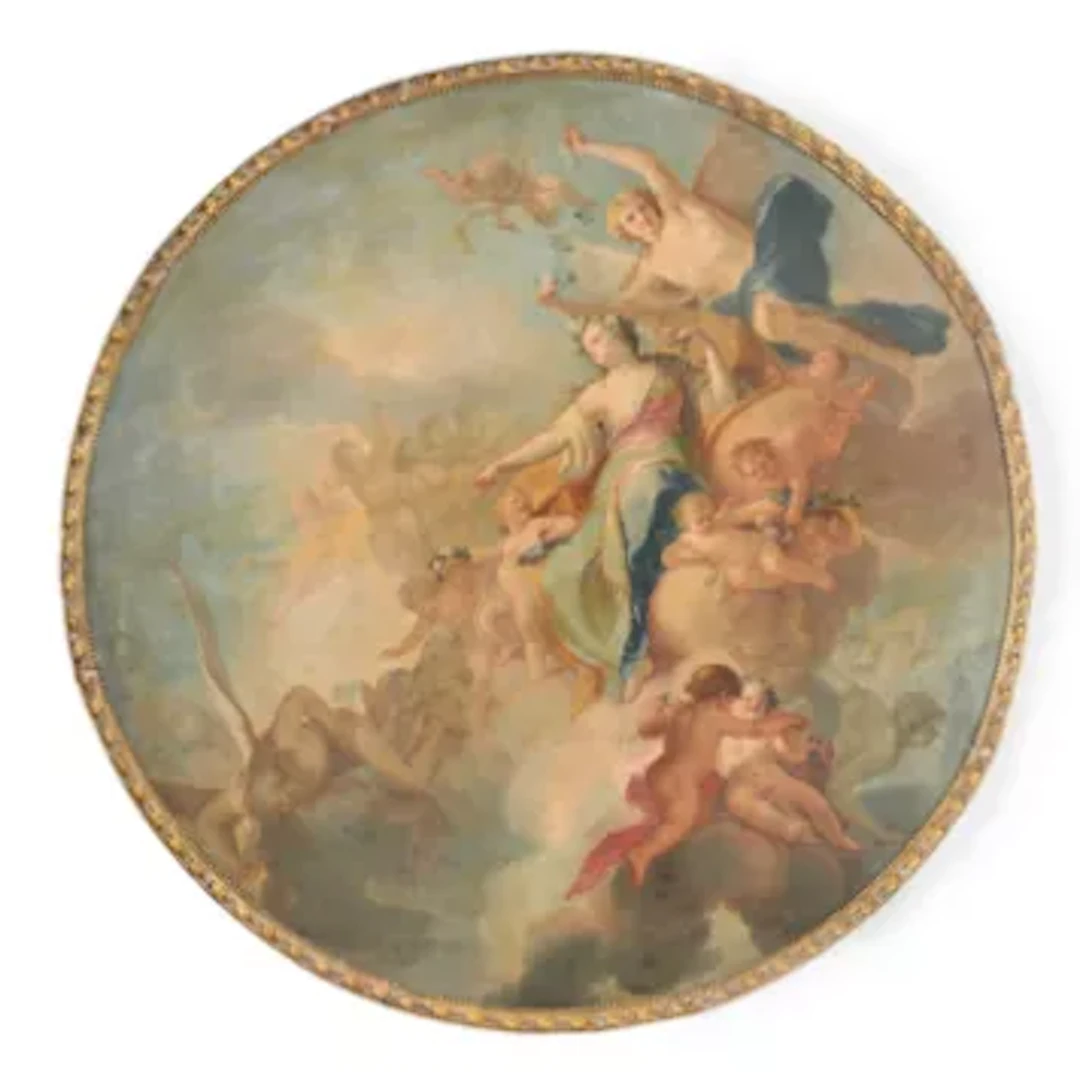
MARIANO ROSSI (ITALIAN 1731-1807) TRIUMPHANT FLORA Oil on canvas, tondo 279 x 270cm (109¾ x 106¼in.) Provenance: By repute Palazzo Donn’Anna, Naples Villa Lucia, Naples Private Collection, United Kingdom Mariano Rossi (1731-1807) was a Sicilian painter who trained in Palermo with the local artist Filippo Randazzo (c. 1692-1744), then in Naples in the workshop of Francesco Solimena (1657-1747), and finally in Rome under the influential Marco Benefial (1684 1764) [1]. Quickly recognised for his draftsmanship, Rossi was elected into the Accademia di San Luca in 1766. Rossi was much in demand and gained prestigious commissions all over Italy. Many of these were ecclesiastical commissions, most notably for the churches of Santa Maria in Aracoeli and San Giuseppe alla Lungara, as well as Cattedrale di Palermo. The prominent patron Cardinal Alessandro Albani (1692-1779) purportedly recommended Rossi to Charles Emmanuel III (1701-1773), the King of Sardinia and Duke of Savoy, who summoned him to produce a number of frescoes for the Royal Palace of Turin. His work also decorates the Royal Palace of Caserta, and perhaps the most well-known among Rossi’s works are those in the Palazzo Barberini and the Galleria Borghese. The entrance hall of the Galleria Borghese is called the ‘Mariano Rossi Hall’ to honour Rossi’s extraordinary vault fresco. Since its creation in the late eighteenth century, it has been lauded as one of the finest examples of the grand tradition in Italian ceiling painting [2]. One contemporary writer declared that the fresco ‘assures its author a luminous place among those artists who have become most celebrated in painting’ [3]. More recently, art historians have considered Rossi to be one of the last artists to exemplify the full splendour of the Baroque style [4]. Rossi’s exceptional command of proportion and light are apparent in the present large tondo, which was previously, by repute, displayed in Palazzo Donn’Anna and then Villa Lucia, both in Naples, before entering a private collection in the United Kingdom. In this dramatic composition, a prominent female figure is seated on clouds, surrounded by putti, and attended by a male figure who places a wreath of flowers on her head. Although the female figure is being crowned and the dejected winged figure in the lower left corner appears to be a fallen angel, the scene does not align with any traditional representation of the Coronation of the Virgin, as it lacks clear Christian iconography. The scene is instead allegorical or mythological. The female figure may personify an abstract ideal, such as Virtue, who, lifted and celebrated, triumphs over the shadowy Vice, or she most likely represents Flora, the goddess of flowers. As Flora is associated with fertility and growth, she may be rendered here as triumphant over the desolation and darkness of winter and barrenness. The fallen figure may symbolise the retreat of winter, as a contrast with Flora’s vibrance and vitality. Despite her pointed finger, her pose is relaxed and graceful, and she appears elegantly clothed in flowing garments of soft and muted shades of blue and pink. The putti are lively and playful in the swirling clouds, and they hold flowers, which suggest themes of spring, beauty, and the blossoming of life. The winged male figure crowning her is possibly Zephyr, the god of the west wind, who was Flora’s lover, according to Roman mythology, and aided in her role as the bringer of spring. Rossi has adeptly used curving and diagonal lines to create movement and make the figures appear to spiral and soar. The breadth of his brushwork and his use of foreshortening also create depth and impressive atmospheric perspective in the airy background, and this sense of space brings the viewer into the action and energises the scene. We would like to thank Professor Riccardo Lattuada of Università degli Studi della Campania for confirming the attribution from images. [1] C. Paul, ‘Mariano Rossi’s Camillus Fresco in the Borghese Gallery’, The Art Bulletin, 74 (1992), 301. [2] Ibid., 297. [3] Memorie per le belle arti, Rome: Stamperia Pagliarini, 1785, p. 188. [4] A. Blunt, Guide to Baroque Rome, London and Granada1982, p. 212. Condition Report: Framed Measurements: 285 cm (112 ½ in.) diameter Condition Report Disclaimer, MARIANO ROSSI (ITALIAN 1731-1807), TRIUMPHANT FLORA, MARIANO ROSSI (ITALIAN 1731-1807) TRIUMPHANT FLORA Oil on canvas, tondo 279 x 270cm (109¾ x 106¼in.) Provenance: By repute Palazzo Donn’Anna, Naples Villa Lucia, Naples Private Collection, United Kingdom Mariano Rossi (1731-1807) was a Sicilian painter who trained in Palermo with the local artist Filippo Randazzo (c. 1692-1744), then in Naples in the workshop of Francesco Solimena (1657-1747), and finally in Rome under the influential Marco Benefial (1684 1764) [1]. Quickly recognised for his draftsmanship, Rossi was elected into the Accademia di San Luca in 1766. Rossi was much in demand and gained prestigious commissions all over Italy. Many of these were ecclesiastical commissions, most notably for the churches of Santa Maria in Aracoeli and San Giuseppe alla Lungara, as well as Cattedrale di Palermo. The prominent patron Cardinal Alessandro Albani (1692-1779) purportedly recommended Rossi to Charles Emmanuel III (1701-1773), the King of Sardinia and Duke of Savoy, who summoned him to produce a number of frescoes for the Royal Palace of Turin. His work also decorates the Royal Palace of Caserta, and perhaps the most well-known among Rossi’s works are those in the Palazzo Barberini and the Galleria Borghese. The entrance hall of the Galleria Borghese is called the ‘Mariano Rossi Hall’ to honour Rossi’s extraordinary vault fresco. Since its creation in the late eighteenth century, it has been lauded as one of the finest examples of the grand tradition in Italian ceiling painting [2]. One contemporary writer declared that the fresco ‘assures its author a luminous place among those artists who have become most celebrated in painting’ [3]. More recently, art historians have considered Rossi to be one of the last artists to exemplify the full splendour of the Baroque style [4]. Rossi’s exceptional command of proportion and light are apparent in the present large tondo, which was previously, by repute, displayed in Palazzo Donn’Anna and then Villa Lucia, both in Naples, before entering a private collection in the United Kingdom. In this dramatic composition, a prominent female figure is seated on clouds, surrounded by putti, and attended by a male figure who places a wreath of flowers on her head. Although the female figure is being crowned and the dejected winged figure in the lower left corner appears to be a fallen angel, the scene does not align with any traditional representation of the Coronation of the Virgin, as it lacks clear Christian iconography. The scene is instead allegorical or mythological. The female figure may personify an abstract ideal, such as Virtue, who, lifted and celebrated, triumphs over the shadowy Vice, or she most likely represents Flora, the goddess of flowers. As Flora is associated with fertility and growth, she may be rendered here as triumphant over the desolation and darkness of winter and barrenness. The fallen figure may symbolise the retreat of winter, as a contrast with Flora’s vibrance and vitality. Despite her pointed finger, her pose is relaxed and graceful, and she appears elegantly clothed in flowing garments of soft and muted shades of blue and pink. The putti are lively and playful in the swirling clouds, and they hold flowers, which suggest themes of spring, beauty, and the blossoming of life. The winged male figure crowning her is possibly Zephyr, the god of the west wind, who was Flora’s lover, according to Roman mythology, and aided in her role as the bringer of spring. Rossi has adeptly used curving and diagonal lines to create movement and make the figures appear to spiral and soar. The breadth of his brushwork and his use of foreshortening also create depth and impressive atmospheric perspective in the airy background, and this sense of space brings the viewer into the action and energises the scene. We would like to thank Professor Riccardo Lattuada of Università degli Studi della Campania for confirming the attribution from images. [1] C. Paul, ‘Mariano Rossi’s Camillus Fresco in the Borghese Gallery’, The Art Bulletin, 74 (1992), 301. [2] Ibid., 297. [3] Memorie per le belle arti, Rome: Stamperia Pagliarini, 1785, p. 188. [4] A. Blunt, Guide to Baroque Rome, London and Granada1982, p. 212. Provenance:, The Art Bulletin, Memorie per le belle arti, Guide to Baroque Rome, Condition Report:, Framed Measurements: 285 cm (112 ½ in.) diameter, Condition Report Disclaimer
Stima:€35,368.02
Vai all’astaVedi tutti gli oggetti diDreweattsoArte, Pittura e Arti Grafiche
Stima:
€35,368.02
OCT 8 | 3:00 PM
Porta la tua asta ai collezionisti di tutto il mondo!
Pubblica ora
€90
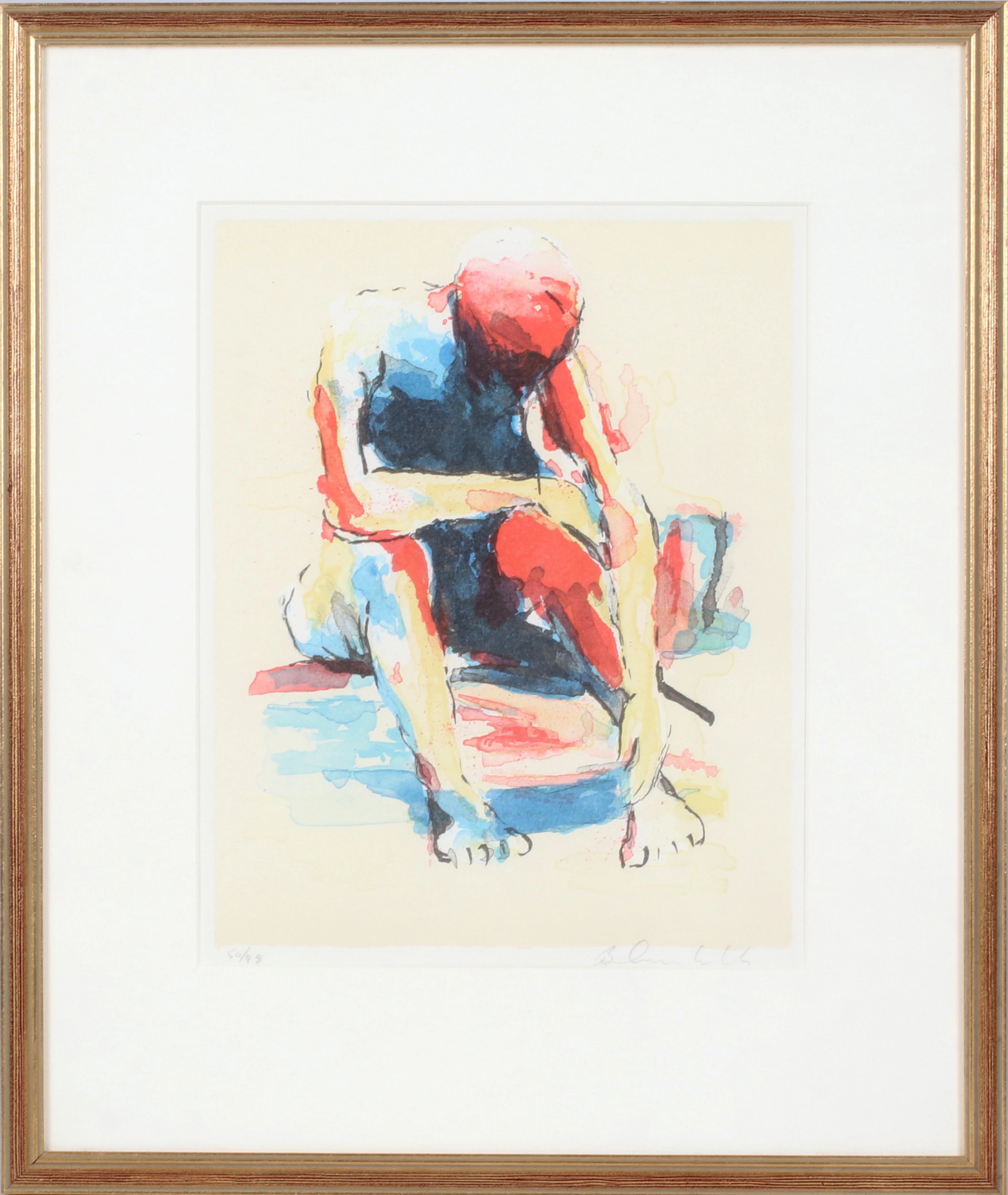
BJÖRN AUREBEKK. Sittande kvinna, litografi, signerad och numrerad 50/99.
10/06/2026
€26.78
Stima: €44.4