Late Roman/Early Byzantine Ceramic Oil lamp - 15 cm (No reserve price)
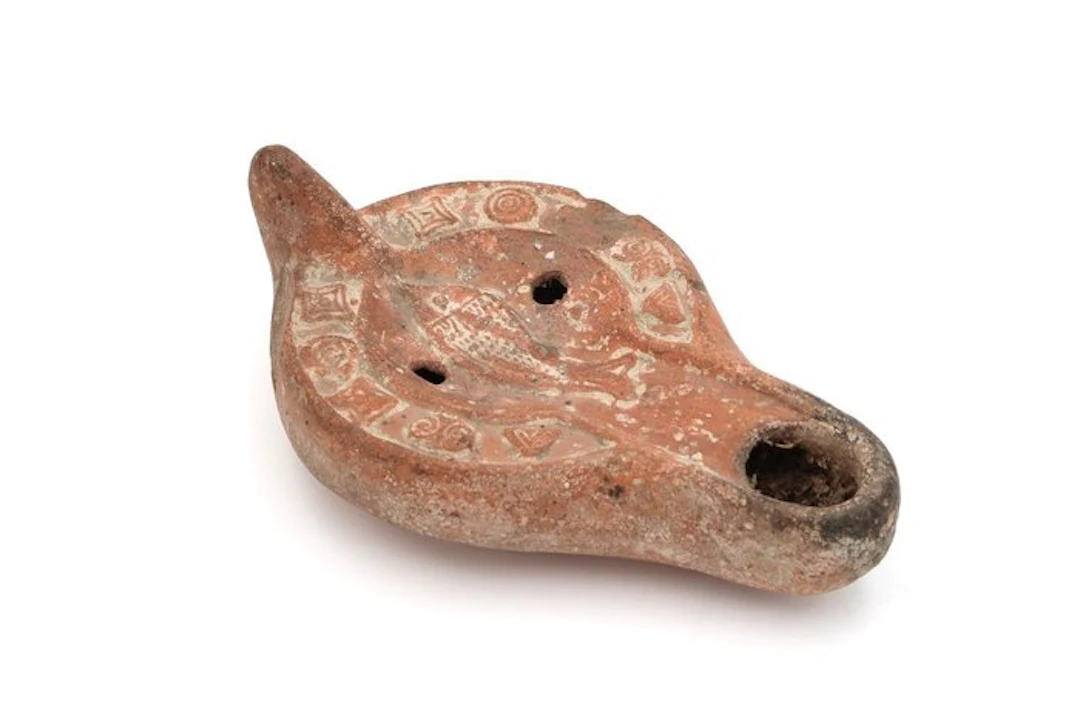
Oil lamp in sigillata ware, Romano-Byzantine period This oil lamp, 15 cm long, 9 cm wide and about 5 cm high, is molded in red-orange engobe terracotta, characteristic of the so-called African sigillata or its derivatives. It presents the almond- or tear-drop-shaped plan typical of Late Antique lamps: a slightly domed discoid body, equipped with a tubular spout thickened at its end, blackened by the use of the wick, and a handle or grip knob on the opposite side, intended to hold or place the lamp on a support. The decoration on the disk depicts a fish in relief, rendered with scales and fins in detail, enclosed in a circular frame punctuated by an outer band of geometric motifs repeated: concentric circles, spirals, finely hatch-marked diamonds, and triangles, forming a rhythmic and dense frieze. The base is concave, decorated with hollow concentric circles characteristic of turning inside the mold. This lamp belongs to the typological family of North African lamps from Late Antiquity, mass-produced between the 3rd and 7th centuries CE, especially in workshops of the province of Africa proconsularis, corresponding to present-day Tunisia and Algeria. African sigillata, with its red-orange paste and surface smoothed by a slip, enjoyed an extraordinary diffusion throughout the Mediterranean world of late Roman and Byzantine times, its products being exported as far as Gaul, Italy, Spain, and the Near East. Lamps of this type are classified by archaeologists according to John W. Hayes’s typology, particularly Hayes types I and II, which correspond to productions of the 4th–7th centuries. The fish depicted on the disk is one of the most common iconographic motifs on lamps of this period, and its interpretation is twofold. In a profane context, the fish is simply a common decorative motif, related to the nourishing Mediterranean. In a Christian context, which dominates the 4th–6th centuries, it takes on the christological symbol in reference to the Greek acronym IXΘYΣ, “fish,” whose letters stand for the formula “Jesus Christ, Son of God, Saviour,” making the fish one of the signs of recognition of the early Christians, used on lamps as well as on sarcophagi, rings, and tableware. This lamp, by its shape, its decoration and the quality of its paste, fits perfectly into North African Romano-Byzantine production of the 4th–5th centuries and constitutes a common yet precious material testimony to lighting practices and the diffusion of Christian iconography in the late antique Mediterranean world."
Stima:€375
Vai all’astaVedi tutti gli oggetti diCatawikioArte Antica