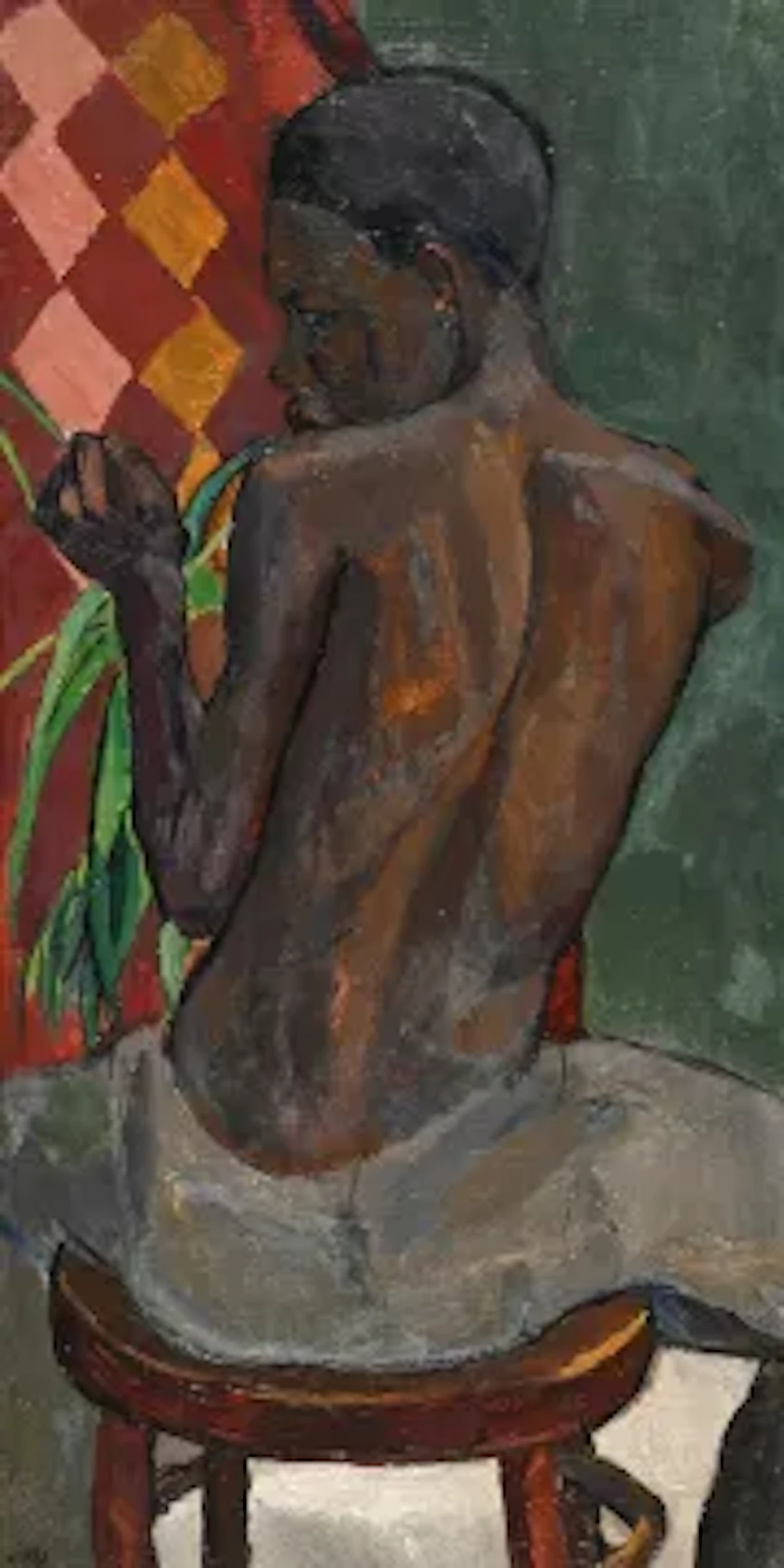
λ EDWARD WOLFE (BRITISH 1897-1982), "BASSOUTO BOY"
λ EDWARD WOLFE (BRITISH 1897-1982) "BASSOUTO BOY" Oil on board Signed (lower left) 67 x 33.5cm (26¼ x 13in.) Executed in 1920 Provenance: Private collection, Enslin du Plessis (1894-1978) Sale, Sotheby's, London, 1 October 1997, lot 196 Sale, Sotheby's, London, 5 September 2004, lot 141 Sale, Lot's Road Auctions, London, 5 September 2021, lot 372 Edward Wolfe moved to London from South Africa, during the First World War to study, initially at Regent’s Street Polytechnic and then at the Slade School of Art. Whilst at the Slade he met Nina Hamnett, who introduced him to Roger Fry. By 1917, he was invited to join the Omega Workshops, for whom he designed and painted furniture in a bold Fauvist palette. Wolfe was deeply influenced by the work of Matisse, Modigliani and Gauguin, absorbing their painterly style and vibrant palette. His work was characterised by bold colours and carefully observed, simplified forms, with a focus on everyday life and the people and landscapes he encountered. Wolfe was part of a group of artists who were inspired by European and particularly French modern art and became integral in the development of Modern British Art, helping to create a movement that transformed the wider European modernism into a distinctly British idiom. Throughout his life, Wolfe exhibited widely in both Britain and abroad. He exhibited at the London Group for the first time in 1918 and was subsequently elected a member of the group in 1923. He became a member of the Seven and Five Society, between 1926 and 1931. Wolfe’s first solo exhibition took place in Johannesburg in 1920 and in London (at the Mayor Gallery) in 1926. He exhibited at the Royal Academy between 1951 and 1970, was elected an Associate of the Royal Academy in 1967 and became a full member in 1972 at the age of 75. Wolfe travelled extensively, spending part of the 1920s in Paris and Italy and long periods in Mexico and North America, as well as back in his native South Africa. During the Second World War, he worked as a BBC censor. Wolfe met the artist and journalist Enslin du Plessis at the exhibition of Wolfe’s work at Leon Levson’s gallery in Johannesburg in 1920. Du Plessis served in the Middle East during World War I and acted as correspondent for various South African newspapers. He took up painting when he was in his 30s and exhibited in Britain from the late 1920s, exhibiting at several of the leading Mayfair Galleries of the period, including Goupil, Leicester Galleries and Roland Browse and Delbanco. Following the success of his 1920 exhibition and before he returned to London, Wolfe was invited to stay near the gold mines of Village Deep. The violinist Zelma Whitehouse and her husband lent Wolfe a house near the mine and he set up studio in an empty barracks in the mine workers' compound. As William Plomer stated, the resulting drawings from this visit captured ‘in a flowing line the shapely sadness and exiled vigour of naked black miners’ and as John Russell Taylor noted, in the process Wolfe found ‘a new strength and tension…he was fascinated by the heroic aspect of the miners, their physical beauty and dignity, as he was by the stark shapes of the nearby landscape, something which returned to haunt him for the rest of his life’ (John Russell Taylor, Edward Wolfe, Trefoil Books, 1986, p. 28). Condition Report Disclaimer, λ, λ EDWARD WOLFE (BRITISH 1897-1982) "BASSOUTO BOY" Oil on board Signed (lower left) 67 x 33.5cm (26¼ x 13in.) Executed in 1920 Provenance: Private collection, Enslin du Plessis (1894-1978) Sale, Sotheby's, London, 1 October 1997, lot 196 Sale, Sotheby's, London, 5 September 2004, lot 141 Sale, Lot's Road Auctions, London, 5 September 2021, lot 372 Edward Wolfe moved to London from South Africa, during the First World War to study, initially at Regent’s Street Polytechnic and then at the Slade School of Art. Whilst at the Slade he met Nina Hamnett, who introduced him to Roger Fry. By 1917, he was invited to join the Omega Workshops, for whom he designed and painted furniture in a bold Fauvist palette. Wolfe was deeply influenced by the work of Matisse, Modigliani and Gauguin, absorbing their painterly style and vibrant palette. His work was characterised by bold colours and carefully observed, simplified forms, with a focus on everyday life and the people and landscapes he encountered. Wolfe was part of a group of artists who were inspired by European and particularly French modern art and became integral in the development of Modern British Art, helping to create a movement that transformed the wider European modernism into a distinctly British idiom. Throughout his life, Wolfe exhibited widely in both Britain and abroad. He exhibited at the London Group for the first time in 1918 and was subsequently elected a member of the group in 1923. He became a member of the Seven and Five Society, between 1926 and 1931. Wolfe’s first solo exhibition took place in Johannesburg in 1920 and in London (at the Mayor Gallery) in 1926. He exhibited at the Royal Academy between 1951 and 1970, was elected an Associate of the Royal Academy in 1967 and became a full member in 1972 at the age of 75. Wolfe travelled extensively, spending part of the 1920s in Paris and Italy and long periods in Mexico and North America, as well as back in his native South Africa. During the Second World War, he worked as a BBC censor. Wolfe met the artist and journalist Enslin du Plessis at the exhibition of Wolfe’s work at Leon Levson’s gallery in Johannesburg in 1920. Du Plessis served in the Middle East during World War I and acted as correspondent for various South African newspapers. He took up painting when he was in his 30s and exhibited in Britain from the late 1920s, exhibiting at several of the leading Mayfair Galleries of the period, including Goupil, Leicester Galleries and Roland Browse and Delbanco. Following the success of his 1920 exhibition and before he returned to London, Wolfe was invited to stay near the gold mines of Village Deep. The violinist Zelma Whitehouse and her husband lent Wolfe a house near the mine and he set up studio in an empty barracks in the mine workers' compound. As William Plomer stated, the resulting drawings from this visit captured ‘in a flowing line the shapely sadness and exiled vigour of naked black miners’ and as John Russell Taylor noted, in the process Wolfe found ‘a new strength and tension…he was fascinated by the heroic aspect of the miners, their physical beauty and dignity, as he was by the stark shapes of the nearby landscape, something which returned to haunt him for the rest of his life’ (John Russell Taylor, Edward Wolfe, Trefoil Books, 1986, p. 28). EDWARD WOLFE (BRITISH 1897-1982), "BASSOUTO BOY", Provenance:, in a flowing line the shapely sadness and exiled vigour of naked black miners’, ‘a new strength and tension…he was fascinated by the heroic aspect of the miners, their physical beauty and dignity, as he was by the stark shapes of the nearby landscape, something which returned to haunt him for the rest of his life, Edward Wolfe, Condition Report Disclaimer
Stima:€8,159.17
Vai all’astaVedi tutti gli oggetti diDreweattsoArte, Pittura e Arti Grafiche