


Tutte le aste / Arte Antica / KIYOCHIKA • Famous Views of Tokyo • Sea at Ōmori •orig

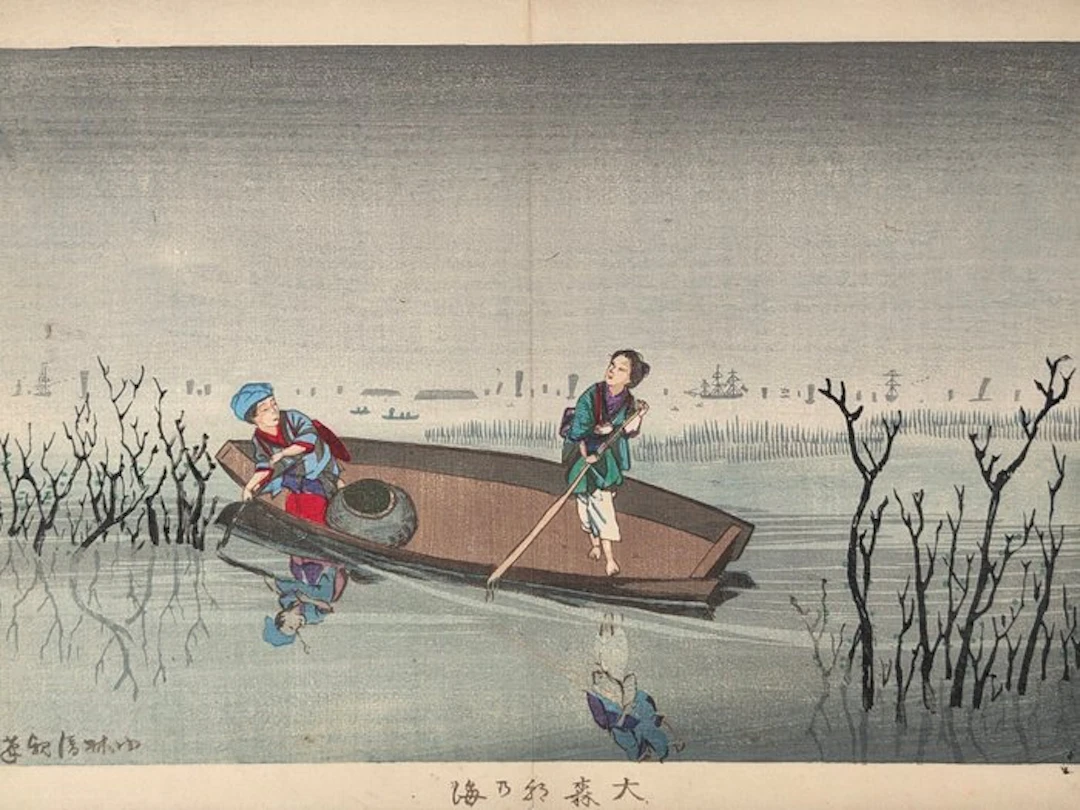
Artist: Kobayashi Kiyochika (小林清親, 1847–1915) Title: Ōmori Asa no Umi (大森朝乃海) — The Morning Sea at Ōmori; also catalogued as "Morning Sea at Ōmori" and "Sea and Seaweed at Ōmori" Series: Tōkyō Meisho Zu (東京名所図) — Famous Views of Tokyo, popularly called kōsen-ga (光線画) Date: Meiji 13 (1880), per the dated cartouche Publisher: Fukuda Kumajirō (福田熊次郎), Hasegawa-chō 9-banchi, Tokyo Technique: Woodblock print (mokuhanga), polychrome nishiki-e — Meiji ukiyo-e in the kōsen-ga manner Format: Ōban yoko-e (horizontal) — image approx. 23 × 34 cm (9 × 13½ in.), sheet with margins on all four sides Signature: Kobayashi Kiyochika hitsu (小林清親筆) in the lower left of the image; title in the bottom margin Marginal cartouche: Registration block at right: 御届 明治十三年 — publisher Fukuda Kumajirō of Hasegawa-chō, with the artist's own address given as Yonezawa-chō 2-chōme Condition Very good to excellent. This is a design that lives or dies on its printing, and the printing here is intact: the long bokashi gradation from the dark slate band at the top of the sheet down through the pale silver of the horizon is smooth and unbroken, and the woodgrain of the block reads clearly across the sky and water — evidence of careful hand-printing rather than heavy overinking. The small passages of colour that carry the whole composition remain fresh and unfaded: the teal-and-purple stripes of the poling woman's jacket, the cornflower headcloth and scarlet underskirt of her companion, the warm brown of the boat's hull, and the dark green of the gathered seaweed in the tub. The keyblock lines of the bare brushwood in the foreground are crisp and black. Paper The sheet is unbacked, firm, and retains margins on all four sides. There is a vertical fold at the centre, together with light overall toning and a small number of scattered dark specks, one of them in the sky at upper left. The centrefold is characteristic of the series: the horizontal ōban sheets of the Tōkyō Meisho Zu were routinely folded and bound into albums soon after publication, and its presence should be read as typical of surviving impressions rather than as damage. No tears, holes, losses, or repairs. The Scene — What the Black Branches Are The black, leafless branches standing in the water are not dead trees. They are hibi — brushwood stakes driven into the tidal shallows so that nori spores would settle and grow on them over the winter, to be picked off by hand at low tide. The regimented rows receding across the middle distance are the nori beds themselves, and the tub in the boat is filling with the harvest. Ōmori, on the western shore of Tokyo Bay, had been the centre of this industry since the early eighteenth century, and remained the largest producer in Japan for most of the Meiji period; the seaweed sold in Edo as asakusa-nori was in large part grown here. The beds are gone. In December 1962 the Ōmori fishing cooperative surrendered its rights ahead of the reclamation of the bay, the last harvest was taken in the spring of 1963, and roughly three centuries of cultivation ended. The wholesalers remain in Ōmori to this day, but nothing grows in that water now. Which is the quiet power of this sheet. Kiyochika went to Ōmori to paint light — the flat, colourless, faintly luminous light of a winter dawn over water, a problem no earlier ukiyo-e designer had seriously attempted — and in solving it he made the most exact surviving picture of a working landscape that no longer exists. The near-monochrome treatment is entirely deliberate: the whole sheet is graded grey but for the figures, the hull, and the green of the seaweed, so that the eye is pulled to the only warm objects in a cold morning. The Series — Where Ukiyo-e Meets the Age of Photography In 1876 Kiyochika began, with the publisher Matsuki Heikichi, an initially untitled project depicting the rapidly modernising capital in Western-derived perspective and naturalistic light. Over the following five years he produced seventeen designs for Matsuki and a further seventy-six for Fukuda Kumajirō, who took over primary production from 1878 — bringing the body of work now known as Tōkyō Meisho Zu to roughly ninety designs. This sheet, bearing Fukuda's publisher's block and dated Meiji 13 (1880), belongs to that second and larger phase. The series is remembered above all for its treatment of light: collectors and scholars call it kōsen-ga (光線画), "light-ray pictures," a term that captures Kiyochika's central innovation — replacing the flat colour fields and hard outlines of Edo landscape prints with graded atmospheric effects of dawn, dusk, gaslight, moonlight and rain, informed by his study of Western painting and by the new medium of photography then reshaping how Japanese artists looked at their own city. Where Hiroshige, a generation earlier, had organised Edo into stable and legible icons, Kiyochika's Tokyo is caught mid-transformation: the same riverbanks, ferries and tidal flats, but rendered as weather-bound moments rather than fixed views. Production ended abruptly in 1881, after fire destroyed Kiyochika's home and studio and, by most accounts, public appetite for his Westernised manner cooled. The work of those five years is now regarded as the artistic high point of Meiji landscape printmaking and the clearest bridge between the classical tradition and the shin-hanga revival that followed a generation later.
Stima:€900
Vai all’astaVedi tutti gli oggetti diCatawikioArte Antica
Stima:
€900
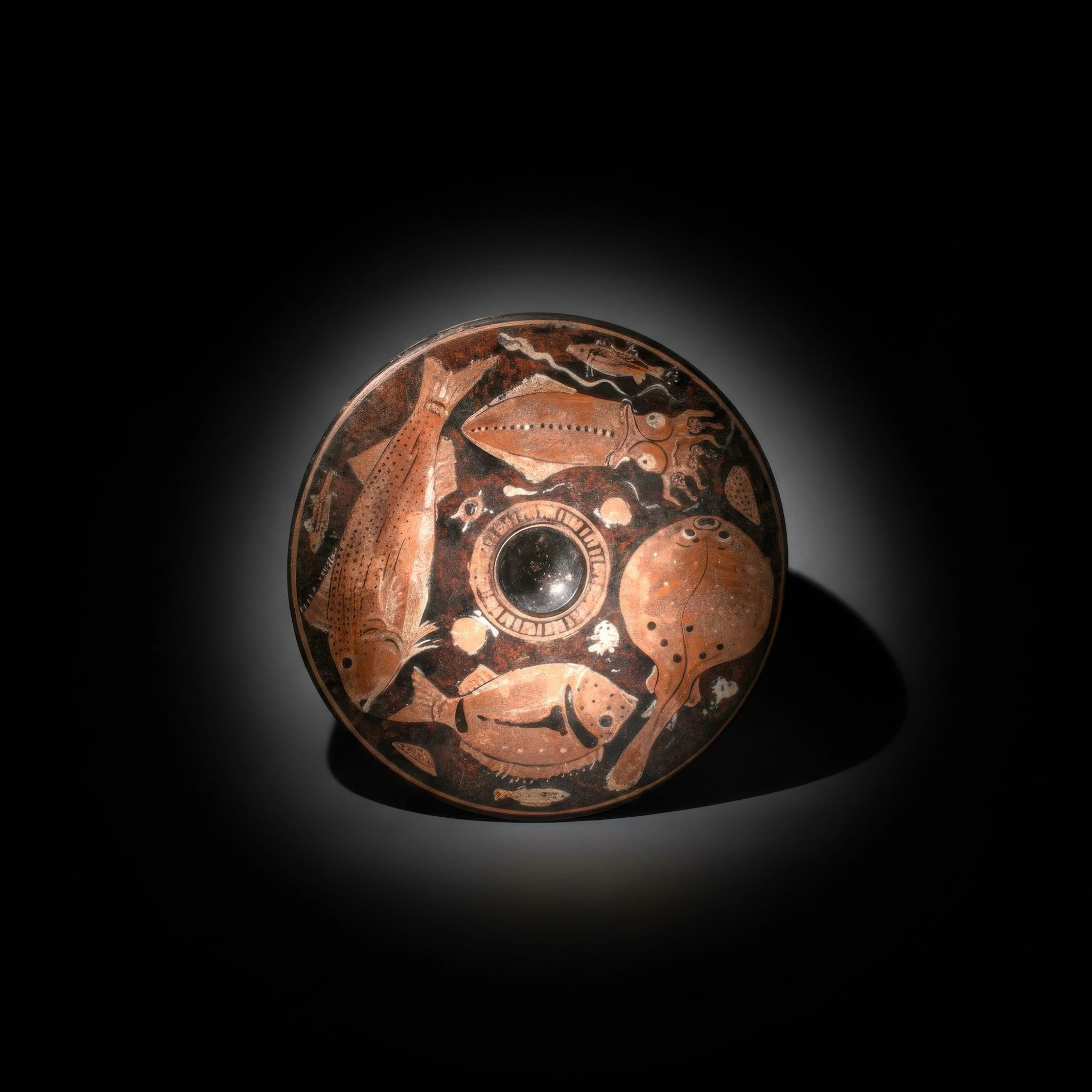
VERY RARE APULIAN RED-FIGURE FISH PLATE WITH 15 SEA CREATURES
06/21/2026

€23,187.64
Stima: €11,540.27
Porta la tua asta ai collezionisti di tutto il mondo!
Pubblica oraIscrivendoti, accetti la politica sulla privacy. Annulla l'iscrizione in qualsiasi momento.
Barnebys HQ
Brahegatan 10
BOX 5038
114 37 Stockholm
