


NOV 8 | 1:00 PM

Tutte le aste / Altro / Julien Van Langenhove (1920–1986) - Latemse


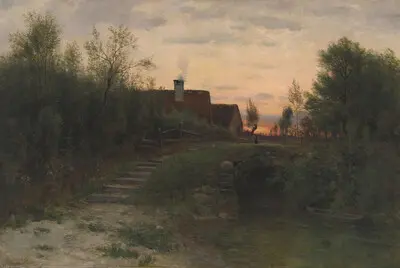
JULIEN VAN LANGENHOVE (1920–1986) LANDSCAPE Artist: Julien Van Langenhove Born: 1920, Ghent, Belgium Died: 1986, Sint-Martens-Latem, Belgium Nationality: Belgian Field: Painting Education: Academie te Dendermonde and Academie te Menen Teachers: F. Gogo, L. Spanoghe, Wallecan Movement / character of work: Belgian landscape painting of the 20th century; third generation of the Sint-Martens-Latem school, also referred to as the Latem school; romantic-realist painting with clear impressionist features, with emphasis on atmosphere, light, color, and painterly handling of the landscape Creation period: stylistically likely postwar period, around the 1940s–1950s Title: “Landscape” Technique: Oil on canvas Canvas dimensions: 55 × 70 cm Framed dimensions: about 75 × 90 cm Signature: “J. Van Langenhove” DESCRIPTION OF THE WORK The presented painting is a moodful landscape by the Belgian artist Julien Van Langenhove (1920–1986), belonging to the third generation of painters associated with the renowned Sint-Martens-Latem artistic milieu, one of the important centers of Belgian landscape painting in the 20th century. The painting depicts a vast, tranquil rural landscape, rendered with generous brushwork, a sense of space and atmosphere. The composition is built through broad, soft areas of color, subtle tonal transitions, rhythmic arrangement of landscape elements, and a commitment to natural light. To the right of the composition is an old stone church, crowned by a distinctive tower and cross. Its presence gives the landscape a clear Flemish character and provides a strong orienting focal point for the whole composition. To the left are farm buildings and houses with red tiled roofs. Between them and the church unfolds a peaceful rural landscape. In the central part of the composition flowers appear, and the space is organized further by a small fence traversing the landscape. The combination of old architecture, red roofs, greenery, flowers, fencing, and open space creates a characteristic scene of a Flemish village. It is not merely an topographical reproduction but a painterly vision of a calm, harmonious landscape. Particularly noteworthy is the painting technique. The surface of the work is developed with pronounced, relief-like impasto. The paint is applied decisively and spatially in places, so light reflects off the surface of the canvas, and individual parts of the landscape gain additional depth and materiality. Natural light, greenery, the red of roof tiles, subdued earth tones, and brighter accents create a harmonious atmosphere typical of Belgian landscape tradition linked to the Leie region and Sint-Martens-Latem. The work possesses clear decorative values, but its significance goes beyond mere decoration. It is representative of the area of creative activity with which Van Langenhove’s name is historically associated: the landscape of Flanders, rural scenes, the Leie river region, and the Sint-Martens-Latem landscape. The canvas format 55 × 70 cm allows the artist to develop the landscape space, and the total dimensions of the work with the decorative frame, about 75 × 90 cm, lend the piece a representative character while remaining well suited for display in a home, study, or private collection. AUTHOR AND POSITION IN THE LATEM SCHOOL Julien Van Langenhove was a Belgian painter primarily associated with Sint-Martens-Latem. He was born in Ghent in 1920 and died in Sint-Martens-Latem in 1986. In 1948 he settled in Sint-Martens-Latem, where he formed a permanent link with the local artistic milieu. Biographical sources describe him as a representative of the third generation of Latem painters. His main interest lay in landscape, especially Flemish countryside, the Leie region, rural scenes, villages, and city views. Van Langenhove’s work is described as romantic-realistic, with a strong emphasis on the atmosphere of the landscape and painterly treatment of nature. At the same time, his handling of light, color, and impasto gives many of his works a distinctly impressionist character. The presented painting fits well within this area of his oeuvre. The artist uses color, texture, and light to create a specific mood while remaining within the Flemish landscape tradition. Membership in the third generation of the Latem school is essential for interpreting the work, as its thematic character and method of building the landscape remain tied to the regional artistic tradition of the Leie. EDUCATION AND MASTERS Van Langenhove had formal artistic training. Until 1937 he studied at the Academie de Dendermonde, under F. Gogo and L. Spanoghe. Then, in 1937–1939, he continued at the Academie de Menen, under Wallecana. His educational path indicates he was not a self-taught artist but someone with regular academic training developing his craft under several teachers. POSTWAR PERIOD AND THE CHARACTER OF THE PRESENT LANDSCAPE The present work has no visible annual dating, but its execution, palette, composition, brushwork, and the depiction’s character place it stylistically in the postwar period, likely in the 1940s or 1950s. This is a particularly interesting period in Van Langenhove’s biography, because in 1948 the artist settled in Sint-Martens-Latem and permanently connected with the local artistic milieu. This type of landscape well aligns with his primary interest in the landscape of Flanders and the Leie region. It is not incidental in his oeuvre but a theme at the core of his artistic activity. The painting’s character, color scheme, treatment of architecture, greenery and flowers, and the clear impasto correspond to the Belgian postwar landscape painting tradition. Dating to the 1940s–1950s is a stylistic assessment rather than an absolute proven date. MONOGRAPHY AND HISTORICAL DOCUMENTATION A particular significance for assessing the artist’s position is that during his lifetime, in 1978, a separate monograph devoted to his work was published: Jos Murez, Julien Van Langenhove. Latemse landschapschilders. Monografie, 1978. The publication is noted in Belgian library catalogs, with Sint-Martens-Latem, Galerij Leie Latem listed as the place of publication. Bibliographic Belgian catalogs confirm the existence of this 1978 publication. The monograph contains black-and-white and color illustrations, confirming that Van Langenhove’s work was developed and documented during his lifetime, not only in contemporary times. EXHIBITIONS AND LATEM ENVIRONMENT Van Langenhove participated in the Sint-Martens-Latem artistic life. In 1978 his works were exhibited at the “Schilderijen rond ‘Het dorp’” show at Latemse Galerij, alongside works by other Latem-affiliated artists. His name remains part of the artistic history of Sint-Martens-Latem. In the 20th century the town became one of Belgium’s important artistic centers, and the tradition of Leie landscape painting became one of the recognizable elements of Belgian art history. Van Langenhove belongs to a later generation of this tradition, ensuring his oeuvre continues the region’s landscape artistry. JULIEN VAN LANGENHOVE AT THE ARTISTS’ CEMETERY OF SINT-MARTENS-LATEM Julien Van Langenhove rests in the new cemetery in Sint-Martens-Latem, a town with which he remained connected from 1948 until his death in 1986. The official municipal history lists his grave among those of artists tied to the local artistic tradition. Other graves at this cemetery include those of Richard Minne, Lieven Duvoisela, Firmin Van Hecke, Edgar Gevaert, Pol Van Assche, Miel Roosa, Carl De Cock, Jules De Sutter, Hubert Malfait, Herman Van den Abeele, Miele De Cauter, Maurice Schelcka, Chris Pots, Frans De Cauter, and Hendrik Caspeele. Old Latem cemetery houses the graves of, among others, George Minne and Albina Van den Abeele, while the Deurle cemetery includes the graves of Gust and Leon De Smet, Xavier De Cock, Jenny Montigny, and Albert Claeys. The official municipal history lists these sites as part of the heritage associated with the artistic history of Sint-Martens-Latem and Deurle. The artist’s resting place contributes an additional historical context to his biography, confirming his ties to the town whose artistic milieu played a significant role in the history of Belgian painting. ARTISTIC HERITAGE AND PLACE IN THE LATEM TRADITION The history of Sint-Martens-Latem shows that this town played a crucial role in the development of Belgian 20th-century painting. The activity of Latem-affiliated artists gave it a lasting place in Belgian art history. Julien Van Langenhove belongs to the generation that continued this tradition in the postwar period. His significance lies primarily in consistently developing landscape painting and keeping the living artistic tradition of the Leie region alive. In his work, landscape remains the central subject, and light, color and texture serve to build mood. The presented landscape well illustrates this approach to landscape painting. The old stone church with a tower and cross on the right, the traditional red-roofed houses on the left, the flowers in the center, and the distinctive fence guiding through the landscape—these elements form the image of Flanders. DOCUMENTATION IN MUSEUM AND INSTITUTIONAL RECORDS The name Julien Van Langenhove appears in documentation related to institutions involved in documenting Belgian art and the region’s artistic heritage of Leie, where the artist is listed as a Belgian visual artist born in 1920 and died in 1986. Biographical sources also note that his works are in various museum collections. At the same time, due to the lack of publicly accessible, unambiguous inventory numbers for a specific painting in a museum catalog, this description does not attribute the presented work to a specific museum without additional confirmation. This preserves the accuracy of the auction documentation. CONNECTION TO GHENT AND THE LEIE REGION Ghent occupies an important place in Van Langenhove’s biography because that is where the artist was born in 1920. His later activity in Sint-Martens-Latem directly places him in the artistic tradition of the Leie region, an area of exceptional significance for Belgian landscape painting in the 20th century. The connection of Ghent, the Leie, and Sint-Martens-Latem is also important for the present work. The landscape aligns with the artist’s principal interests. DEFINITIVE AUCTION MARKET EVIDENCE The name Julien Van Langenhove appears in the documentation of the international art market. Auction results for his works from various years have been recorded, including 1995, 2002, 2010, 2020, and 2026. Two specific Belgian market results provide useful references for assessing the artist’s market presence. 1. Julien Van Langenhove, “Bouquet fleuri” (still life with flowers) Auction house: Horta, Brussels, Belgium Auction date: March 24, 2026 Lot number: 498 Medium: Oil on canvas Dimensions: 100 × 80 cm Signature: “J. Van Langenhove” Auction result: €1,000 The flower bouquet painting was cataloged as an oil-on-canvas work signed by the artist. The €1,000 result provides a recent reference point for Van Langenhove’s market. Auction card: https://www.horta.be/default.asp?dayid=962&page_nbr=13&sCode=CATALOG-NL&sale=366 2. Julien Van Langenhove, “Bloemenstilleven” (still life with flowers) Auction house: Flanders Auctions, Belgium Auction date: June 19, 2024 Medium: Oil on canvas Canvas dimensions: 130 × 150 cm Framed dimensions: 157 × 178 cm Signature: upper right corner Auction estimate: €400–€600 Auction result: €450 The work depicts a still life with flowers. Its much larger format allows comparing it in size to the presented landscape, though the subjects and tones differ. The €450 result provides another reference point for the artist’s presence in the Belgian auction market. Auction card: https://www.flandersauctions.be/nl/product-detail/24877/ Both results confirm that Van Langenhove’s works appear on the professional auction market. The results concern different subjects and formats, so they should be treated as points of comparison rather than a direct price guarantee for the presented painting. SIGNIFICANCE OF THE PRESENT WORK The presented painting is noteworthy for its thematic alignment with the artist’s principal area of work: landscape and countryside of Sint-Martens-Latem and Flanders. Its documentary value is reinforced by: - signature “J. Van Langenhove”; - alignment of style and theme with documented areas of the artist’s oeuvre; - academic education of the author; - studied under F. Gogo, L. Spanoghe, and Wallecan; - belonging to the third generation of the Latem school; - long-standing connection with Sint-Martens-Latem; - birth in Ghent and later link to the Leie region; - monograph dedicated to the artist published in 1978; - documented exhibitions; - inclusion of the artist’s name in institutional documentation related to the Leie heritage; - burial site in Sint-Martens-Latem; - verified auction results, including “Bouquet fleuri” sold for €1,000 in 2026 and “Bloemenstilleven” for €450 in 2024; - thematic alignment with the artist’s core interest: the landscape of Flanders and the Leie region; - attractive format of 55 × 70 cm and about 75 × 90 cm with the frame; - romantic-realist treatment of the landscape with clear impressionist features; - relief impasto; - very good condition; - probable postwar stylistic dating. The work represents a representative example of 20th-century Belgian landscape painting, remaining within the artistic tradition of Sint-Martens-Latem and the Latem school. STYLE AND CHARACTER OF THE WORK The painting belongs to Belgian 20th-century landscape painting and remains linked to the Sint-Martens-Latem tradition. Julien Van Langenhove represented the third generation of this milieu, developing primarily a romantic-realist approach to portraying the landscape. At the same time, his handling of light, color, and texture gives his works a distinctly impressionist character. In this work, the painterly treatment of nature is especially evident. The artist does not limit himself to exact reproduction of every landscape element but uses color, light, soft tonal transitions, and decisive impasto to create a specific mood. Greenery, subdued colors, red roof tiles, stone church architecture, and brighter floral accents give the composition harmony. The relief-like texture of the paint enhances the painting’s materiality. The impasto areas create subtle light folds, giving the work added vitality when viewed up close. COLLECTORIAL AND DECORATIVE VALUE The present painting combines artistic, historical, and decorative values. The 55 × 70 cm format is sufficiently large for the landscape to retain its full impact, yet comfortable for private collection display. The approximately 75 × 90 cm size with the frame gives the work a more representative character and allows it to be displayed in a living room, library, study, or in a collection dedicated to Belgian art. The subject is notable as well: the old stone church with a tower and cross, traditional red-roofed houses, flowers, a fence, and a tranquil landscape form a characteristic image of Flanders. The work may be of interest both to a collector of Belgian painting and to a viewer seeking European landscape with strong decorative qualities. CONDITION The painting is in very good condition. No cracks, significant damage, or other major issues affecting the viewing of the work have been detected. The artist’s signature “J. Van Langenhove” has been preserved. The painting has a decorative frame suited to the work, further enhancing its representative character. SUMMARY “Landscape” by Julien Van Langenhove (1920–1986) is an attractive example of Belgian 20th-century landscape painting, linked to the Sint-Martens-Latem artistic tradition and the Leie region. The artist had formal academic training, studied in Dendermonde and Menen, and from 1948 was permanently associated with Sint-Martens-Latem. His work focused primarily on the landscape of Flanders, rural scenes, the Leie region, and the Sint-Martens-Latem landscape. Importantly, Van Langenhove’s work was documented in a separate monograph during his lifetime (1978). He participated in Latem exhibitions, and his name remains in institutional documentation related to the Leie heritage. An additional biographical element is his burial site. Julien Van Langenhove rests in the cemetery in Sint-Martens-Latem, a town tied to the history of Belgian landscape painting and to many artists of the Latem tradition. Presence on the auction market is confirmed by two results: the sale of “Bouquet fleuri” for €1,000 in Horta (March 2026) and “Bloemenstilleven” for €450 at Flanders Auctions (June 2024). The present painting offers an attractive format of 55 × 70 cm, a decorative frame about 75 × 90 cm, and the signature “J. Van Langenhove.” Its visual value is enhanced by an extended landscape composition: the old stone church with a tower and cross on the right, traditional houses with red roofs on the left, flowers in the center, and a distinctive fence leading through the landscape. The painting is in very good condition, with no visible cracks or major damages, and features a pronounced, relief-like impasto that highlights its painterly handling of the landscape. The work’s character, color palette, light, texture, and treatment of architecture and greenery are consistent with the artist’s main body of work. Given the lack of an annual date on the painting, its date is best regarded as a postwar stylistic guess, circa the 1940s–1950s. The piece combines decorative appeal with historical-artistic value stemming from the artist’s membership in the Latem generation, his academic training, ties to Sint-Martens-Latem, monographic documentation, and proven presence in the Belgian auction market. ⸻ FOOTNOTE UNDER THE PHOTOGRAPH Author: Julien Van Langenhove (1920–1986) Place and year of birth: Ghent, 1920 Place and year of death: Sint-Martens-Latem, 1986 Artistic affiliation: third generation of the Sint-Martens-Latem/Latem school Character of work: Belgian romantic-realistic landscape with clear impressionist features Title: “Landscape” Technique: Oil on canvas Canvas dimensions: 55 × 70 cm Framed dimensions: about 75 × 90 cm Signature: “J. Van Langenhove” Dating: stylistically likely postwar period, about the 1940s–1950s Condition: very good, no visible cracks or significant damages
Stima:€200
Vai all’astaStima:
€200


NOV 8 | 1:00 PM


Porta la tua asta ai collezionisti di tutto il mondo!
Pubblica oraIscrivendoti, accetti la politica sulla privacy. Annulla l'iscrizione in qualsiasi momento.
Barnebys HQ
Brahegatan 10
BOX 5038
114 37 Stockholm
