Hyakunin Isshu zukō kokura no nishiki' 百人一首図考 小倉のにしき...
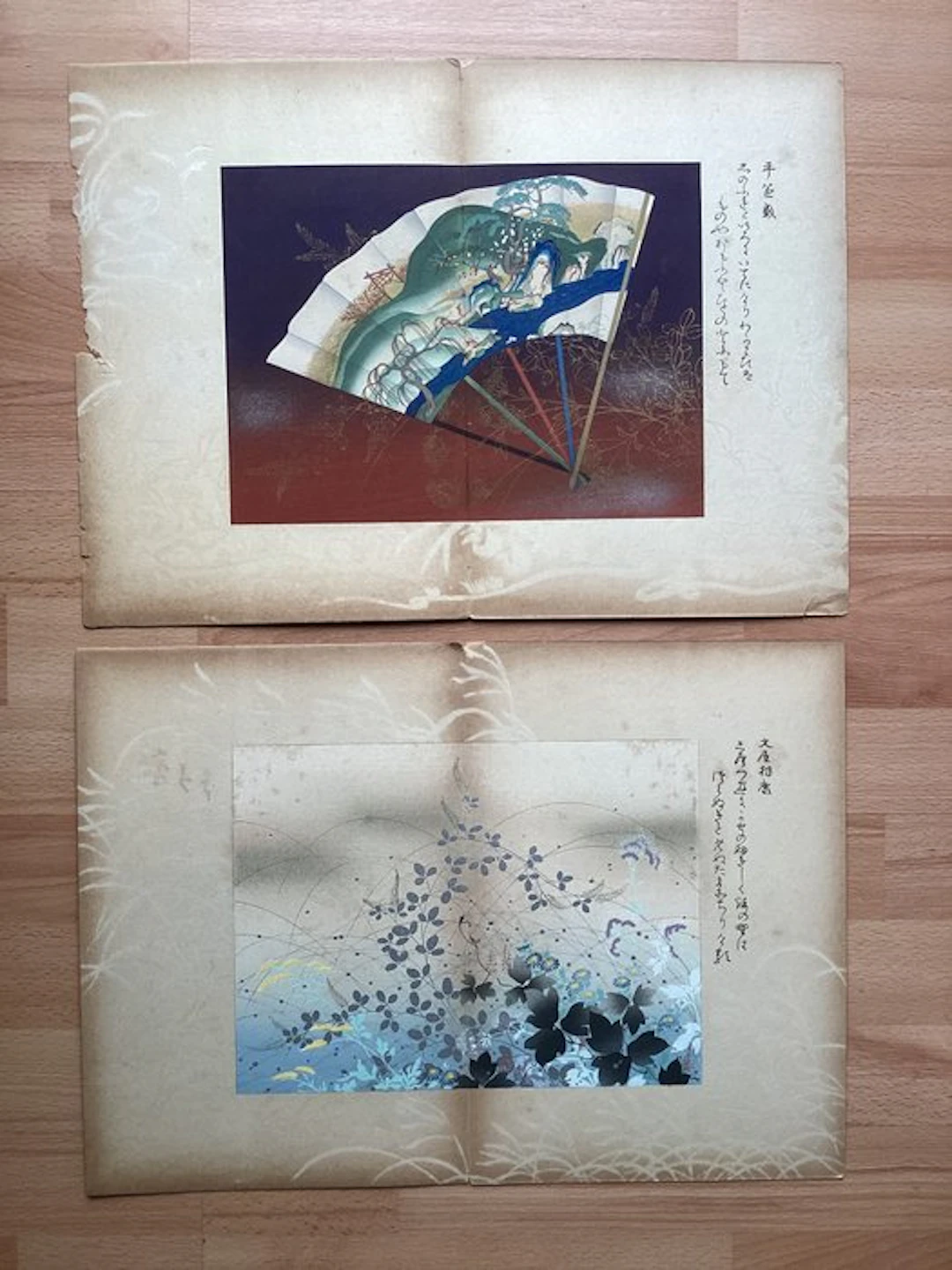
The first image shows an original woodblock print from the work titled *Hyakunin Isshu zukō ogura no nishiki* (百人一首図考 小倉のにしき), Volume 2. It was originally published in 1935 by the artist Shikō Iida (飯田始晃). The piece is notable for its refined traditional aesthetic: Central design: It features a meticulously decorated folding fan (*sensu*) painting illustrating a classic river landscape with pine and weeping willow trees set against bright green hills. Calligraphy: A poem written in traditional Japanese calligraphy appears to the right of the fan. Composition: The fan rests against a gradient background transitioning from deep purple to reddish-brown, framed by textured *washi* paper with aged edges and subtle, embossed floral motifs. The stylized calligraphy on the right belongs to the famous classical anthology *Ogura Hyakunin Isshu* (小倉百人一首), a compilation of the one hundred most beautiful poems in Japanese court literature. This specific page is dedicated to Poem Number 25. Key details regarding its text and meaning are: Author and Text Identification Author: Sanjō no Udaijin (三条右大臣)—the official title held by Fujiwara no Sadakata (873–932), a prominent noble of the imperial court during the Heian period. Title at the top: Reads *Tegoshi no tawafe* (or *Tegoshi no tawabure*), referring to a lyrical scene or pastime associated with the historic locale of Tegoshi. The original poem is written in the classical *waka* format (a 5-7-5-7-7 syllable structure) using an elegant courtly cursive script known as *kana* or *onnade* ("woman's hand"): *Na ni shi ohaba* / *Ahuzaka-yama no* / *Sane-kazura* / *Hito ni shirarede* / *Kuru yoshi mogana* Meaning and Symbolism of the Poem The poem is an ingenious declaration of secret love, rich in literary wordplay (*kakekotoba*): "If you are true to your name—oh, *sane-kazura* vine of the Mountain of Meeting (Mt. Ōsaka)—how I wish there were a way to coil you up and draw you to me, coming secretly without anyone knowing." The central wordplay: The author employs the *sane-kazura* plant (a vine native to Japan). The word *sane* sounds exactly like the word for "sleeping together" (*sane*), while *kuru* signifies both "coiling the vine" and "coming/drawing near" (*kuru*). Mount Ōsaka: It is not merely a physical location; In Heian poetry, Ahuzaka (Ōsaka) literally means "the mountain of the meeting" (a meeting between two lovers). The message: The poet expresses a fervent desire for his beloved to come secretly to meet him at night, intertwining with one another as discreetly and covertly as the roots and vines on the mountainside. The fan painting accompanying the text illustrates this natural setting in an abstract manner, reflecting the flow of the river and the mountain vegetation where the lovers long to meet. The second work is a Japanese print in a traditional style (linked to artistic movements such as Rinpa or Nihonga), characterized by its delicate depiction of autumn grasses and flowers (*akigusa*). Analysis of Visual Content and Style—Composition and Elements: The image displays dense wild foliage featuring blue and purple flowers (reminiscent of gentians or bellflowers), dark foreground leaves, golden stalks of grasses (such as *susuki* or pampas grass), and fine, curved lines in the background that suggest flowing water, strands of dew, or the autumn wind. The tonal transition moves from a deep blue at the bottom to a misty gray background. Calligraphy and Poetry: On the right side, a poem appears in fluid cursive calligraphy (*sosho*), preceded by the author's name or the name of the place of composition (reading "文雇初齋" or a similar signature associated with an art studio). Integrating poetry (*waka* or *haiku*) to evoke the melancholy of the changing seasons is a common practice in Japanese art. Medium: The work is executed in a fold-out book or album format (*oriho*); the beige outer paper features a subtle pattern of water waves or clouds—either embossed or printed with silver dust—framing the central landscape. The text calligraphed on the artwork is a renowned classical Japanese poem (*waka*) by Funʼya no Asayasu (文屋朝康), who was active in the late 9th century during the Heian period. This piece is poem number 37 from the celebrated imperial anthology *Hyakunin Isshu* (百人一首, "One Hundred Poems by One Hundred Poets"). Original Japanese Text (Modern characters): 白露に 風の吹きしく 秋の野は つらぬきとめぬ 玉ぞ散りける. Romaji Reading: *Shiratsuyu ni / kaze no fukishiku / aki no no wa / tsuranuki tomenu / tama zo chirikeru*. Spanish Translation: Upon the white dew / the wind blows ceaselessly; / in the autumn field, / like unstrung pearls, / the droplets scatter! Explanation of the Poem and Its Relationship to the Painting: The author employs a traditional Japanese poetic device (*mitate*)—a form of visual metaphor—comparing dew drops to precious jewels or pearls. The poem describes an autumn morning where a strong, steady wind stirs the wild grasses. As it blows, it sends the glistening dew drops gathered on the foliage flying into the air. The poet imagines the wind acting in a destructive yet beautiful way, breaking the "invisible threads" that held these natural pearls together and causing them to scatter chaotically. This beautiful literary image perfectly complements the album painting, which meticulously depicts autumn plants (*akigusa*) interwoven with fine, arched lines representing gusts of wind and the dynamism of the approaching winter season. Both illustrations are enhanced with metallic inks (gold and silver). Works with some foxing (see the photos). Second-hand. Please refer to the provided photographs for a better understanding of the item´s condition. Provenance: The seller can certify that the lot was legally purchased Shipping method: registered mail, securely packaged. All items are shipped 12/24 hours after payment is made. Import duties, taxes and charges are not included in the item price or shipping charges. These charges are the buyer´s responsibility. Please check with your country´s customs office to determine what these additional costs will be before bidding.
Stima:€1
Vai all’astaVedi tutti gli oggetti diCatawikioArte Antica