Giovanni Boldini (1842-1931) - Rari croquis - note di...
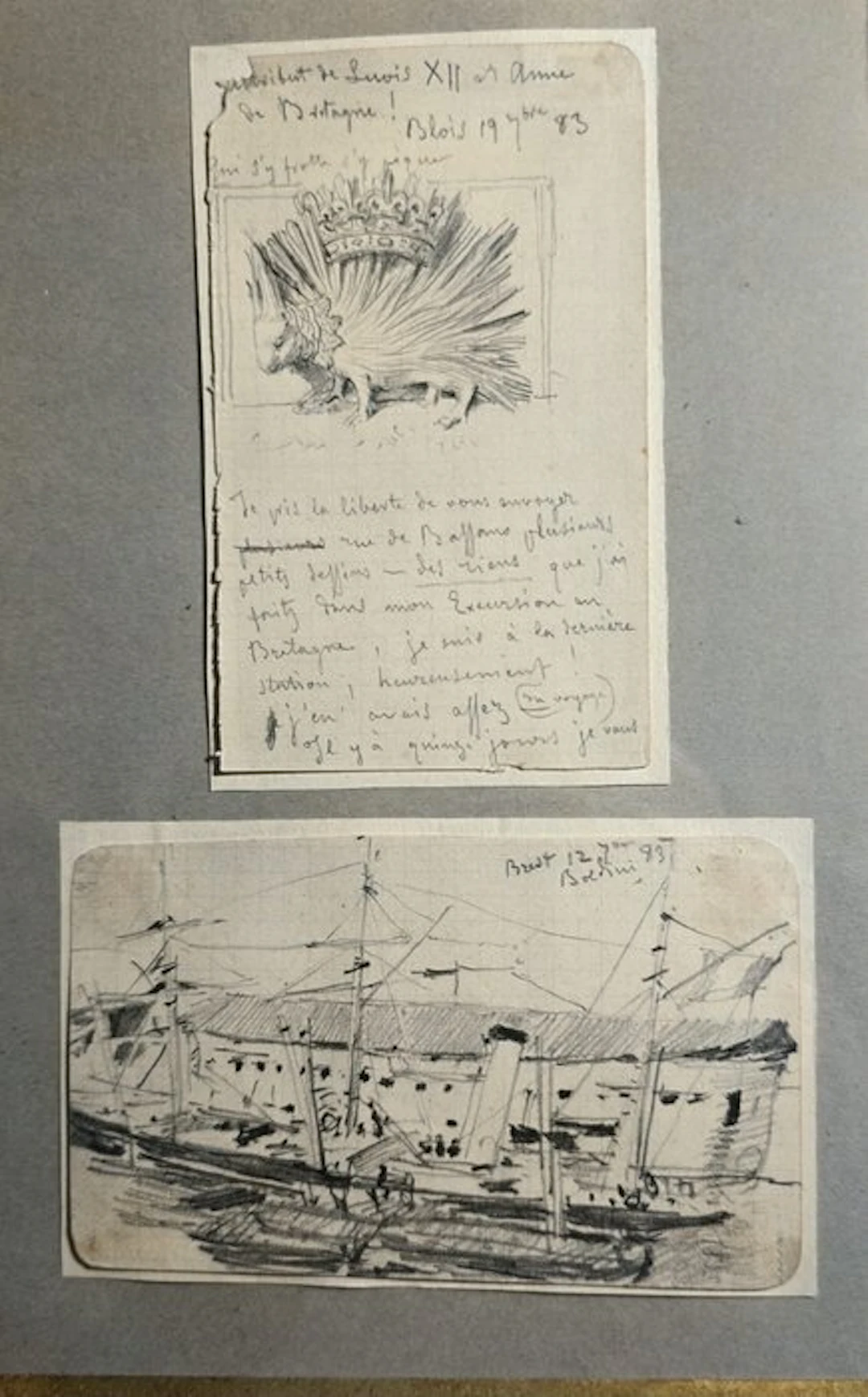
Extremely rare and beautiful two pencil drawings on squared paper from the travel notebook of the artist of one of the most important Italian artists of the second half of the nineteenth century: Giovanni Boldini. The sizes of the two works are: Top drawing: 7 x 11.30 cm. Bottom drawing: 6.8 x 11.50 cm. External dimensions with frame: 37 x 45 cm. The two works will be shipped with their frame and by tracked and insured shipping with precise and careful packaging. Boldini is considered the most important Italian painter of the late 19th century, together with Giuseppe De Nittis, Telemaco Signorini and Federico Zandomeneghi. Boldini was the leading exponent of Italian Impressionism together with Giuseppe Nittis and the most important interpreter of the graphic and artistic language of the Belle Époque. Known as the “Master of the Swish” for his fast, dynamic, vibrant brushstrokes, the Ferrarese painter immortalized both women from his private life and the most prominent figures of international high society, turning them into eternal icons of style. Boldini is regarded as the most important portraitist of the upper bourgeoisie and aristocracy, known for his sabre-like brushwork and the luminous chromatic effect and the speed achieved with oil brushstrokes on canvas or chromatic play in his watercolors, using neutral and dark colors. His favorite models he often painted included Lina Cavalieri, Berthe, Contessa Gabrielle de Rastye, the Spanish dancer, and Marchesa Luisa Casati. Boldini initially joined the Macchiaioli group alongside Giovanni Fattori, Vincenzo Cabianca, Telemaco Signorini, Odoardo Borrani, Cristiano Banti and others. However, the artist later left the group after a short time and joined the Impressionist movement that originated in France with Claude Monet and Jean Frédéric Bazille, and this movement spread in Europe, including Italy. Giovanni Boldini befriended Giuseppe de Nittis and the composer Giuseppe Verdi. In Paris, during his travels, he met French painters such as Edgar Degas, Toulouse-Lautrec and Pierre-Auguste Renoir. The sketches drawn by the artist in his travel notebooks are very rare because only a few examples remain in private collections, due to their size, as they were often lost over time or because the artist produced only a few of these sketches drawn on squared paper and then written in the form of a letter, signed and dated by himself. These two rare sheets are drawings by Giovanni Boldini from his travel notebooks during the period when he was in France. *Period* Both works are dated 1883. Boldini lived in Paris since 1871 and was already a successful portraitist of the Belle Époque. In those years he traveled often between Paris, the French Riviera, Biarritz and Normandy for commissions and for leisure. The rapid handwriting, the squared paper and the informal tone of the note are typical of his travel notes from that period. An important hint: Boldini writes “On envoie un dessin à Biarritz.” Biarritz was one of the places most frequented by the high society he portrayed between 1898 and 1905. *Detailed description* The sheet is a squared notebook page, yellowed, mounted on gray cardboard. *1. The written part - at the top* It is a quick note in French: > “On envoie un dessin à Biarritz – veuillez me dire si vous l’avez reçu. > mes meilleurs compliments > Boldini” Translation: “A drawing is sent to Biarritz – please tell me if you have received it. My best regards. Boldini” The signature is flowy, typical of him. The tone is courteous but brisk, from an artist who follows the shipments of his works. *2. The drawing - in the center* It is a pencil portrait, very quick and gestural, of Louis XII, King of France. - *Head and crown*: he wears a very elaborate royal crown and beneath it the title Louis XII. The figure has long hair spilling out at the sides, thin mustaches, and a stern, frontal gaze. - *Bust*: it is only hinted at. You can see the shoulders and a collar with what appear to be 3 lilies/pendants, symbols of the kings of France. - *Style*: nervous, incisive stroke, with few lines. No chiaroscuro. Boldini does not seek historical precision but captures the “character” of the figure. It is a study from memory or copied from a sculpture he had seen in a museum/trip. *3. The writing below* Under the bust it clearly says: “Louis XII.” Confirming that the subject is Louis XII, king of France from 1498 to 1515, called “the Father of the People.” *What this sheet tells us* It is a perfect example of Boldini’s method: he fuses social life with historical/artistic notes. During his travels he noted commissions, addresses, and in the meantime sketched what he saw in museums or at monuments. Here he probably saw a statue or a portrait of Louis XII at the Louvre or in a Loire castle and quickly noted it in the notebook, between a letter and another. One is a sketch of a harbor landscape in Brest, the other pays homage to King Louis XII and Anne of Brittany. Analysis of the two works: the artist wants to convey character, decisiveness and authority through these two quick yet elaborate pencil sketches of a porcupine with a crown, the portrait of Louis XII and the view of the port of Brest, creating the impression that the sea in the harbor is rough and that the sailing boats move near the shipyard. The artist wants to demonstrate all his talent and drawing abilities through his speed of execution and also showing great execution skills in drawing small subjects rendered so well on small supports such as these two small notebook sheets, further enriched by his notes written during his trip to Brest and Blois.
Stima:€3,300
Vai all’astaVedi tutti gli oggetti diCatawikioAltro