








Tutte le aste / Etnografia / Gilded wooden eagle finial sculpture, Italy, 17th century

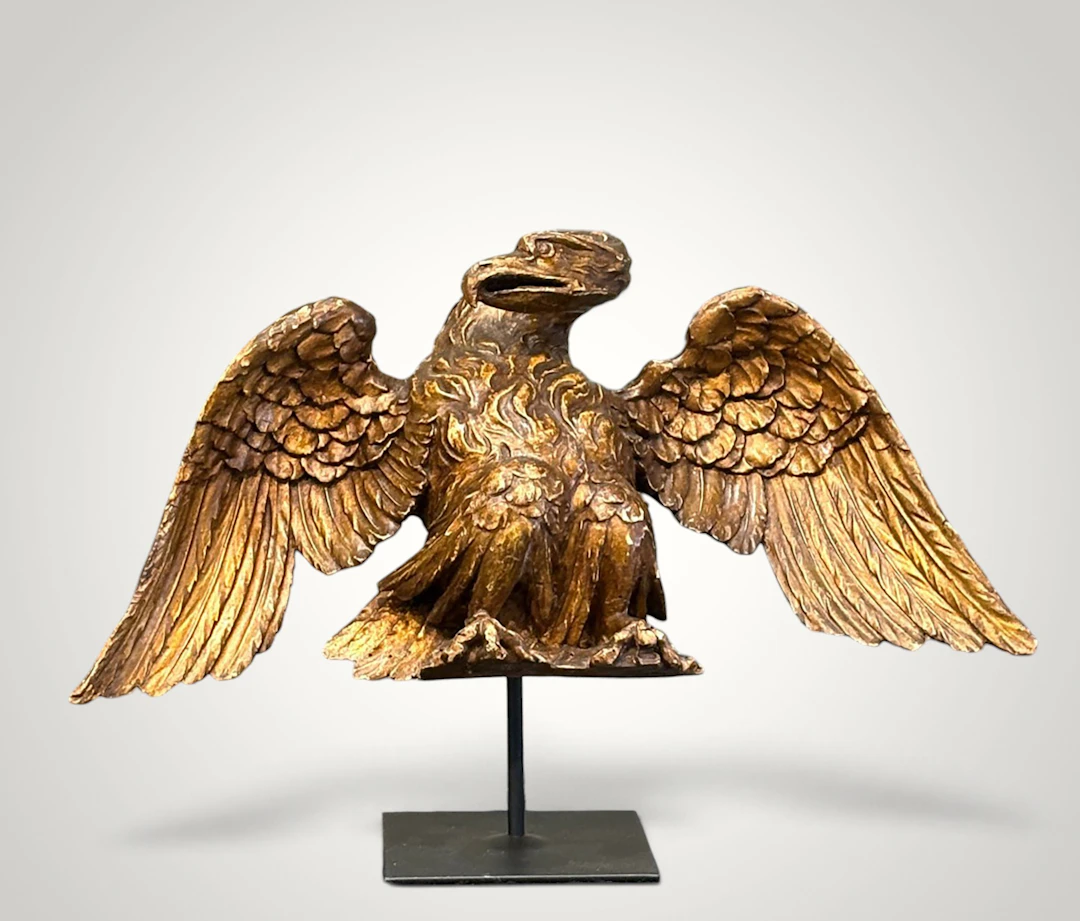
Descriptio Carved, polychromed, and gilded wood. Dimensions: 45 × 20 cm. This ornamental sculptural finial depicts an eagle with outstretched wings, conceived following the decorative models of 17th-century European Baroque. The figure presents a frontal composition of marked symmetry, with the body positioned vertically, the head turned to its left, and the wings widely spread on either side, creating a monumental silhouette of great expressive power. The bird is depicted with its beak slightly open, prominent eyes, and a powerful body structure, elements that accentuate its majestic and symbolic character. The meticulous treatment of the wings deserves special attention; their feathers are arranged in different overlapping registers, with deeply incised carving that distinguishes the coverts from the long flight feathers, creating a remarkable effect of volume and movement. The breast features ornamentation of undulating forms and stylized plumage, while the lower body is composed of broad, carved tufts that converge toward an irregular base, possibly corresponding to its original mounting system. The surface retains a gilded decoration in warm tones, with chromatic variations and wear that reveal the richness of the sculptural work and the ornamental character of the piece. From an iconographic perspective, the eagle is one of the most representative symbols of power, authority, and victory, associated since antiquity with the god Jupiter and later incorporated into European imperial, monarchical, and noble heraldry. In the Christian tradition, the eagle is also identified with Saint John the Evangelist, one of the four symbols of the Tetramorph, so this type of representation could have been part of either a secular decorative ensemble or a piece of liturgical furnishings. The arrangement of the wings, the expressive treatment of the head, and the richness of the carving find parallels in 17th-century Italian, Spanish, and Central European Baroque ornamental sculpture, especially in altarpiece finials, architectural crowning elements, heraldic shields, and ceremonial furnishings. Its formal language can be related, as a general stylistic reference, to the Baroque carving tradition developed in the workshops of Alonso Cano (Granada, 1601–1667) and Pedro de Mena (Granada, 1628–Málaga, 1688), due to the emphasis on sculptural modeling and the decorative effects of the surfaces, although these comparisons do not imply a direct attribution nor allow for the establishment of a specific geographical origin. The work exhibits wear to the gilding, minor losses of material, surface irregularities, and signs of aging, particularly visible at the wing tips and the lower part of the body, visually consistent with an antique ornamental piece.Although its chronology and state of conservation must be confirmed by direct examination, it is presented on a modern dark metal display stand, consisting of a vertical rod and a rectangular base, which allows the sculpture to be appreciated independently. Due to its compositional and iconographic characteristics, it constitutes an interesting example of the use of the eagle as an ornamental and symbolic motif within the European Baroque sculptural repertoire, standing out for the breadth of its wings, the richness of the plumage treatment, and the expressiveness of its formal conception. Lot in international warehouse (within the EU). Intra-EU shipping: no import duties apply within the EU. An export permit from the country of origin may be required.
Stima:€600
Vai all’astaVedi tutti gli oggetti diTemplum Fine Art AuctionsoEtnografia
Stima:
€600

DYKARHJÄLM, C. A Lindqvist, Stockholm, omkring sekelskiftet 1900.
10/19/2026
€3,100.92
Stima: €1,797.14
Porta la tua asta ai collezionisti di tutto il mondo!
Pubblica oraIscrivendoti, accetti la politica sulla privacy. Annulla l'iscrizione in qualsiasi momento.
Barnebys HQ
Brahegatan 10
BOX 5038
114 37 Stockholm
