Georgius Jacobus Johannes van Os (XVIII-XIX Follower)...
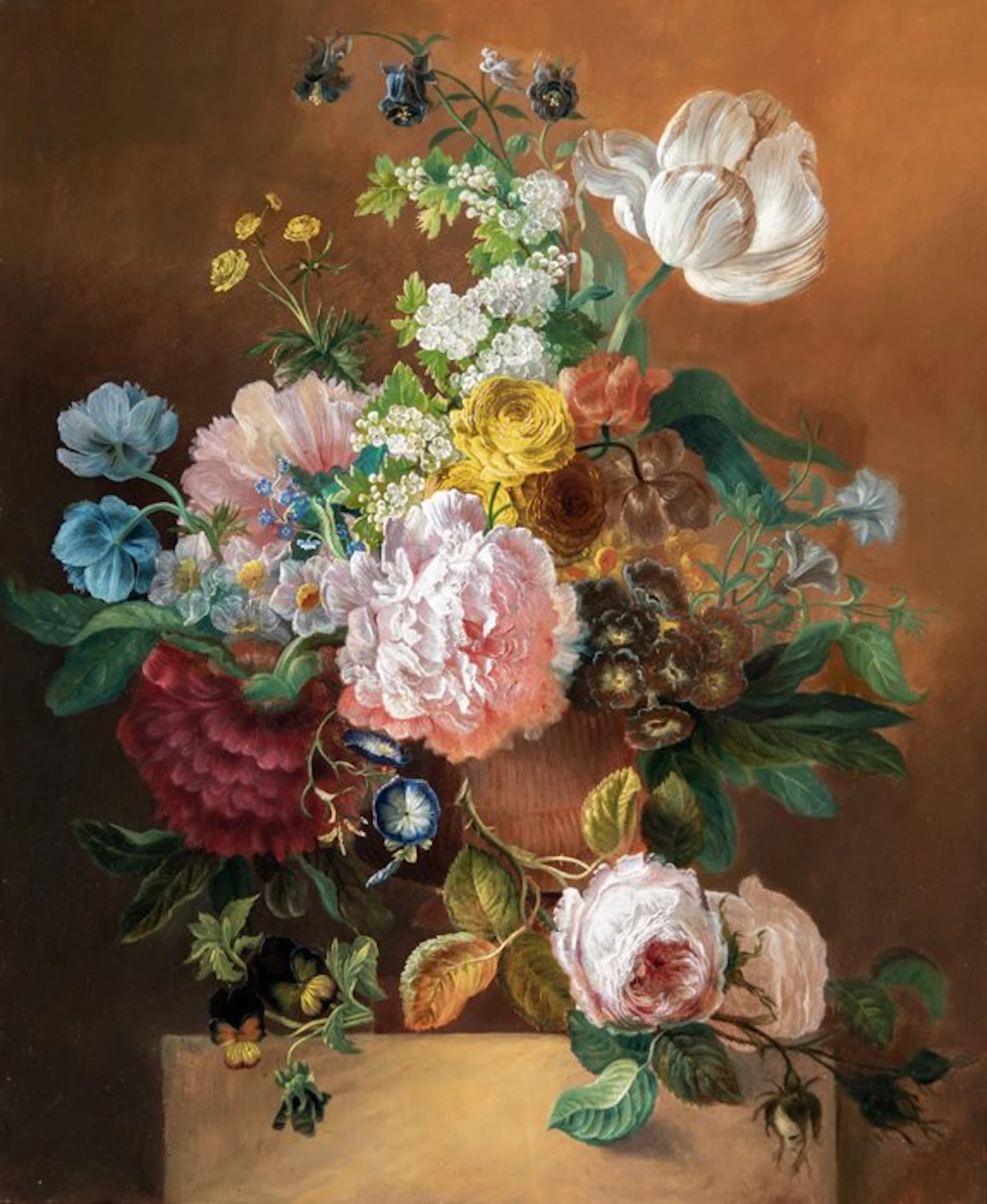
Description: XVIII–XIX follower of Georgius Jacobus Johannes van Os (1782–1861) Dating: eighteenth–nineteenth century Title: Still life with flowers Medium and technique: oil on canvas Dimensions of painting: 62.5 × 52 cm Dimensions with frame: 83.5 × 73 cm Signature: carries the signature ‘P. Faes’; the signature and the work are not regarded as an authentic work by Pieter Faes Provenance: Den Haag Vendu, 1999; Korendijk Auction House, 2026, sold as attributed to Pieter Faes (1750–1814) Documentation: RKDimages Lite, registration number 427439, registered under Peter Faes Frame: gilded museum frame with profiled and richly ornamented surround Artist Pieter Faes, also listed as Peter or Peeter Faes, was born in 1750 in Meer near Hoogstraten and died in 1814 in Antwerp. He was a Southern Dutch painter who specialized in floral and fruit still lifes. Faes studied at the Antwerp academy and worked within the late eighteenth-century Antwerp tradition of the decorative floral piece. His signed and dated oeuvre comprises meticulously arranged bouquets in which individual flower species are arranged against a dark background. In 1788 he was among the founders of the Antwerp Konstmaatschappij, an artists’ association that organized exhibitions and promoted exchange among artists. Faes’s floral still lifes align with the eighteenth-century tradition of Jan van Huysum and with the works of Antwerp- and Paris-active floral painters such as Jan Frans Eliaerts and Jan Frans van Dael. Characteristic are the constructed arrangement of the bouquet, the separate elaboration of flowers and fruits, and the combination of botanical recognizability with a decorative composition. An authentic painting by Faes is not determined solely on subject matter or signature. Also essential are the painting technique, material construction, dating, and coherence with his documented oeuvre. Georgius Jacobus Johannes van Os was born in 1782 in The Hague and died in 1861 in Paris. He was a Dutch flower and landscape painter and was trained by his father, Jan van Os, who was also known as a painter of flower and fruit still lifes. Van Os continued a family tradition of still-life painting. He worked in Amsterdam, Paris, and Haarlem and became best known for flower pieces and botanically oriented scenes. In his flower still lifes, Van Os combined a precise differentiation of flower species with a controlled composition and clear modeling of petals, leaves, and stems. His work sits at the transitional point between the late eighteenth-century tradition of floral still life and nineteenth-century Romantic painting. In addition to paintings, he produced botanical illustrations. He supplied drawings for Flora Batava and was connected in Paris to the Sèvres porcelain factory, where his knowledge of floral motifs was also applied. The current designation of the painting as the work of a follower of Georgius Jacobus Johannes van Os refers to the formal and stylistic alignment with this tradition. It does not attribute the work to Van Os himself. The signature ‘P. Faes’, the older auction description attributing to Pieter Faes, and the RKD registration under Peter Faes are part of the documentary and attribution history of the object. The signature and the painting are not regarded as authentic works by Faes. Object description The painting shows a large bouquet in a reddish-brown vase, placed on a rectangular, light-colored stone plinth. The floral arrangement almost fills the entire picture plane and is depicted against a brownish-red background with no further spatial or architectural indications. In the center lies a large pink bloom with strongly folded petals. Around it are yellow, red, blue, white, and dark brown flowers grouped. A large white tulip rises above the bouquet in the upper right. The petals of that tulip are modeled with long, curved brushstrokes. To the left of the tulip a few dark, bell-shaped flowers protrude above the other vegetation. Thin stems with small yellow blossoms fill the open space on the upper left. Grapes of small white blossoms rise from the center and connect the compact central flower group with the higher flowers. On the left are several blue flowers and a large dark red flower, partly surrounded by broad green leaves. Between the larger flowers are small blue blossoms, violets, buds and finer leaf forms. To the right of the center is a group of dark flowers with pale centers. Behind them long narrow green leaves and thin, curved stems spread to the right. A rose branch runs diagonally from the middle section toward the lower right. Two pink roses rest partly on the plinth, while a few buds and leaves hang over the edge. At the bottom are violets and downward-facing flower buds. The reddish-brown vase is largely hidden by the flowers and leaves. The visible portion has a rounded form and is modeled with vertical and curved brushstrokes. The vase sits centered on the plinth, which, because of its light color, provides a clear horizontal termination of the presentation. Technique and material analysis The subject is executed in oil on canvas. The background is relatively smooth and laid in broad. Locally broad, intermingling brushstrokes are still recognizable. The transition from dark brown on the left to a warmer, lighter brown tone on the right supports the delineation of the flowers without suggesting a concrete space. The flowers are built up with alternating opaque and more transparent paint. In the large pink and white flowers, individual brushstrokes follow the curve and direction of the petals. Light paint is applied in raised strokes in places. This is especially evident in the white edges of the central pink flower, the large tulip, and the small white blossoms. The yellow flowers are built up from concentric, short brushstrokes that indicate the successive petals. In the dark flowers, brown, red, and almost black tones are combined with lighter accents around the centers. The blue flowers contain radially placed strokes that run from the center toward the edges. The leaves are mainly built up in green fields. Lighter and darker strokes give veins, rolled edges, and shadows. Thin stems, tendrils, and twigs are painted linearly. The painting style thus alternates between broader modeling in the background and leaves and finer, more descriptive touches in flowers, blossoms, and stems. In several dark and mid-tone passages there is fine craquelé. The canvas is doubled. This doublure forms a later reinforcement of the original support. Also the present retouchings belong to a later restoration phase. Composition and form analysis The composition is organized around a vertical main axis that runs from the vase through the central pink flower and the white blossom sprays to the higher flowers. The central structure is interrupted by several lateral movements. To the left the blue and dark red flowers widen the bouquet. To the right the large white tulip, the spreading leaves and the hanging rose branch create an asymmetrical expansion. The greatest visual weight lies in the middle and the lower half of the scene. Here large flowers, leaves, and stems overlap to form a compact mass. Upward, the arrangement becomes more open. The individual stems and flowers stand relatively free against the even background. The white tulip forms the highest and lightest discrete accent. Depth is achieved mainly through overlapping, scale differences, and tonal contrasts. The central flowers lie in front of the vase, while smaller flowers and leaves partially disappear behind other motifs. The stems pass through different layers of the picture and connect the separate flower groups. There is no fully developed linear perspective; the space remains shallow and subordinate to the presentation of the bouquet. The plinth provides a stable horizontal base against the vertical development of the bouquet. The rose branch hanging over the edge links the vertical order with the foreground. The placement of loose buds, violets and leaves at the bottom prevents a sharp separation between bouquet and support. The color structure is based on a green and brown-red underlying harmony, interrupted by white, pink, yellow, and blue accents. White and pink dominate the center and the upper right corner. Yellow concentrates around the middle. Blue flowers lie mainly to the left and below the center. Dark red and almost black flowers connect the lighter areas with the background. Rhythm arises from the alternation of large round flower forms, small spray blossoms, and long leaves. Repetitions of curved stems and petals placed on top of one another guide the eye through the bouquet. The work combines a densely packed core with distinct, clearly defined flowers at the edges. Stylistic and art-historical context The work belongs to the tradition of the arranged floral still life as continued in the Netherlands in the eighteenth and nineteenth centuries. This tradition includes the isolated presentation of a composed bouquet, the dark neutral background, the stone plinth, and the separate description of flower and leaf forms. The flowers are not depicted as a casually picked or naturally grown bouquet. The combination of species, the distribution of colors, and the varied directions of bloom indicate a constructed pictorial order. Large flowers determine the main structure, while smaller blossoms, buds, stems, and leaves fill the interstices. The stylistic positioning within Romanticism rests on the emphasis on a richly composed arrangement, pronounced color contrasts, and the decorative amplification of individual flowers. At the same time, the work remains connected to the older Dutch and Flemish floral still-life tradition through the dark background, the stone plinth, and the attention to individually recognizable flower types. The relationship to Pieter Faes lies in subject matter, compositional form, and historical signature and attribution. Faes worked in the late eighteenth-century Antwerp tradition of floral and fruit still lifes. The presence of a signature with his name is, however, insufficient to attribute the work to him. The painting technique and object status support the current cataloging as a non-authentic Faes work. The relationship to Georgius Jacobus Johannes van Os lies in the continuation of the floral still life in the early nineteenth century. The clear isolation of the flowers, the vertical construction of the bouquet, the light accents on the petals, and the combination of botanical description with decorative ordering align with the tradition in which Van Os worked. The designation ‘follower’ indicates that these formal features have been adopted or continued without attributing the painting to Van Os himself. Comparable artists Jan van Os, Gerard van Spaendonck, Willem van Leen, Eelke Jelles Eelkema, Jan Frans van Dael, Johann Baptist Drechsler Condition The canvas is doubled. Retouchings are present in the paint layer. Fine craquelé is locally visible, especially in dark and uniformly painted areas. The surface shows differences between the smoother treated background and the more accentuated floral parts. The painting is housed in a broad gilded museum frame with profiled edges and relief ornaments. Conclusion Still life with flowers is an oil-on-canvas floral still life from the eighteenth or nineteenth century. The work belongs to the Dutch and Flemish tradition of the arranged floral piece and is stylistically placed within its Romantic continuation. The painting bears the signature ‘P. Faes’ and was linked in 1999 to Den Haag Vendu and in 2026 to Korendijk Auction House with Pieter Faes. It is also registered in RKDimages Lite under Peter Faes with number 427439. However, the signature and the painting are not regarded as authentic works by Faes. The current cataloging as a work by a follower of Georgius Jacobus Johannes van Os rests on the formal alignment with the nineteenth-century floral still-life tradition in which Van Os worked. This designation does not constitute an attribution to Van Os himself. The material condition is affected by a doublure, retouchings, and local craquelé. The work "Still life with Flowers" is housed in a gilded museum wooden frame with plaster ornaments Total dimensions: 83.5 × 73 cm. Medium dimensions: 62.5 × 52 cm Free Shipping The customer is responsible for any import duties and additional costs that may apply to deliveries abroad. Shipping artworks always involves certain risks. Although shipping is possible, we recommend collecting the artwork in person when this option is available. If shipping is chosen, it is entirely at the buyer’s risk. Picking up provides the certainty that the work is received undamaged and in optimal condition. After purchase you can easily schedule an appointment to collect the artwork at our workshop and studio, where it is safely and carefully prepared for you. Transport Quote request via our website (Service-transport) or via Catawiki support When purchasing this artwork, you have the option to have it delivered with or without the frame. The frame, richly decorated and matching the work, is offered free of charge so you can hang the painting immediately. While we take utmost care to ensure professional packaging and shipping, there is a small risk of damage to the frame or glass during transport. Any damage to the frame or glass that does not affect the artwork itself is not accepted as a valid reason for a claim or cancellation. We recommend collecting the work or arranging your own transport, as damage to the frame, especially the plaster ornaments, will not be compensated. We strive to deliver your artwork safely and in optimal condition, paying careful attention to packaging and shipping procedures. If you have questions or special requests, you can always contact Catawiki customer service. From the moment your purchase is confirmed, we treat each shipment as a unique project. Each painting is carefully packaged with high-quality professional shipping materials, and we select the most suitable carrier based on destination, transit time, and handling requirements. We monitor each package closely until delivery is completed. Because no two artworks are the same, we often create tailor-made, hand-crafted shipping crates or boxes that are tailored to the size, frame, and fragility of the painting, as well as the distance and transport conditions to your address. This guarantees the best possible protection throughout the journey. To support a smooth international shipping process, we prepare the correct papers and shipping documentation, including customs codes and export-related information if necessary. In some cases we proactively contact you to confirm that your package has arrived safely, that the painting is in good condition, and to answer any questions you have. We typically call the phone number provided to Catawiki, and the call will be in English. If preferred, you can also reach us by e-mail or via the Catawiki chat.
Stima:€4,000
Vai all’astaVedi tutti gli oggetti diCatawikioAltro