Frans Helfferich (1871–1941) - In gedachten verzonken - NO RESERVE
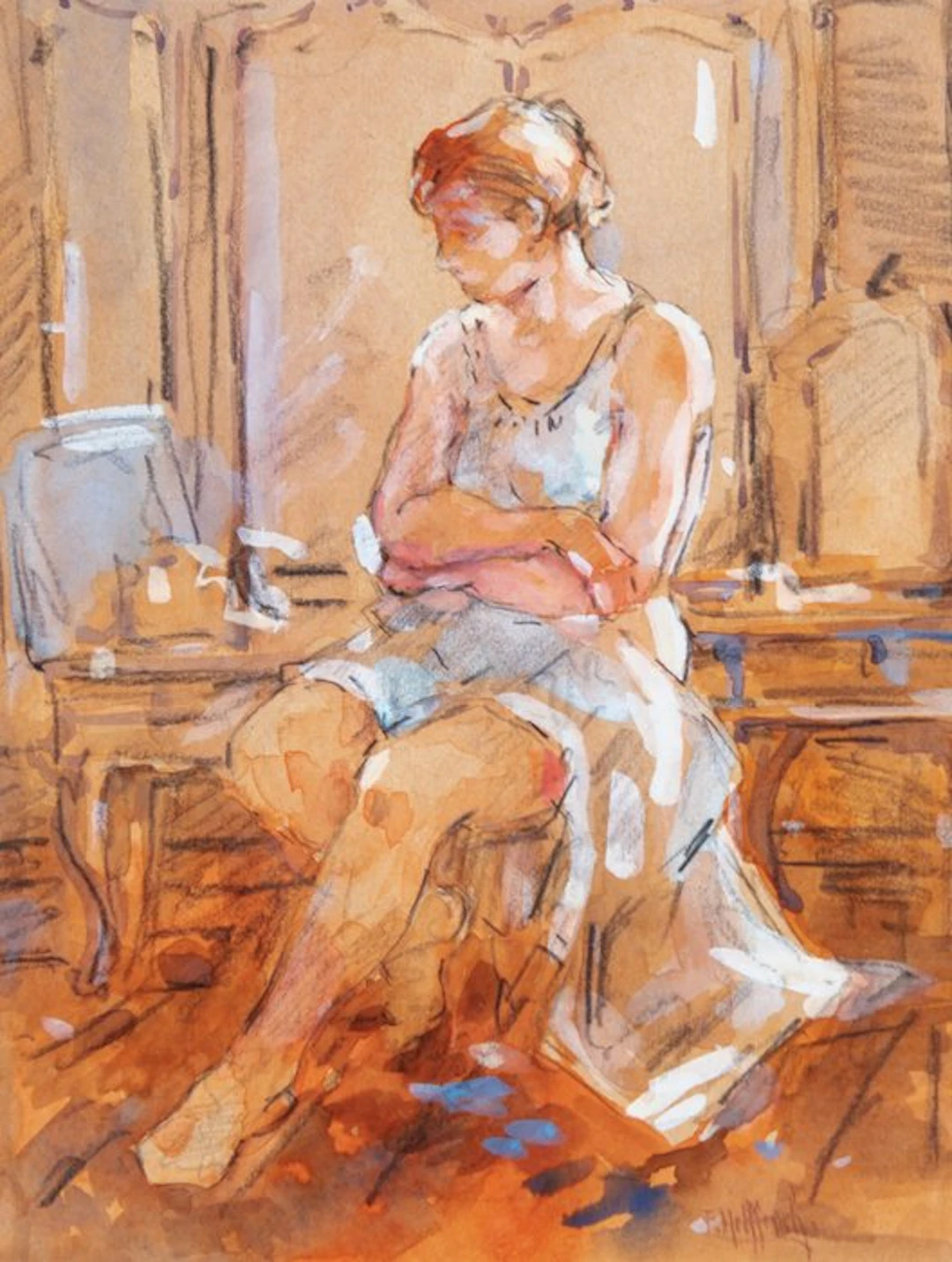
Artist: Frans Helfferich (1871–1941) Title: Lost in Thought Medium: mixed technique, gouache and pencil/charcoal on paper Dimensions: sight size 26.5 × 22.5 cm; with frame 52.5 × 45.5 cm Signature: hand-signed bottom right Provenance: Dutch private collection Franciscus Willem ‘Frans’ Helfferich was born in 1871 in The Hague and died there in 1941. He studied at the Royal Academy of Art in The Hague and was a member of the Haagse Kunstkring. His oeuvre developed from the tradition of the Hague School toward a looser, impressionistic treatment of landscape, urban life, and figure subjects. A seated woman forms the central motif of the composition. She is placed almost frontally, but tilts her head to the left and downward. The arms are crossed over the chest. This closed posture and downward gaze determine the intimate character of the work. The face is only sketched out; a few reddish-brown, pink, and gray tones structure the facial area and the cloth tied around the head. The figure wears a light blouse and a full skirt. Around the shoulders, arms, and clothing there are white and light-blue accents, while skin tones are predominantly built up from warm ocher, pink, and vermilion hues. The woman is set in an interior that is indicated with a limited number of lines and color planes. To the left stands a large light-gray vessel or ceramic object on a piece of furniture. Behind and to the right of the figure, wall surfaces, furniture, and vertical interior elements are only sketched. The signature is in the bottom right, drawn in a thin reddish-brown line that aligns with the drawing-like handling of the subject. Technique and material analysis The work is executed on paper using a combination of drawing materials and opaque paint. Pencil or charcoal lines do not serve solely as preparatory contours but remain as an independent pictorial medium; they determine, among other things, the body outline, folds of the clothing, the chair, furniture elements, and architectural lines of the interior. Color is applied in relatively thin, locally transparent layers. More opaque gouache accents lie over it. Especially the white areas on the head, shoulder, clothing, and interior function as direct light touches. Small saturated blue, red-purple, and vermilion accents are placed next to and over the warmer undertones without extensive modeling. The painting technique remains flat and direct; there is no paste-like buildup. The locally exposed warm paper tone visible through the paint is an integral part of the color composition. Composition and formal analysis The composition is vertically organized around the seated figure, placed slightly to the right of the center axis. The head, torso, and crossed arms form a compact upper mass, while the legs and the outward-spreading skirt create a broader triangular structure. Vertical lines of the interior stabilize the composition. In contrast, the diagonals of the forearms, legs, and clothing folds create dynamic movement. The space is not constructed through precise linear perspective but arises from the overlapping of figure, chair, furniture, and background planes. The background remains subordinate to the figure motif. The color structure is governed by ocher, siena, and vermilion. Cool light-blue and gray-white areas interrupt this warm tonal range, especially around the upper body and in the skirt. The strongest color accents appear low in the composition, where a few blue and blue-purple touches are placed opposite the vermilion plane. Stylistic and art-historical context The combination of a distinctly present drawing line, loosely applied color planes, and direct, lightly worked modeling aligns with Helfferich’s impressionistic method. The work is not built from the atmospheric tonality associated with the earlier Hague School, but from color contrasts and a rapid capture of figure, light, and interior. A characteristic feature is that contour and color do not fully coincide. The dark drawing lines regularly remain visible next to the painted form, while white gouache touches mark the light rather than gradually modeling it. This gives the sheet the character of an autonomous, spontaneously executed figure study, where immediate visual impression is more important than detailed furnishings or precise spatial development. Comparable artists Floris Arntzenius, Isaac Israëls, George Hendrik Breitner, Édouard Vuillard, Pierre Bonnard Condition The work is behind glass in a mat and presented in a wooden frame with a bronze-gold finish. No deviations or retouches have been detected. In the visible image zone there are no significant losses of paint, tears, or pronounced distortions of the support. The fine drawing lines and the light and saturated gouache accents are clearly legible. Conclusion Lost in Thought can be placed within Helfferich’s Hague School and impressionist context as a figure study in which drawing line and freely applied color touches together determine the form. The warm ground tone, sparing cool accents, and the minimal handling of the interior concentrate attention on the seated figure. The work is in a stable-looking state and is protectively presented behind glass and matting. The work "Lost in Thought" sits in a brown wooden frame with bronze-gold finish behind glass in a mat. Total dimensions: 52.5 x 45.5 cm Visible medium dimensions: 26.5 x 22.5 cm All shipping in professional packaging via FedEx, DPD, or PostNL. For all shipments a surcharge for packaging materials applies, which is already included in the stated shipping price. The customer is responsible for any customs duties and additional costs that may apply when delivering abroad. Shipping works always carry certain risks. Although shipping is possible, we recommend picking up the artwork personally when this option is available. If shipping is chosen, it is entirely at the buyer’s risk. Collecting ensures that the work is received undamaged and in optimal condition. After purchase, an appointment can easily be scheduled to collect the artwork at our workshop and studio, where it will be prepared safely and carefully for you. Transport quote request via our website (Service-transport) or via Catawiki support When purchasing this artwork you can choose to have it delivered with or without a frame. The frame, richly decorated and fitting the work, is offered free of charge so that you can hang the painting immediately. While we take utmost care with professional packaging and shipping, there is a small risk of damage to the frame or glass during transport. Any damage to the frame or glass that does not affect the artwork itself is not accepted as valid grounds for a claim or cancellation. We advise you to pick up the work or arrange your own transport, as damage to the frame, especially the plaster ornaments, will not be compensated. We strive to deliver your artwork safely and in optimal condition, paying careful attention to packaging and shipping procedures. If you have questions or special requests, you can always contact Catawiki customer service. From the moment your purchase is confirmed, we treat every shipment as an individual project. Each painting is carefully packaged with high-quality, professional shipping materials, and we select the most suitable carrier based on destination, transit time, and handling requirements. We monitor every package closely until delivery is completed. Because no two artworks are the same, we often create customized, handmade shipping containers or boxes tailored to the size, frame, and fragility of the painting, as well as the distance and transport conditions to your address. This guarantees the best possible protection throughout the journey. To support a smooth international shipping process, we prepare the correct paperwork and shipping documentation, including customs codes and export-related information if needed. In some cases, we proactively contact you to confirm that your package has arrived safely, that the painting is in good condition, and to answer any questions you may have. We usually call the phone number provided to Catawiki, and the call will be in English. If desired, you can also reach us by email or through the Catawiki chat.
Stima:€600
Vai all’astaVedi tutti gli oggetti diCatawikioAltro