Domenico Fedeli
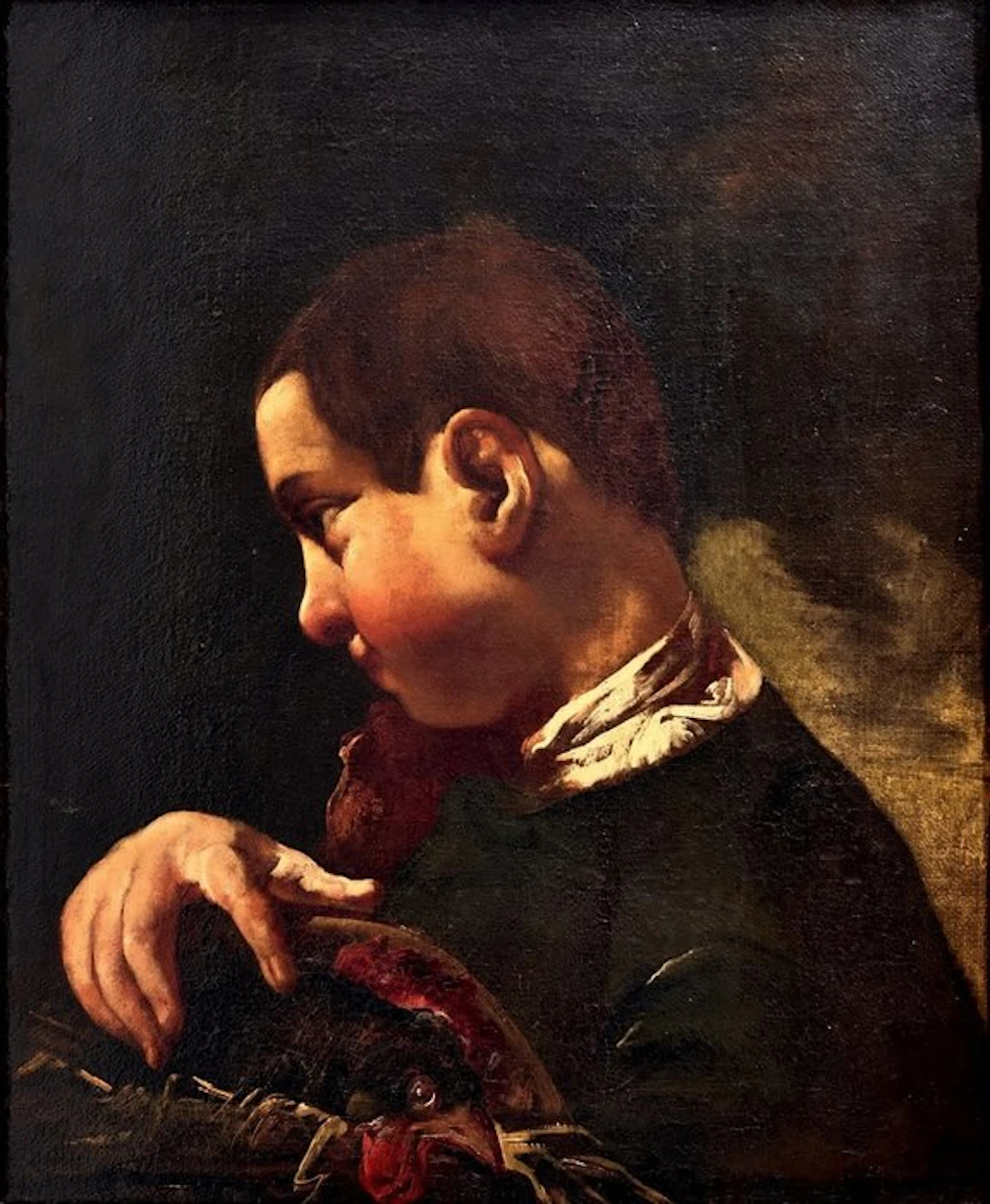
Domenico Fedeli, called the Maggiotto (also attestated as Magiotto or Majotto; Venice, 1712 – Venice, April 16, 1794) “Young with a Rooster” datable between 1740 and 1750 Oil on canvas Description of the work The painting depicts a young man half-length, in profile to the left, captured in a moment of focused concentration. The head is slightly bowed and the gaze is directed at the rooster, on which the hand rests with a measured gesture. The composition is built through a decisive chiaroscuro relationship: the figure emerges from a dark brown-black indistinct background, while a warm, concentrated light strikes the forehead, the profile of the face, the cheek, the ear, the collar and the hand. The face is modeled through gradual transitions from shadow to light. The full cheek, the sharply defined nose and the lowered eye give the protagonist an absorbed, intimate character. The hand constitutes the second major luminous focal point of the composition and introduces, together with the presence of the animal, a narrative component typical of genre painting. The palette is restrained and dominated by browns, earth tones, blacks and deep reds, enlivened by the illuminated areas of the flesh and by the white of the collar. Historical-artistic framing The work fits within the Venetian painting culture of the mid-18th century and shows characteristics coherent with the production of Domenico Fedeli called the Maggiotto, a painter trained in the studio of Giovanni Battista Piazzetta. Biographical documentation confirms the long relationship with Piazzetta and identifies in Maggiotto’s early maturity, between 1740 and 1754, a phase of faithful adherence to the master’s lexicon, with particular attention to half-figures, genre subjects and concentrated chiaroscuro. In this phase Maggiotto assimilates the Piazzetta-like plasticity of figures, the emergence of flesh tones from dark grounds, and the preference for young people and isolated popular characters, often translating such models into a more narrative and everyday dimension. Reasons for the attribution proposal The proposal of the name Domenico Maggiotto is based on the convergence of several elements. The protagonist’s typology – broad head, full face, compact cheek, lowered eye, robust neck – appears coherent with the young-figure repertoire of the artist. Equally significant is the lighting direction: the light selects the face, the ear, the collar and the hand, leaving the rest of the figure progressively absorbed into the background. A particularly relevant comparison is offered by the Giovane con medaglia in the National Gallery of Parma, a Maggiotto work dated 1740-1750. The Parma painting measures 46 x 40 cm, a size almost coincident with the 47 x 38 cm of the work examined here, and belongs to the same culture of young half-figures derived from Piazzetta’s prototypes. The close format does not in itself prove autography, but it strengthens the typological and chronological pertinence of the comparison. The presence of the rooster also introduces a genre element fully compatible with Maggiotto’s activity, as he was the author of numerous everyday, pastoral and half-figure subjects. In the painting, the construction of the hand, the definition of the ear, the chiaroscuro transition on the jaw and the warm, earthy palette are the aspects that best support the attribution. Conclusions In light of the stylistic, compositional and iconographic characteristics observable in the photographic documentation, the painting is proposed as a work by Domenico Fedeli called the Maggiotto, plausibly referable to the early maturity phase, about 1740-1755, still strongly tied to the Piazzetta’s influence. This expert report is a historical-artistic proposal formulated on photographic basis. Direct examination of the painting surface and the back of the canvas, together with any UV, IR and radiographic investigations, is recommended to verify conservation status, restorations and technical data and to further consolidate the attribution. The estimate is formulated in relation to the attribution proposal, dimensions, visible quality and subject type. It should be understood as a market-oriented indication and may vary depending on direct examination, state of conservation, provenance, any specialist opinions and the sale context. Essential references E. Merkel, "Fedeli, Domenico, called the Maggiotto", Dizionario Biografico degli Italiani, vol. 45, Istituto dell'Enciclopedia Italiana, 1995. Complesso Monumentale della Pilotta, Galleria Nazionale di Parma, Domenico Fedeli called the Maggiotto, Giovane con medaglia, 1740-1750. E. Merkel, Domenico Fedeli called the Maggiotto, in G.B. Piazzetta. Il suo tempo, la sua scuola, Venice, 1983, pp. F. Del Torre, "Per un catalogo di D. Maggiotto", Atti dell'Istituto Veneto di Scienze, Lettere ed Arti, CXLVI, pp. 87-112. Studio Arte Milano Expertise storico-artistica BIOGRAPHY Domenico Maggiotto was the son of boatman Sebastiano. He trained in the workshop of Giovanni Battista Piazzetta from the age of 10, becoming one of his best pupils[1]. The works from 1730 to 1750 reflect Piazzetta’s artistic expression, always representing figures, such as Ragazzo con il flauto (1745) at Ca’ Rezzonico in Venice. The plasticity of shapes and the effects of chiaroscuro are the common and recurring elements in the works of this period. On April 23, 1738 he married Elena Zuliani with whom he had sons Francesco (who also became a painter adopting his father’s surname) and Giuseppe Giovanni. The wife died on June 16, 1777. After 1754 he moved from the Santa Ternita area to the parish of San Giovanni in Bragora where he and his son Francesco were registered with the Confraternity of San Giovanni Battista and where it is recorded that his son Giovanni married. For this church he painted the canvas (lost) The Virgin, the Eternal, some cherubs and two angels and restored Cima da Conegliano’s Baptism of Christ. This intervention drew considerable criticism, although there were many commissions for restoring works of art. From 1750 he became part of the College of Painters and from 1756 he became a member of the Venetian Academy of Painting and Sculpture, at the invitation of the Tiepolo, where he held administrative positions and was also a teacher. At the death of his master, Maggiotto, morally unsettled by the loss of artistic guidance, developed a tendency that translates into a non-specific eclecticism. If in the altarpiece of Saint Nicholas the Bishop, Saint Leonard and the Blessed Archangel Canetoli (1754) for the church of San Salvador, already sketched by Piazzetta, he forcefully repeats the master’s tonalities but under a certain influence of Gaspare Diziani, he produced, in very light tones, the altarpiece Jesus Child appears to Saints Urban, Pope, Anthony and Francis of Paola (1758-9) in the parish church of San Bartolomeo in Valnogaredo and the Miracle of Saint Spiridion for the Venetian Pietà; he also produced two Stations of the Cross, the III and XII (1755), for Santa Maria del Giglio. He was nevertheless not inclined to producing religious works, preferring genre painting. Late in the Allegory of the Academy (ca. 1762-63), now in the Galleries, he reveals a more academic tendency with notable influences of the Romano classicizing taste. His artistic life can thus be divided into three distinct periods: the youthful one at Piazzetta’s school, the middle one during his maturity, with an inability to continue independently with his own artistic line, and the third, in old age, with a return to youthful models in an Arcadian key. Oil on canvas in an authentic late 18th-century gold-mecca frame – size: 60 x 52 cm Canvas: 47 x 38 cm (relined) In good conservation condition with normal signs of age, frame also shows signs of aging. Work relined Ideal for collectors and investment Note on the frame The work is presented within an important carved and gilded wooden frame from the 18th century, characterized by rich decoration with vegetal and ornamental motifs along the entire profile. The gilded surface shows abrasions, small losses and widespread traces of wear, consistent with its age and with the natural handling of the artifact, which preserve a pleasant antique patina. The frame appears to be of good execution quality and particularly appropriate to the historical character of the painting. - The present frame is included with the sale of the work as a courtesy. Any transport damage related to the frame alone cannot be subject to refund or dispute. Photographic note: Some images of the work were professionally taken with artificial lighting (studio spotlight) to highlight more clearly the painting’s characteristics, material, color, and conservation status. Color and brightness perception may therefore vary slightly compared with viewing the work under natural or ambient light. With proof of legitimate provenance according to law – Expertise Professional packing and insured shipping
Stima:€4,000
Vai all’astaVedi tutti gli oggetti diCatawikioAltro