Cofanetto "Grand Tour" in Vetro Bisellato e Ottone Dorato...
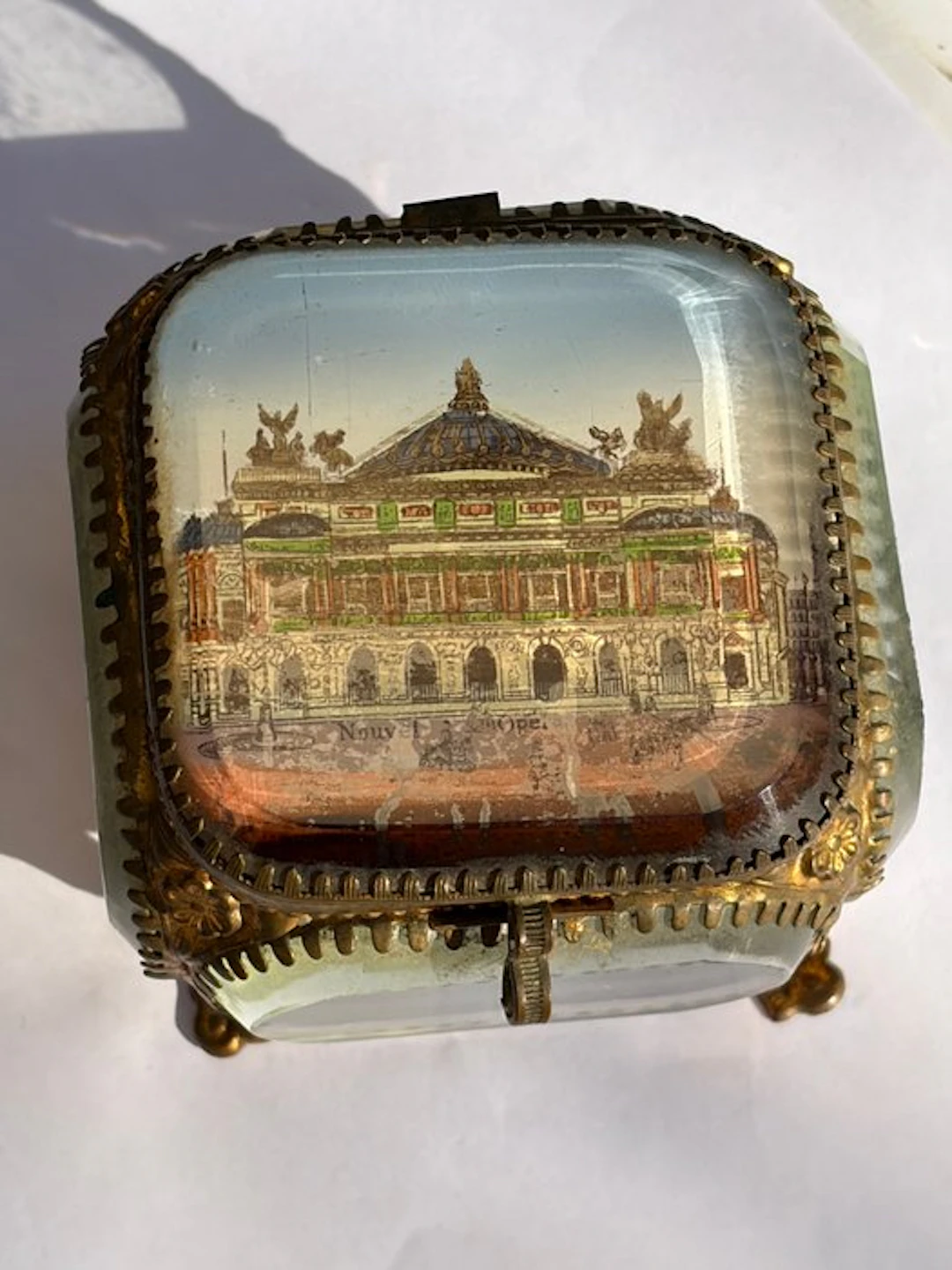
A fascinating late French craftsmanship jewelry/cocktail box and pocket watch case from the end of the manufactory era, dating to the late 19th century or the very early years of the 20th century (the full Napoleonic III / Belle Époque period). This refined decorative art object testifies to the famous tradition of luxury souvenirs tied to the Grand Tour, intended for the aristocracy of the time. The upper lid preserves a superb artistic view of the “Nouvel Opéra” of Paris (the present Palais Garnier), marvelously executed with the complex technique of reverse-painted glass (églomisé), topped by the contemporaneous period inscription “Nouvel Opéra.” The structure is composed of thick beveled crystal glass panels set within a rich gilded brass surround (ormolu), finely chased with floral rosette motifs. The case rests on four elegant scroll-and-leaf feet in full Rococo style. The outer metal bottom features an accurate, textured geometric workmanship of the period. A collectible piece characterized by intimate elegance, ideal for enhancing period interiors or for safeguarding and displaying small jewelry in an antique showroom. Curiosities and Historical Notes for Collectors The Charm of the Grand Tour: Between the 19th and early 20th centuries, aristocratic travelers and international upper-class visitors who visited Paris bought these chests in exclusive boutiques around Place de l’Opéra or inside the Palais-Royal. They were considered true status symbols, created to document one’s cultural journey. The inscription “Nouvel Opéra”: The term “Nouvel Opéra” (New Opera) stamped on the lid is a philological designation of great interest. It was used in catalogs and memoirs of the era for only a few decades after the theater’s opening (1875) to distinguish it from the old Opéra building on Rue Le Peletier, destroyed by fire in 1873. This indication allows placing the object in a precise and narrow time window around the turn of the century. The Églomisé technique: The image of the palace is not a common print but is executed entirely on the reverse side of the mirrored glass. It is a high-caliber artisanal craftsmanship that requires extreme precision and is today almost extinct. It gives the view a unique brilliance and chromatic depth, impossible to replicate with modern techniques. Compact and well-proportioned dimensions: Height: 8 cm; Width: 7 cm; Depth: about 7 cm. Condition (Total Transparency): The item presents in good overall condition and entirely authentic for its age, preserving its original patina. Structure and Mechanics: The rear hinge is solid, straight, and perfectly cohesive; the front clasp and stability of the feet are excellent. Glass: The panels retain their vintage luster. Noted, for utmost precision and transparency, a small internal chip/filament on the inner edge of a corner of the glass (visible in macro close-ups) that does not go through to the other side and does not compromise the structural solidity of the case. Aesthetics and Details: Stunning antique patina on the brass gilt, with a natural historical oxidation spot on the external base. The églomisé painting on the lid is well preserved. Interior: The original fabric cushion has been lost over time, exposing the internal gilt and the old hand-welded tin anchors of the period. Please examine carefully the photographic gallery, which forms an integral part of the description.
Stima:€110
Vai all’astaVedi tutti gli oggetti diCatawikioMobili, Design & Specchi