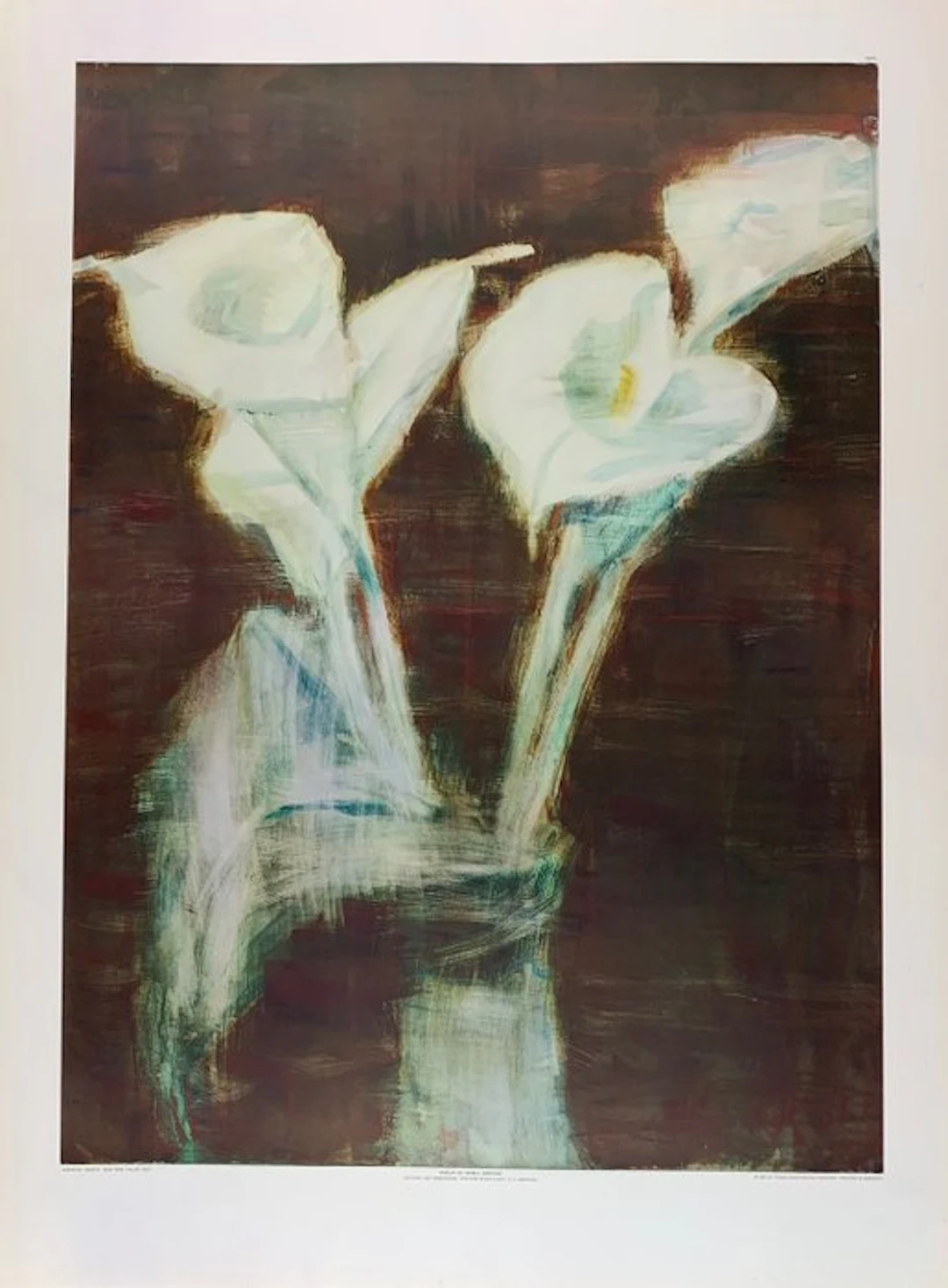
Christian Rohlfs - Callas, 1937 - Antiquarian Collotype - Artprint - 93 x 64 cm
Beautiful, expressive fine art print by Christian Rohlfs in the format 93 x 64 cm titled Callas. The work is a high-quality giclée print and in very good condition. Artist: Christian Rohlfs Title: Callas Type: Fine art print Technique: Giclée print Originality: Reproduction Sheet size: 93 x 64 cm Condition: Like new, very well preserved Origin: Hanfstaengl Druck Era: Modern Art Nationality: German Art Christian Rohlfs: Christian Rohlfs, born on December 22, 1849 in Groß Niendorf, Germany, and died on January 8, 1938 in Hagen, was a significant German painter who is regarded as an important representative of German Expressionism. His work, spanning seven decades, shows a remarkable development from academic realism to a powerful, expressive style characterized by vibrant colors and dynamic brushwork. Rohlfs began his artistic training at the Grand Duke’s Art School in Weimar, where he was initially taught in an academic style. In his early works, influences of realism and impressionism are recognisable, particularly from artists such as Adolph von Menzel and Wilhelm Leibl, known for their precise and detailed renditions. A turning point in Rohlfs' career was his encounter with modernity, made possible through contact with art collector and patron Karl Ernst Osthaus. Osthaus, founder of the Folkwang Museum in Hagen, invited Rohlfs to settle in Hagen, where he served as a professor at the local art school from 1901. Osthaus' collection included works by Vincent van Gogh, Paul Cézanne, and Edvard Munch, whose innovative approaches influenced Rohlfs profoundly. Van Gogh's works, especially his expressive landscapes and portraits, inspired Rohlfs to a more intense color palette and more dynamic compositions. Cézanne's structural approach and his ability to create volume and space through color also had a deep influence on Rohlfs' painting style. Munch's emotional intensity and his use of color to depict psychological states also manifested in Rohlfs' later works. In the 1910s, Rohlfs began turning toward Expressionism, a movement characterized by its emotional expressiveness and the use of bold colors and forms. Artists such as Ernst Ludwig Kirchner and Emil Nolde, members of the artist group Die Brücke, and Wassily Kandinsky and Franz Marc of Der Blaue Reiter, influenced Rohlfs' development toward a more expressive style. The bright colors and distorted forms used by these artists can be found in Rohlfs' works as well. Notably, Rohlfs' handling of watercolor, which he mastered masterfully, is particularly remarkable. His watercolors show a liveliness and intensity similar to his oil paintings, characterized by a dynamic, often spontaneous application of color. This technique is connected with the works of Paul Klee, whose playful use of watercolors and ability to depict emotions and dreams parallels Rohlfs' work. The German Expressionist movement was also strongly influenced by the Russian avant-garde, especially artists like Alexej von Jawlensky and Lyonel Feininger. Jawlensky's use of strong colors and abstracted forms and Feininger's crystalline structures and transparent color layers are reflected in the development of Rohlfs' style. Both artists emphasized the emotional and spiritual dimension of art, an aspect central to Rohlfs' work. Besides his painting, Rohlfs was also an important printmaker. His woodcuts and etchings, often dealing with biblical and mythological themes, reveal an affinity with the works of Käthe Kollwitz and Ernst Barlach, who are also known for their powerful and expressive graphics. Rohlfs' prints are characterized by clear line work and a dramatic light-dark effect that enhances the emotional impact of his works. Rohlfs' late works are marked by increasing abstraction and a reduced color palette. This development is linked to the emerging abstract art influenced by artists such as Piet Mondrian and Kazimir Malevich. Mondrian's geometric abstractions and Malevich's suprematist compositions opened new avenues of image construction that also influenced Rohlfs in his late works. Christian Rohlfs' influence extends far beyond his lifetime. His work inspired numerous subsequent generations of artists, including members of the Neue Sachlichkeit and the Berlin Secession. Artists like Max Beckmann and Otto Dix, known for their realistic yet expressive representations, incorporated elements from Rohlfs' work and developed them further. In summary, Christian Rohlfs remains a central figure in German art history, whose influence extends far beyond his lifetime. His ability to fuse various styles and techniques and his continual search for new forms of expression make him an inexhaustible source of inspiration for artists worldwide. From the Impressionists to the Expressionists and the modern Abstracts, Rohlfs repeatedly redefined the boundaries of what is possible, and he remains a living legacy in 21st-century art. Shipping information: We roll prints onto rigid backing boards, wrap them with corrugated cardboard, and ship them in particularly sturdy boxes. Shipping is with a tracking number for shipment tracking. About us: We have been active in the art trade for over 20 years and have extensive experience in the professional handling and shipping of artworks.
Stima:€1
Vai all’astaVedi tutti gli oggetti diCatawikioMobili, Design & Specchi