An Extensive Civil War Correspondence
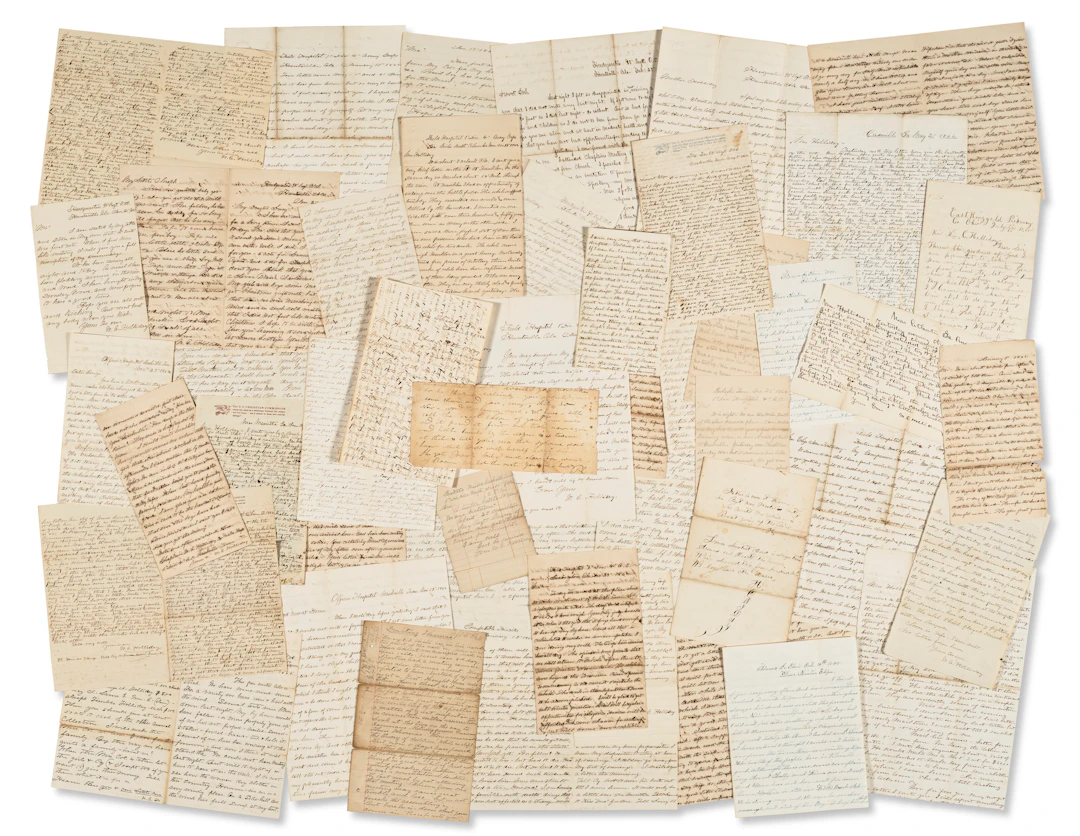
[CIVIL WAR] HOLLIDAY, William C (1838-1921). An archive of approximately 110 letters penned mostly to his wife Eliza and his family, various places including Nashville, TN, Franklin, TN, Atlanta, GA, and others, dates vary from 1863 to 1869, with the bulk of the letters dating from May 1864 to 1865. Most letters are three to five pages, bifolium, measuring 185 x 115mm on average. An extensive correspondence from William C. Holliday (1838-1921), Chaplain of the 90th Ohio Volunteer Infantry Regiment, exceptionally detailing battles, casualties, and his opinions on the war during the Atlanta and Franklin-Nashville Campaigns. Holliday enlisted December 21, 1863 as a Chaplain and mustered out with the regiment on June 13, 1865. Several of his letters are diary-style and span days, especially when he was engaged in fighting. Holliday is particularly descriptive of the Franklin-Nashville Campaign, and the Battle of Nashville from 15-16 December 1864 which destroyed the Confederate Army of Tennessee. On 3 December, the Chaplain writes of the encroaching Confederate forces near Nashville and his decision to pay his entire month's wages just to sleep at a safer Boarding House in town rather than in camp with the rest of his regiment: "No doubt you want to hear from me often in a time like this when the enemy [is] All drawn up in line of battle in our front...Money is a small matter, if a Man can keep out of danger - What is a month's wages to being shot...We will not be here long I think. If the rebels fight us here, they will do so soon..." The following day on 4 December, Holliday recalls "last night there was considerable Artillery firing on our right - Our Men shelling the rebels. And this morning they are still at it. I can hardly think the rebels will fight us here and yet there are indications of it. We only hope they will. We are strongly fortified..." On 5 December, Holliday writes of no change in the military situation: "Our Army is still fortifying. The rebels I guess are doing the same..." Three days later, he recounts a large fire in town which burned several government buildings, the stoppage of the mail for fear of capture, and increasing prices. On 12 December, he writes of the bitter cold, icy roads, and sleet so severe that "...all the way along horse and mules were down. So smooth they would fall down while standing still..." On 13 December, he opens stating that "there was every indication of a movement, but I presume the inclement weather has interfered..." On 15 December, the date of the Battle of Nashville, Holliday writes uncharacteristically simply and hurriedly in pencil: "A terrible battle today. We are victorious. About 20 casualties in my Regt. Many of whom are yet to be cared for tonight. I am well. God be praised." Three days later, Holliday would review the casualties of the battlefield in a letter to his wife: "The rebels suffered terribly. They assaulted one works and were killed by the hundred. I counted on one side over three hundred and fifty graves. There were as many on the other side..." In a letter to his mother on the same day, he recalled "our troops moved rapidly after the panic stricken and fleeing rebels...they slept on mud and under the rain. It rained all day, but this Army is so flushed with victory that they did splendid marching...it is the greatest victory of the war..." The archive is an unusually frank, honest, and vulnerable depiction of military life and the horrors of war. One such example is from an undated letter, in which the Chaplain writes from a military hospital after hearing that an acquaintance was drafted: "Soldiering is a hard life. If I were he I would pay $300.00 if I could possibly raise it... I am writing from the hospital. I am somewhat familiar with scenes of suffering. One resolution I have adopted - that is to avoid being shot. When I see how men suffer in hospitals & while being sent home, I get cowardly. I have not been with the regt. much for one week. I don't intend to when there is danger. A Lieut. Co. in a regt was shot dead today. I could have gotten your letter one day sooner if I had been with the regt. But what are letters & everything else when a man's head is shot off...there are men here wounded in every conceivable way..." Another example is his letter to his wife on 14 May (with additional entries until 18 May) describing the Battle of Resaca: "...We found the rebels about two miles from where I wrote last. We were first in line of battle. Breastworks were thrown up & about the middle of the afternoon our brigade (Whitakers) ascended the hill driving the enemy. Hooker's corps was operating on the right flank. Our brigade advanced up a little valley by the extreme left wounded & dead men were brought back rapidly from Whitaker's Brig. Our left was left all exposed & the rebels took advantage of it & threw a whole division in against us, which compelled us to fall back in perfect disorder except our regiment...Every man for himself...About as I was retreating the bullets came whizzing right past where I was. I got behind a big tree but it became evident that the enemy was throwing a large force against us, firing became rapidly...The bullets whizzed by, I went back to a battery which had been planted on a little hill...Our troops in the meantime were retreating in great confusion. As soon as they got out of the way the battery opened on them. I was back of the battery on an elevation & I could see the shells fall & burst right in amongst them. Mercy, but it swept them off. They advancing into an open field & six pieces of Cannon throwing shell grape & canister & among them. I could see their ranks open about 20 feet every shot. The firing of artillery only continued about half hour when it is said they left 300 dead in the field." Later in the letter, he recounts "while we were eating breakfast the bullet came feeling for us. It sounded as though it were feeling for me. I cut breakfast off & got back in a battery just behind our Brigade & began writing this when some bullets came...Heard skirmishing & cannonading has began this morning making the Earth tremble. I saw General Sherman & Hooker last night... May 17th south of Resaca about 4 miles - ...we moved through the rebel works down to Resaca oh, a small village on a little river. I had an opportunity of going over the battlefield or a portion of it. In several places where the heaviest fighting had been dead men of both sides lay all around. It was a terrible sight indeed. The rebels left in a great hurry. They were strongly fortified & they could have held that place if any. They left their dead & part of their wounded. There had been a much greater battle than I supposed. Our shells had done terrible execution. As we passed above toward the river we saw between 50 & 100 of their badly wounded lying in the bushes. What a sight met my eyes! Their wounds had not been dressed. No one is left to care for them. The dead were scattered all along through the woods...Women were crying. Rebels had taken their husbands at the point of bayonet..." In a two-day letter from 15-16 June 1864, Holliday describes the Battle of Marietta: "...While I write our artillery is shelling the rebels like everything. Don't know whether they are falling back on Atlanta or not. We have not got into position yet...They report that the rebel Gen. Polk was killed by a shell yesterday near where I write...Just after I was done writing yesterday every preparation was made for battle..." The next day on 17 June, he continues: "...Yesterday there was considerable skirmishing & on some parts of the line rather warm times... I was back of the regiment with the surgeons & others when the shelling began. I was lying on the ground. My horse was not saddled. I did that in a hurry, but while I was doing that there must have been a half-dozen shells bursting over our heads...Captain Chief of Artillery in our division was killed yesterday in front of our regiment. Shot in the head. Was an excellent officer...I stood on the very spot. The blood was yet visible on the ground...I hear nothing but boom boom boom....I find the shell coming in the direction of me is the most alarming thing that I've ever heard... My curiosity as to warfare is satisfied. Everyday I become more & more bitter in my feeling toward it. There is nothing that I can see in killing persons that affords me any pleasure. But when I have to see the dead & dying I want them to be our enemies..." Just over a month later, Holliday details finding a Confederate soldier that committed suicide: "Had been there several days I think that he must have hung himself. His feet reached ground, was hanging with the strip of bark, but I will not sicken you with the description. I could however sit down & eat beside of the victim. I have become used to seeing sights...I also knelt & prayed in the woods, then more than ever do I think of the loved ones at home..." Holliday's entries then detail the Battle of Atlanta in a pair of letters written July 22 and 24, 1864, just outside the city: "...They resisted our advance here pretty strongly...I did not think the rebels would fight us right in the city, but I believe they now intend to do so. I hope they will feel confident of complete success. They may hold us off several days or weeks, but my opinion is before that this reaches you our army will triumphantly hold Atlanta..." On July 24, Holliday writes: "...When I wrote you day before yesterday there was a terrible battle raging about 1 mile & a half on the left of us in the 17 Corps...The 17 corps was advancing & before the lines were formed or any breastworks thrown up & indeed before the corps commenced on to the 16 corps the rebels attacked them in heavy columns. Drove our men about 1⁄2 mile took 12 pieces of artillery & about 400 of our men prisoners. Our troops were reinforced by the 16th corps & drove the Rebels, reoccupied the best ground & we procured the artillery except four pieces & took about 1,200 prisoners. Gen. McPherson commander in the army...was killed in the engagement. This is quite a loss to us. He was an able General. We could hear the roar of artillery & the volleys of musketry here & could follow the sounds very distinctly realizing the fact that our troops were repulsed. It was terrible...A good many of our men were killed & wounded but many more Rebels...All things taken into consideration it resulted in quite a victory to our side. All our generals ask them is to fight us here. This their new general Hood seems determined to do. General Johnson refused to command the Army any longer because Jeff Davis told him to hold Atlanta which he said could not be done with the forces he had & hence refused to command it any longer...in the course of days, Atlanta will be nearly surrounded...it was a desperate battle. The rebels have been rather quiet since..." On 23 September, he wrote from inside the city, "...The town of Atlanta is all riddled with bullets & shells. I was much mistaken in supposing that the town was destitute of women & children. It is full of them, or rather was full of them...My sympathies were aroused for the destitute women & children, especially the latter..." In his final war-date letter, Holliday writes to his wife on 10 April 1865 regarding the Battle of Ashfield that was fought four days prior. "...O how grateful to God should I be and trust I am for the indescribably glorious news that awaited our arrival at this place this afternoon. 'R.E. Lee surrendered his army to Gen. Grant.' Tremendous cheering followed the announcement but many were incredulous, but a few minutes ago the news was given us officially. While I write the band is playing 'Hail Columbia,' 'Star Spangled Banner' &c. Men are cheering and shooting their guns, singing, throwing up hats and letting out generally. It is night, but how can I sleep over such glorious intelligence as this, 'Praise God from whom all blessings flow.' We have had a week of labor and hard marching and attended with some danger. I intended to write a full account of our expedition to Asheville North Carolina, but, dear me, I shall not do so unless I run out of something to write... Asheville is away beyond The Great Smoky Mountains in North Carolina, 70 miles from here. All that distance is in the enemy's country. 40 miles of our way was along the edge of the water of the French Broad River...We found a few more Rebels there than we expected to find and they showed a bold front. Our instructions were not to take the place if it required any loss. After skirmishing a while, we retreated in the evening...I heard a few more shells and bullets than I expected to hear..."
Stima:€3,484.79
Vai all’astaVedi tutti gli oggetti diChristie'soTappeti, Tappezzerie & Tessuti