AFTER THE ANTIQUE - A BRONZE PORTRAIT BUST OF THE EMPEROR CARACALLA
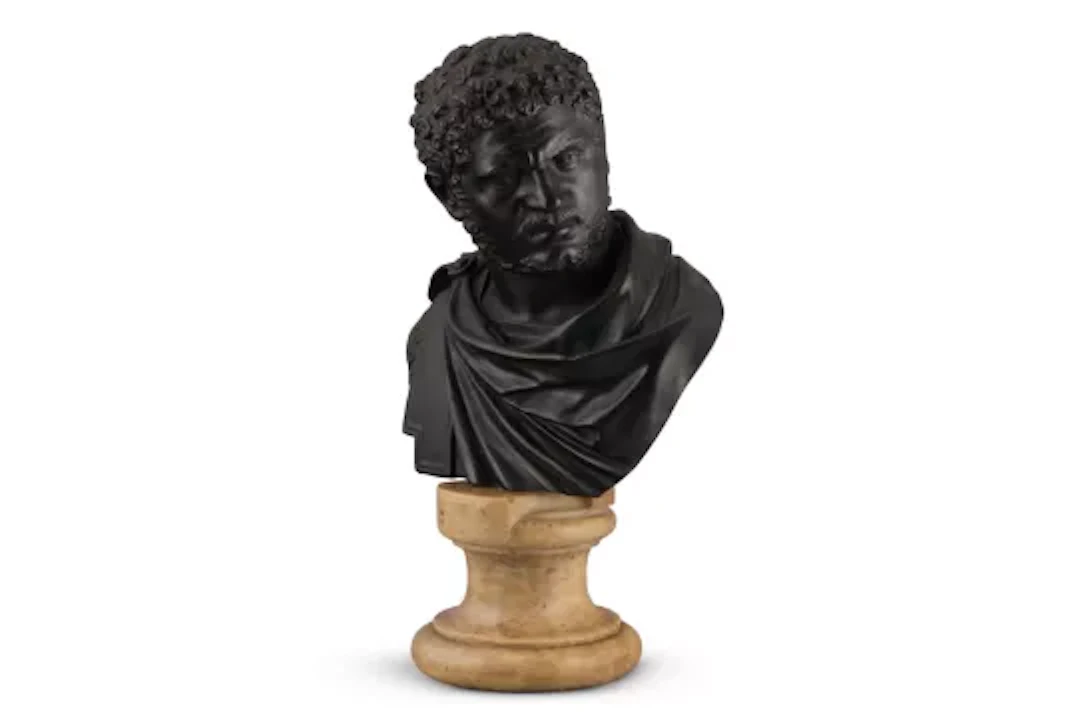
AFTER THE ANTIQUE - A BRONZE PORTRAIT BUST OF THE EMPEROR CARACALLA POSSIBLY NAPLES, 19TH CENTURY The Emperor depicted looking to his left, hollow back with single strut suspension to reverse, set on shaped amber coloured alabaster socle base 71cm high, 51cm wide across shoulders, the base 25.5cm diameter Provenance: Henry Lynch Robinson. This likeness of the Emperor Caracalla was drawn from a bust in the Farnese collection in Rome and then Naples, believed to date from the early 3rd Century A.D and discovered at the Baths of Caracalla in the 16th century. Marcus Aurelius Severus Antoninus Pius Augustus, known as Caracalla, belonged to the Severan dynasty and ruled Rome with a determination that sometimes bordered on aggression. History records him both as a “bold and brutal Roman emperor who murdered his brother in his ascent to power in 212 A.D and later was himself assassinated”. In the Historia Augusta he was described as “gluttonous in his use of food and addicted to wine, hated by his household and detested in every camp save that of the praetorian guard' (C. Scarre, Chronicle of the Roman Emperors, London, 1998, pp. 138-146). History also records with admiration his most defining act, the Constitutio Antoniniana (Edict of Caracalla) of 212 AD, which granted Roman citizenship to all free inhabitants of the Empire, expanding both civic unity and the tax base. Historians also note the architectural splendour of the Baths of Caracalla in Rome and his military victories including those against Germany in AD 213 and the Parthians in AD 216. He is commonly represented, as here, looking to his left with square and heavy features and his trademark frowning brow. The versions vary in form with a more abrupt, swept cloak form in the V&A museum in bronze and marble after the Farnese bust of Caracalla in Museo Nazionale, Naples (A.122-1922). The full-length version of the Farnese bust was utilised by the firms of Chiurazzi and De Angelis and in the 1910 publication “Fonderie Artistiche Riunite”(Naples 1910) the bust of Caracalla is listed and illustrated as item 6033 “de la maison Farnese a Rome” priced at 500fcs for the 52inch version in the Herculaneum patina and 600fcs in the Modern patina. A comparable example of this Farnese form was with Desmet Gallery, Brussels in 2025 and attributed to Luigi Valadier, last quarter 18th century. An example by Bartolomeo Cavaceppi in white marble is held in the Getty Collection (94.SA.46). Condition Report Disclaimer, AFTER THE ANTIQUE - A BRONZE PORTRAIT BUST OF THE EMPEROR CARACALLA, AFTER THE ANTIQUE - A BRONZE PORTRAIT BUST OF THE EMPEROR CARACALLA POSSIBLY NAPLES, 19TH CENTURY The Emperor depicted looking to his left, hollow back with single strut suspension to reverse, set on shaped amber coloured alabaster socle base 71cm high, 51cm wide across shoulders, the base 25.5cm diameter Provenance: Henry Lynch Robinson. This likeness of the Emperor Caracalla was drawn from a bust in the Farnese collection in Rome and then Naples, believed to date from the early 3rd Century A.D and discovered at the Baths of Caracalla in the 16th century. Marcus Aurelius Severus Antoninus Pius Augustus, known as Caracalla, belonged to the Severan dynasty and ruled Rome with a determination that sometimes bordered on aggression. History records him both as a “bold and brutal Roman emperor who murdered his brother in his ascent to power in 212 A.D and later was himself assassinated”. In the Historia Augusta he was described as “gluttonous in his use of food and addicted to wine, hated by his household and detested in every camp save that of the praetorian guard' (C. Scarre, Chronicle of the Roman Emperors, London, 1998, pp. 138-146). History also records with admiration his most defining act, the Constitutio Antoniniana (Edict of Caracalla) of 212 AD, which granted Roman citizenship to all free inhabitants of the Empire, expanding both civic unity and the tax base. Historians also note the architectural splendour of the Baths of Caracalla in Rome and his military victories including those against Germany in AD 213 and the Parthians in AD 216. He is commonly represented, as here, looking to his left with square and heavy features and his trademark frowning brow. The versions vary in form with a more abrupt, swept cloak form in the V&A museum in bronze and marble after the Farnese bust of Caracalla in Museo Nazionale, Naples (A.122-1922). The full-length version of the Farnese bust was utilised by the firms of Chiurazzi and De Angelis and in the 1910 publication “Fonderie Artistiche Riunite”(Naples 1910) the bust of Caracalla is listed and illustrated as item 6033 “de la maison Farnese a Rome” priced at 500fcs for the 52inch version in the Herculaneum patina and 600fcs in the Modern patina. A comparable example of this Farnese form was with Desmet Gallery, Brussels in 2025 and attributed to Luigi Valadier, last quarter 18th century. An example by Bartolomeo Cavaceppi in white marble is held in the Getty Collection (94.SA.46). Provenance, Fonderie Artistiche Riunite, Condition Report Disclaimer
Stima:€17,483.96
Vai all’astaVedi tutti gli oggetti diDreweattsoSculture