
Tutte le aste / Etnografia / A wooden sculpture - Wantchi - Minianka - Mali (No reserve price)

A wooden sculpture - Wantchi - Minianka - Mali (No reserve price)
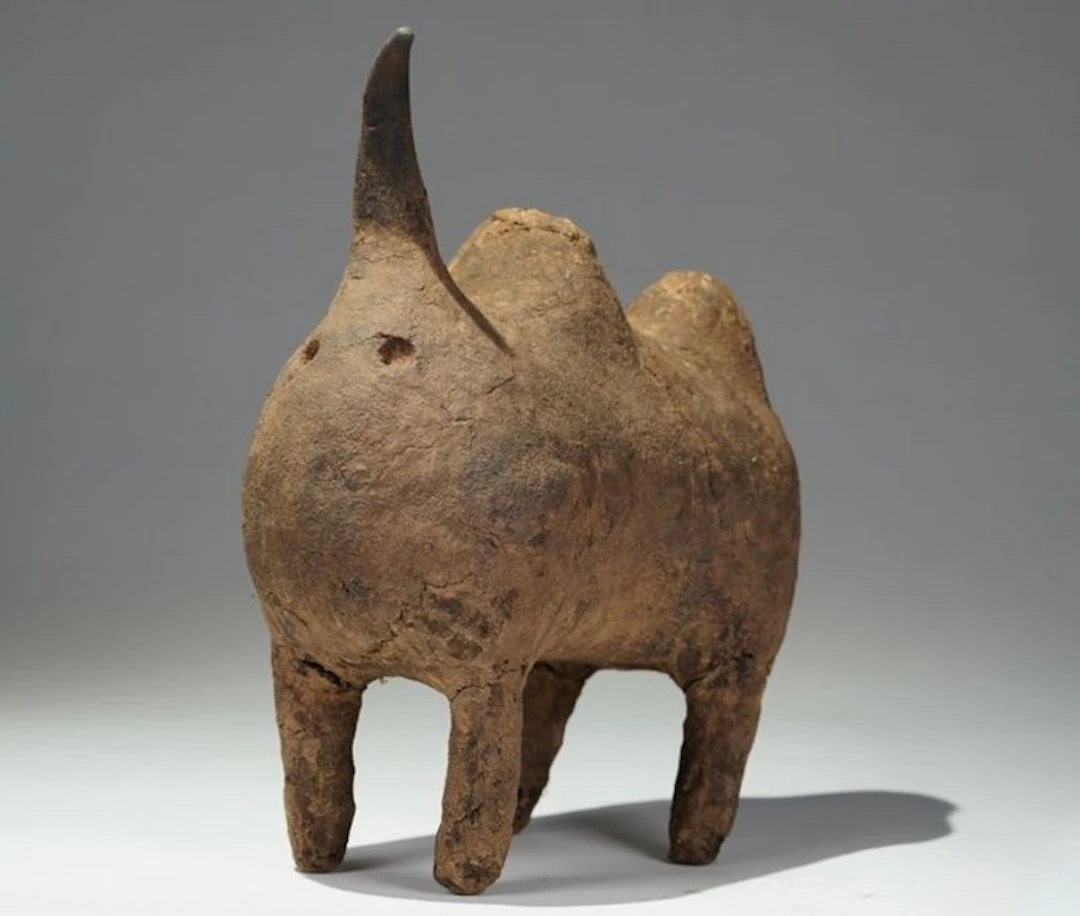
Minianka Wantchi Sculpture, Koutiala Region, Mali Minianka (Mamara), Koutiala region, Mali Wood with earthy ritual patina This remarkable zoomorphic sculpture, locally identified as Wantchi, belongs to the ritual traditions of the Minianka (Mamara) of southeastern Mali. Its compact four-legged body, strongly arched back and extraordinary vertical projection rising from the front create an animal form that is immediately recognizable as zoomorphic yet deliberately resistant to precise zoological identification. The body is conceived as a massive, almost continuous volume. Four short, columnar legs support a rounded torso from which two pronounced humps rise along the back. At the front, the head merges almost completely with the body. Two small recessed openings suggest the eyes, while the muzzle is reduced to a broad rounded mass. Above it rises a long, slightly curving horn-like projection, dramatically extending the silhouette upward. This reduction of anatomical detail is fundamental to the sculpture's visual effect. The animal has not been represented naturalistically. Instead, the sculptor has concentrated upon a few elementary signs—four legs, a powerful body, dorsal masses and a horn—to create an image of concentrated physical presence. Its heavy body contrasts strikingly with the slender vertical projection. The surface is equally important. Brown, ochre and blackened areas cover the object irregularly, while deposits remain in depressions and around the legs and torso. The darker upper portion of the horn suggests repeated handling, application of substances or differential exposure. Such surfaces are characteristic of ritual objects whose significance was progressively reinforced through use rather than determined by their original carved form alone. Regional characteristics The Koutiala region of southeastern Mali is one of the principal areas associated with the Minianka, who are closely related culturally and historically to neighboring Bamana communities. Religious institutions, ritual objects and forms of initiation circulated across this broader cultural landscape, which makes strict distinctions between “Bamana” and “Minianka” ritual art difficult in some cases. Zoomorphic power objects are particularly important within this environment. Comparable objects are commonly classified as boliw (singular boli). A documented example in the National Museum of African Art is explicitly recorded as a boli from the Minianka region and consists of a four-legged, highly abstract animal form whose underlying structure is associated with accumulated organic substances. The present object differs visually from the most heavily encrusted boliw because much of its underlying form remains clearly legible. Nevertheless, the massive quadrupedal construction and the ritualized surface place it within the same wider conceptual environment of zoomorphic power objects. The precise identification as Wantchi derives here from the supplied field information and should therefore be preserved rather than replaced by a zoological interpretation based only on appearance. The animal's identity is particularly intriguing. Its tall frontal projection might suggest a horn, trunk or another transformed anatomical feature, while the two rounded masses along the back further complicate any literal identification. Such ambiguity need not be accidental. Comparable ritual objects from Mali frequently combine recognizable animal characteristics without representing a single species naturalistically. The Smithsonian similarly describes a Minianka-region boli as abstractly zoomorphic and only suggestive of a bovine animal. Within Minianka ritual life, powerful cult objects could receive sacrifices and participate in communication with spiritual agencies. Ethnographic documentation of Minianka Nya ritual, for example, records sacrificial practices and divination as central elements through which participants addressed Nya. This broader ritual context helps explain why the physical surface of such an object can be as significant as its sculptural form. The Koutiala attribution is therefore especially valuable. Rather than treating the sculpture simply as a generic “Malian fetish,” it situates it within a specific southeastern Malian cultural landscape in which Minianka and Bamana ritual traditions interacted closely. Comparable zoomorphic power objects have indeed been documented specifically in relation to the Minianka region. Formally, this example is particularly successful in its radical economy. The four legs establish a stable rectangular foundation, the swelling body creates a compact horizontal mass, and the extraordinary horn-like projection suddenly redirects the entire composition vertically. The sculpture thus derives its power not from anatomical detail but from silhouette, mass and the tension between horizontal and vertical forms. Selected Literature Colleyn, Jean-Paul, ed. Bamana: The Art of Existence in Mali. New York: Museum for African Art; Zurich: Museum Rietberg, 2001. McNaughton, Patrick R. The Mande Blacksmiths: Knowledge, Power, and Art in West Africa. Bloomington: Indiana University Press, 1988. Brett-Smith, Sarah C. The Making of Bamana Sculpture: Creativity and Gender. Cambridge: Cambridge University Press, 1994. Jonckers, Danielle. “Les enfants de Nya: les activités religieuses des jeunes garçons minyanka.” Journal des Africanistes, 58 (2), 1988, pp. 53–72. The study is particularly relevant to Minianka ritual practice and the cult of Nya. Some of the information and photos are generated by artificial intelligence and is based on published sources from the fields of ethnography, archaeology, and art history documents. All information and photos are protected by copyright. Inv. No. MAZ30208 Informant: Petit Coulibaly
Stima:€325
Vai all’astaVedi tutti gli oggetti diCatawikioEtnografia
Stima:
€325
Oggetti simili

Risultati d’asta per oggetti simili

Porta la tua asta ai collezionisti di tutto il mondo!
Pubblica ora