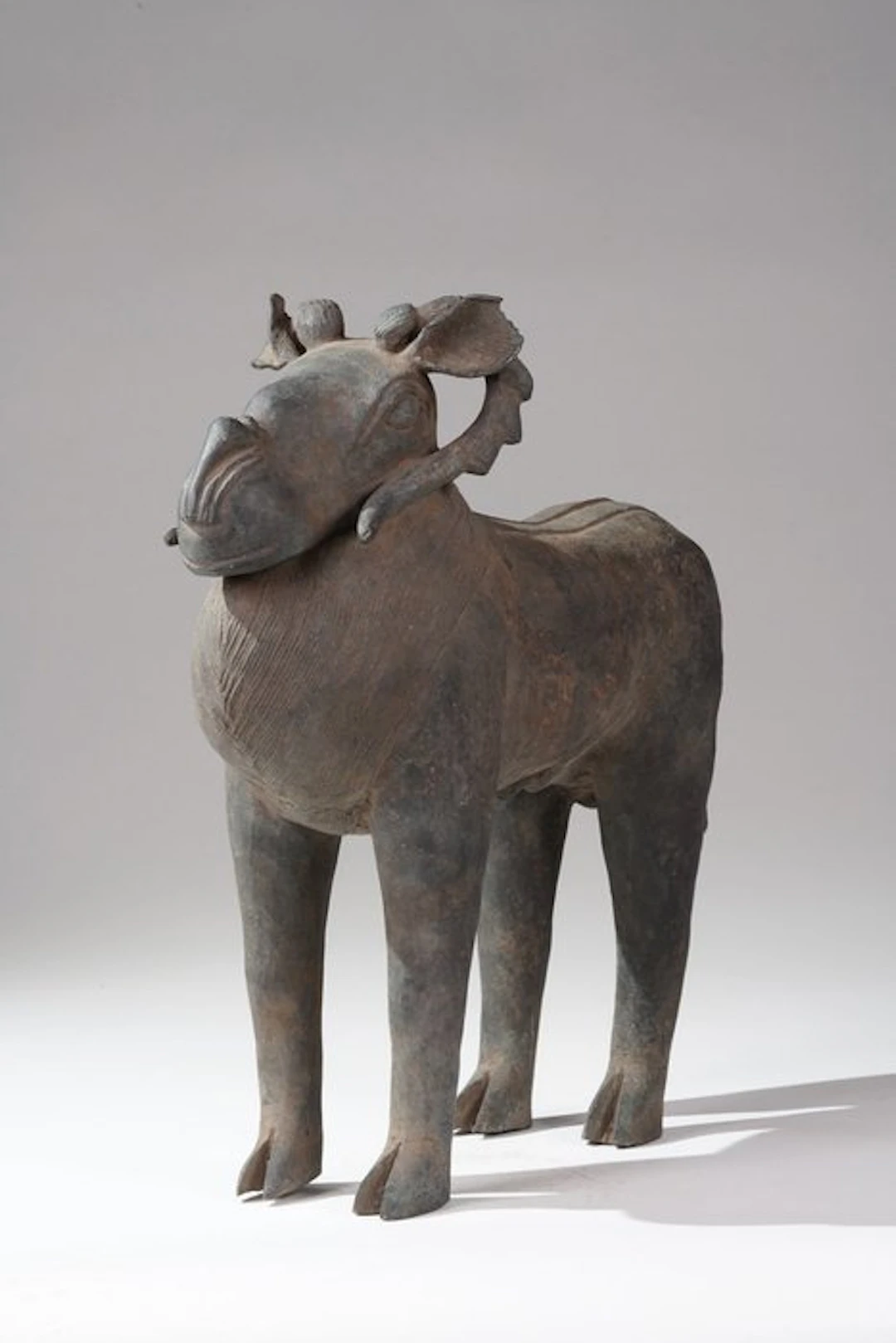
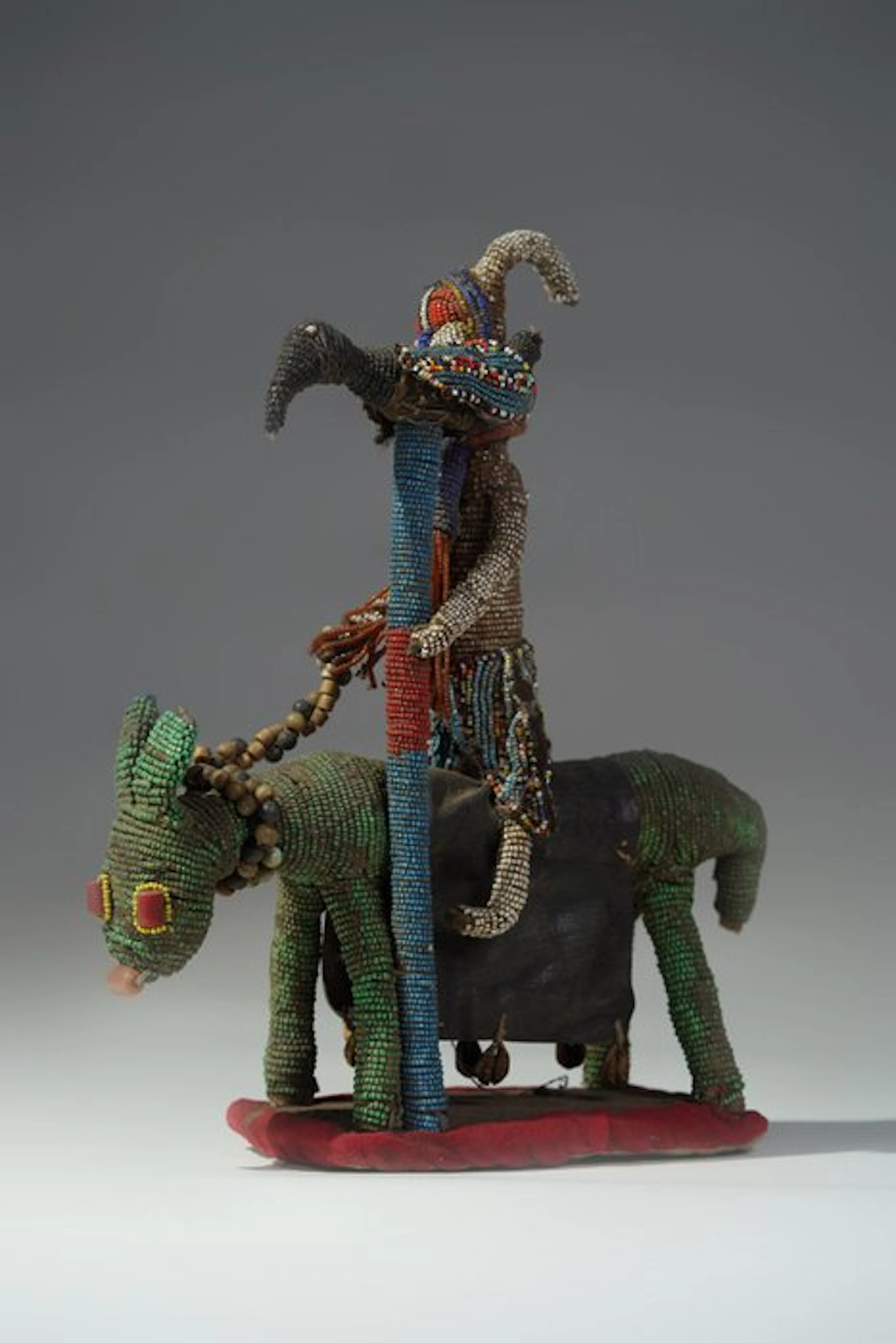
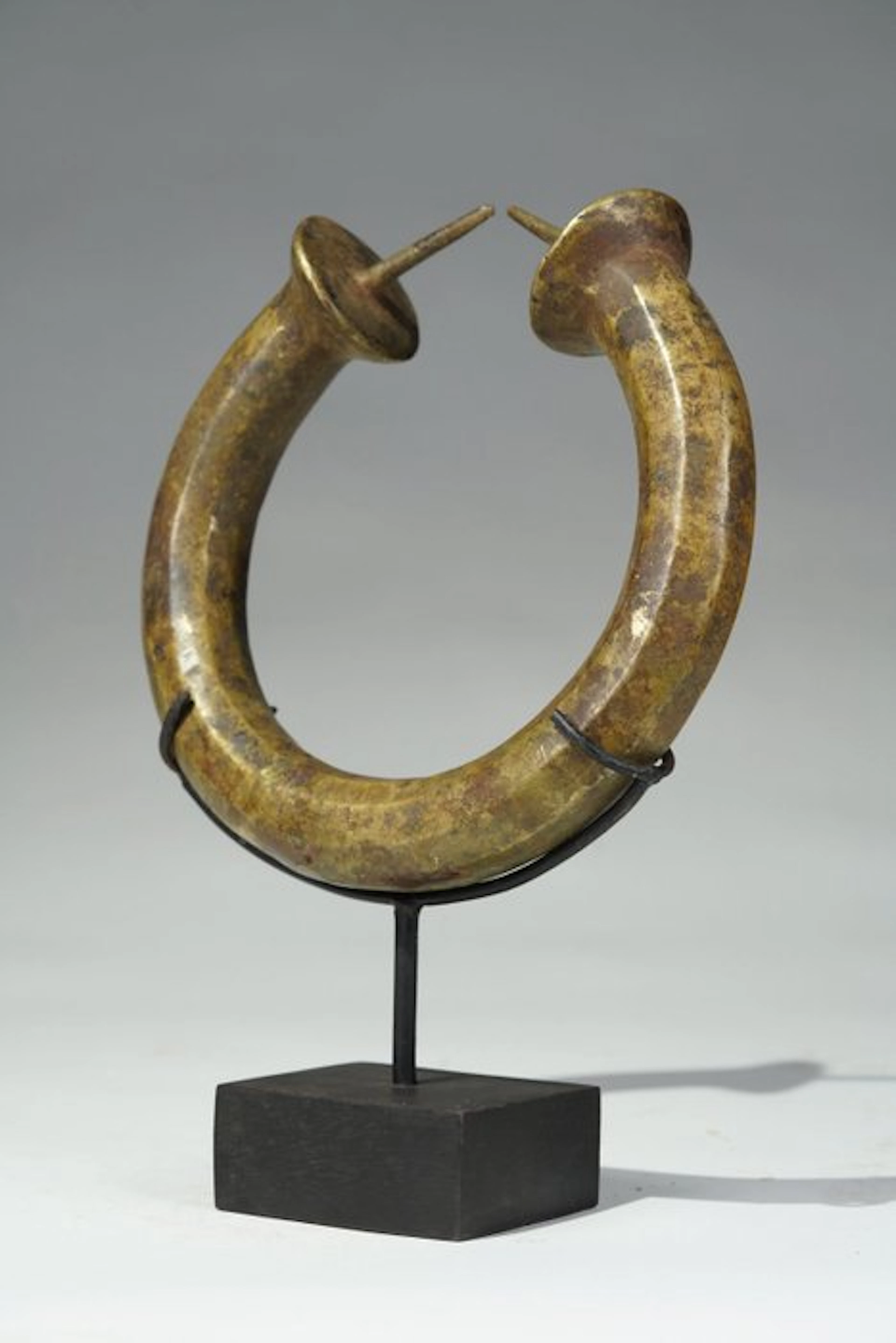
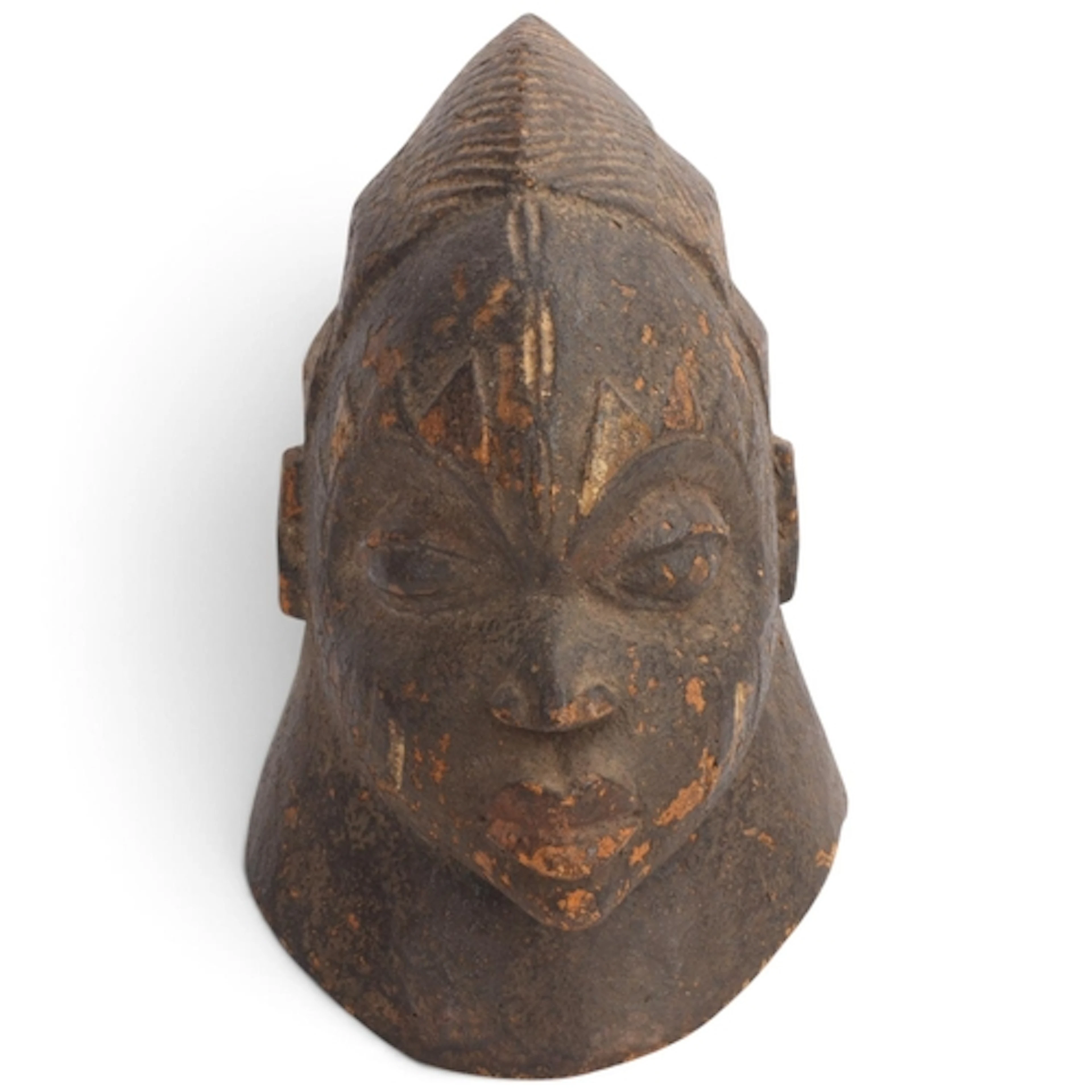
A bronze sculpture - Ram - Benin - Nigeria
This strong sculptural representation of a ram belongs to the tradition of metal casting practiced in the region of Owo, an important cultural center situated between the spheres of influence of the Kingdom of Benin and the Yoruba peoples. Owo developed a distinctive artistic tradition that combines formal elements associated with Benin court art and local stylistic features. The ram is rendered in a compact and stylized manner, with a rounded body, short legs, and a slightly elongated head. Particular emphasis is placed on the curved horns, which coil backward in a rhythmic spiral and visually frame the animal’s head. The modeling is simplified yet expressive, focusing on essential anatomical features rather than naturalistic detail. Such stylization is characteristic of metal sculptures produced in southern Nigeria between the sixteenth and nineteenth centuries. The object was cast using the lost-wax casting technique, also known as the cire perdue process. In this method, the artist first models the form in beeswax, covering it with layers of clay to create a mold. When heated, the wax melts and drains away, leaving a cavity into which molten metal—usually brass or bronze—is poured. Once the metal cools and the clay mold is broken, the resulting sculpture emerges as a unique cast, since the mold cannot be reused. This technique was widely practiced in the Benin and Owo regions and enabled the production of finely detailed ritual and courtly objects. Animal figures such as rams were not merely decorative but carried symbolic significance. In many West African traditions the ram is associated with strength, vitality, and sacrificial power, qualities that connect the animal with ritual offerings and royal authority. Within the artistic context of Owo and Benin, animal sculptures could appear on altars, serve as ceremonial objects, or function as symbolic representations within ritual assemblages. The bronze ram therefore illustrates both the technical mastery of regional metal casters and the complex network of artistic exchange linking Owo to the wider cultural sphere of the Benin court. Through its form and method of production, the sculpture reflects the prestige of bronze casting as a medium closely associated with political power, ritual practice, and sacred authority in the historical societies of southern Philip Dark, die Kunst von Benin, Prag 1960, S. 58/ 59, 87; Barbara Plankensteiner, Benin. Könige und Rituale. Höfische Kunst aus Nigeria, Wien 2007, S. 433.; British Museum, London William Fagg, Bildwerke aus Nigeria, München 1963, S. 75. British Museum, Benin. Könige und Rituale. Höfische Kunst aus Nigeria, Wien 2007, S. 433 (last photo sequence). TL Analyse, Kotalla, 290 years +/.- 19,9 % CAB06926 Legal Framework Under the 1970 UNESCO Convention in combination with the Kulturgutschutz Gesetz (KGSG) any claim for the restitution of cultural property becomes time-barred three years after the competent authorities of the State of origin obtain knowledge of the object’s location and the identity of its possessor. All bronzes and terracotta items offered have been publicly exhibited in Wolfgang Jaenicke Gallery since 2001. Organisations such as DIGITAL BENIN and academic institutions such as the Technical University of Berlin, which have been intensively involved in restitution-reseaches (translocation-project) over the past seven years, are aware of our work, have inspected large parts of our collection and have visited us in our dependance in Lomé, Togo, among other places, to learn about the international Art trade on site. Furthermore, the National Commission for Museums and Monuments (NCMM) in Abuja, Nigeria, has been informed about our collection. In no case in the past have there been restitution claims against private institutions such as the Wolfgang Jaenicke Gallery Our Gallery addresses these structural challenges through a policy of maximum transparency and documentation. Should any questions or uncertainties arise, we invite you to contact us. Each matter will be reviewed diligently using all available resources.
Stima:€3,600
Vai all’astaVedi tutti gli oggetti diCatawikioEtnografia