






Tutte le aste / Monete & Banconote / 1787 Vermont Copper. RR-15, Bressett 9-I, W-2060. Rarity-6. Bust Left.

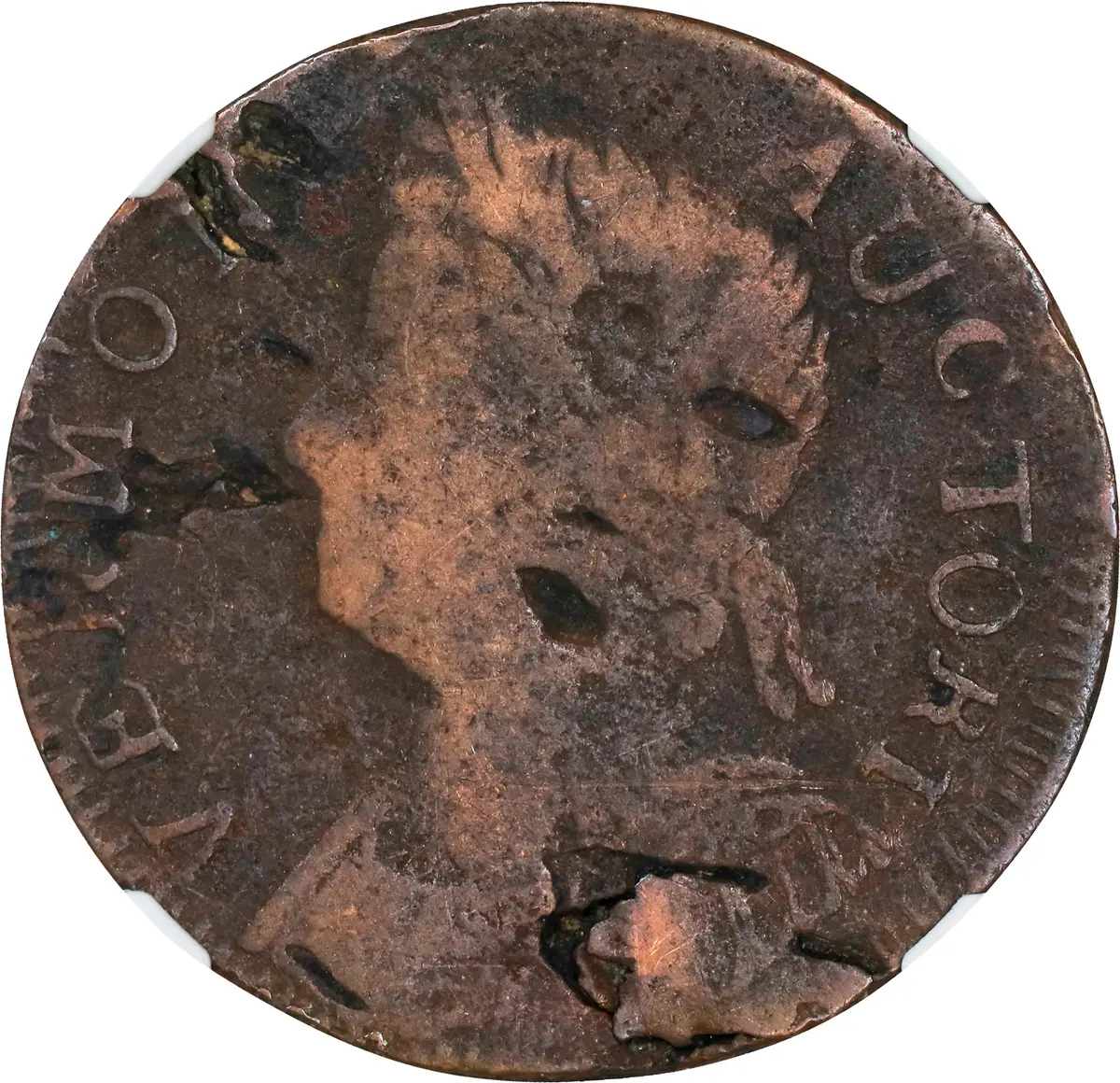
Famous 1787 RR-15 Bust Left Vermont Copper Rarity 1787 Vermont Copper. RR-15, Bressett 9-I, W-2060. Rarity-6. Bust Left. VG-10 BN (NGC). A desirable coin in a well circulated RR-15 Vermont, both sides exhibit modest circulated cameo contrast between warm rose-brown patina on the high points and deeper tobacco-brown color elsewhere. The surfaces are universally microgranular and also display several prominent planchet laminations and fissures, these being very common attributes for survivors of this die pairing. Obverse nicely centered, just a bit tight to upper left, the reverse slightly off-center to 12 o'clock. The most useful identifier for provenance purposes is the particularly pronounced planchet flaw at 5:30 on the obverse, above which is a light horizontal pin scratch that is the only singularly mentionable post-production mark. This iconic variety is the only 1787-dated Vermont copper of the Bust Left style and, as such, it constitutes a distinct Guide Book type that is in great demand. These were almost certainly among the last Vermont coppers struck at Harmon's mint in Rupert before coinage was largely transferred to Machin's Mills in New York. The obverse die was first used in the RR-11 pairing, a 1786-dated variety. The coiners probably introduced the reverse of RR-15 when the calendar advanced to 1787, although it developed a massive cud break at the lower border that for all intents and purposes obliterated the date, leaving only the top loop of the 8 and the crossbar of the 7, as seen on the present example. After a very small press run, the Harmon crew accepted the unsuitability of the RR-15 reverse die for continued coinage and pressed the 1786-dated reverse back into use to strike additional examples of RR-11 in a remarriage. Carlotto (1998) argues that the short-lived reverse die of RR-15 is an unused 1786-dated die overdated to 1787, and he publishes a close-up photo that appears to make his case. He further argues that the act of overdating created a weakness in the date area of the die that resulted in the massive cud break during striking. Bowers (2018) supports the overdating theory and actually lists this variety as 1787/6. At the time of our (Stack's) Ford I Sale, where a superior quality VF realized more than $27,000 as lot 40, Michael Hodder knew of just 19 examples of RR-15 in all grades. He was aware of four coins that were positively finer than the Ford specimen: Bennington Museum, William Anton, Richard August, and a recently discovered (as of 2003) EF. Approximately 20 to 25 examples are known today, although Bowers (2018) provides a liberal estimate of 17 to 32 coins extant, the upper threshold to account for new discoveries. Yet while a few more examples of RR-15 have indeed come to light since Hodder updated Roy Bonjour's census for our Ford I Sale in 2003, including that offered here, there has been little effect on this variety's overall rarity rating, or its rarity in high grades. We expect that this relatively pleasing NGC-certified VG example will see spirited bidding. PCGS# 557. NGC ID: 2B5A. Click here for certification details from NGC.
Stima:€0.89
Vai all’astaVedi tutti gli oggetti diStack's BowersoMonete & Banconote
Stima:
€0.89
Porta la tua asta ai collezionisti di tutto il mondo!
Pubblica oraIscrivendoti, accetti la politica sulla privacy. Annulla l'iscrizione in qualsiasi momento.
Barnebys HQ
Brahegatan 10
BOX 5038
114 37 Stockholm
