

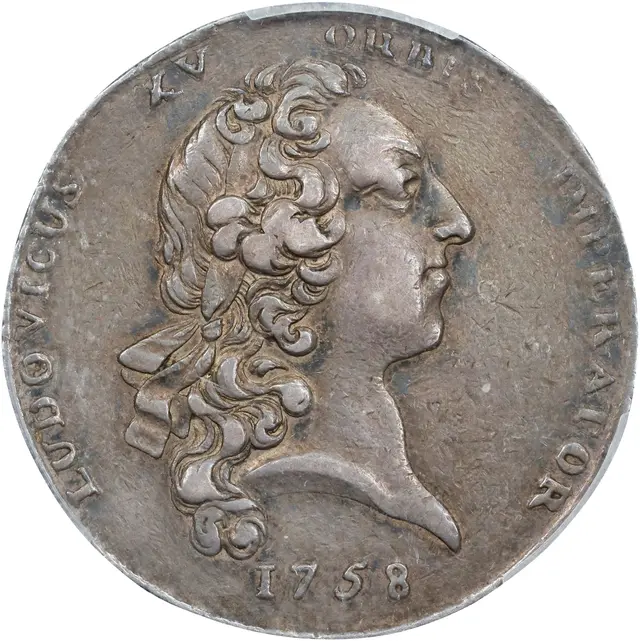






Tutte le aste / Monete & Banconote / "1778-1779" (ca. 1780) Rhode Island Ship Medal. Betts-562, W-1730.


"1778-1779" (ca. 1780) Rhode Island Ship Medal. Betts-562, W-1730. Without Wreath Below Ship. Brass or Pinchbeck. AU-55 (PCGS). A lovely example that retains plenty of original brassy-gold color to otherwise originally toned, deep brown surfaces. Boldly to sharply struck throughout, both sides are equally impressive in preservation with nary a distracting blemish to report. The popular Rhode Island Ship medals continue to fascinate and baffle numismatists. They are believed to have been struck around 1780, though by whom and for what reason remains unclear. The reverse of the medal depicts the Continental Army's withdrawal from Aquidneck Island in August 1778 surrounded by the British fleet commanded by Admiral Lord Richard Howe. The Americans' retreat was necessitated by the withdrawal of a covering French fleet under Charles Henri Hector, Comte d'Estaing to Newport after receiving considerable damage in a storm. The obverse has been the subject of debate as to what it portrays. For generations, it has been assumed that it is a satirical representation of Lord Howe's flagship fleeing Narragansett Bay in 1779, an interpretation in part based on the earliest versions of this medal bearing the word VLUGTENDE ("fleeing") underneath Howe's ship. The most recent scholarship asserts that instead of a pro-American medal, it is actually a British medal intended for the Dutch market, or even an entirely Dutch product created to help garner support to the British cause in the global war for empire that raged throughout the 1770s and 1780s and of which the American Revolution was only a small part. With this current interpretation of the medal, it would appear that if it was intended to influence Dutch feelings towards a more pro-British position, it failed in its purpose. Often at loggerheads with each other, British and Dutch relations were very tense, culminating in December 1780 when the Dutch joined other European nations in the League of Armed Neutrality. The League was established as a counter to the British Royal Navy's policy of intercepting neutral shipping in search of French supplies. Rhode Island Ship medals with VLUGTENDE are of the highest rarity, often with decades between auction appearances. The transitional type with VLUGTENDE removed, offered here, and the later modified die with the wreath, offered below, are of roughly similar rarity with most examples in the VF to low end AU grade range. Mint State specimens are scarce to rare, which fact confirms the significance of this offering for the advanced collector. Provenance: From the Emerald Coast Collection. PCGS# 579. NGC ID: D7HW. Click here for certification details from PCGS.
Stima:€0.89
Vai all’astaVedi tutti gli oggetti diStack's BowersoMonete & Banconote
Stima:
€0.89

Indian Army Temperance Association, 1862, a silver medal, unnamed
10/21/2026

€143.33
Stima: €117.84

British Victories of the Peninsular War, 1815, a copper and brass
10/21/2026
€501.66
Stima: €353.52


Porta la tua asta ai collezionisti di tutto il mondo!
Pubblica oraIscrivendoti, accetti la politica sulla privacy. Annulla l'iscrizione in qualsiasi momento.
Barnebys HQ
Brahegatan 10
BOX 5038
114 37 Stockholm
